

Description
Zebra Sole (Zebrias zebra)
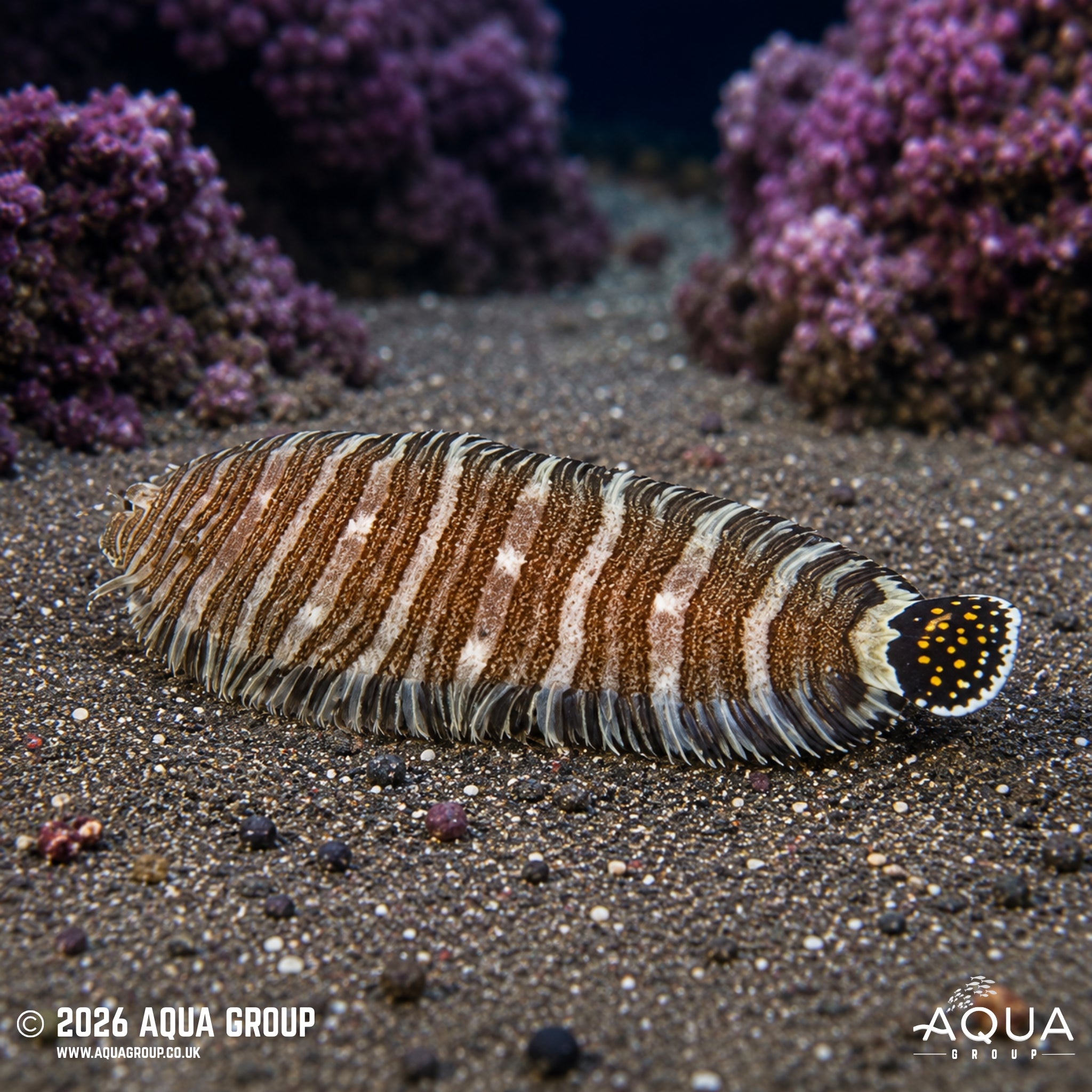
The Zebra Sole, Zebrias zebra, is an unusual bottom-dwelling marine flatfish recognised by the bold dark bands crossing its flattened, oval body. Both eyes sit on the upper side of the fish, allowing it to remain concealed against sand or mud while watching for small crustaceans and other benthic prey. Native to coastal waters of the Western Pacific, this secretive sole spends most of its time resting on or partially buried beneath the substrate. Its distinctive appearance makes it an interesting specialist aquarium fish, but its adult size, predatory diet and limited captive-care history mean it is best suited to an experienced fishkeeper with a mature, purpose-planned system.
Common Name:
Zebra Sole, Zebra-striped Sole, Banded Zebra Sole.
Scientific Name (Latin):
Zebrias zebra
Maximum Size:
Commonly around 16–20 cm, with a reported scientific maximum of approximately 28.8 cm standard length. Long-term accommodation should be planned around the larger potential adult size.
Water Type:
Marine
This species may also occur in coastal brackish environments, but aquarium specimens should normally be maintained under stable full-marine conditions unless their collection history is known.
Origin / Natural Habitat:
Western Pacific, ranging from the Gulf of Thailand through southern Japan, the Philippines, Borneo and Indonesia. It is not naturally recorded from New Guinea or Australia.
Zebra Soles inhabit shallow coastal waters at depths of approximately 5–40 metres. They remain on sandy or muddy bottoms, including areas close to sheltered reefs, seagrass and coastal bays, where their striped pattern and flattened body help them blend into the substrate.
Water Parameters:
Temperature: 24–28°C
pH Range: 8.1–8.4
Hardness or Salinity: Marine salinity 1.023–1.026 specific gravity; stable salinity, strong oxygenation, efficient biological filtration and consistently good water quality are important.
Temperament:
Peaceful towards fish that remain in the open water, but predatory towards small bottom-dwelling animals. The Zebra Sole is not normally territorial or aggressive in the conventional sense, although it may consume small gobies, shrimps, crabs and other animals that rest close to the substrate.
Avoid highly aggressive or boisterous tank mates that may disturb the sole, damage its exposed upper surface or prevent it from obtaining enough food.
Diet:
Carnivorous benthic predator. In the wild, Zebra Soles feed mainly on bottom-living invertebrates, particularly small crustaceans, with worms, molluscs and small fish potentially taken when available.
In the aquarium, offer enriched mysis shrimp, whole or chopped marine prawns, krill, clam, mussel, cockle, chopped marine fish and other sinking meaty foods. Food should be placed directly onto the substrate near the fish, particularly during subdued lighting.
Newly introduced specimens may not immediately recognise prepared foods. Live marine shrimp, enriched Artemia, small crabs or moving food presented with feeding tongs may be required initially before gradually transitioning the fish onto suitable frozen foods.
Minimum Tank Size:
A minimum aquarium volume of approximately 350 litres is recommended for one adult, with a broad footprint and a substantial uninterrupted area of soft substrate. Larger accommodation is preferable for a specimen approaching its maximum recorded size.
Behaviour & Activity:
A highly specialised bottom-dwelling flatfish that spends most of its time lying directly on the substrate or partially burying itself beneath the surface. It moves by undulating the long dorsal and anal fins around the edge of its body, allowing it to glide across the seabed.
The Zebra Sole may remain motionless for extended periods while camouflaged, becoming more active during subdued lighting and after dark when searching for food. Only the eyes and part of the upper body may remain visible when the fish is buried.
Reef Safe:
Reef Safe with Caution
The Zebra Sole is not expected to consume coral tissue deliberately. However, small ornamental shrimps, crabs, worms, snails and other bottom-dwelling invertebrates may be hunted. Very small fish that rest on the substrate may also be at risk.
Its burying and gliding behaviour can disturb loose frags, cover low-positioned corals with sand and reduce populations of beneficial benthic invertebrates. It is better suited to a spacious fish-only, FOWLR or specialist sand-bottom aquarium than a densely stocked mixed reef.
Special Requirements or Care Notes:
Provide a deep, open bed of fine, soft marine sand. The substrate should be smooth and free from sharp shell fragments, coarse crushed coral or abrasive gravel that could damage the fish’s delicate underside and fin margins.
Leave a substantial area of the aquarium floor unobstructed. Rockwork should be placed securely on the aquarium base before sand is added so that the fish cannot undermine unstable structures while burying or moving across the substrate.
Select only an alert specimen with clear eyes, intact fin margins and a well-filled body. Confirm that it is feeding before purchase whenever possible, as aquarium husbandry information for this species is limited and newly imported soles may be difficult to establish.
Target feeding is often necessary. Ensure sinking foods reach the fish before they are taken by wrasses, triggers, puffers or other fast-feeding tank mates. Remove uneaten food promptly to prevent it decomposing within the sand.
Avoid small bottom-dwelling fish and valuable ornamental crustaceans. Suitable companions should remain mainly in the middle or upper water levels and be too large to swallow. Avoid large predatory fish that may attack or attempt to consume the sole.
Use a secure aquarium cover, protect pump intakes and maintain strong overall oxygenation without directing powerful flow across the resting area. Quarantine should be managed in a tank containing soft sand or another non-abrasive resting surface rather than a completely bare glass base.
Suitable for:
Experienced fishkeepers
Availability:
Rare
All images are a visual representation of the fish you will receive, made to be as accurate as possible. Please note that Mother Nature is a wonderful thing, and variation in patterns and colours will occur — that is part of the unique beauty of these animals.
Order and get 40 reward points
Earn points by signing up for our rewards program