

Description
Longnose Butterflyfish (Forcipiger longirostris)
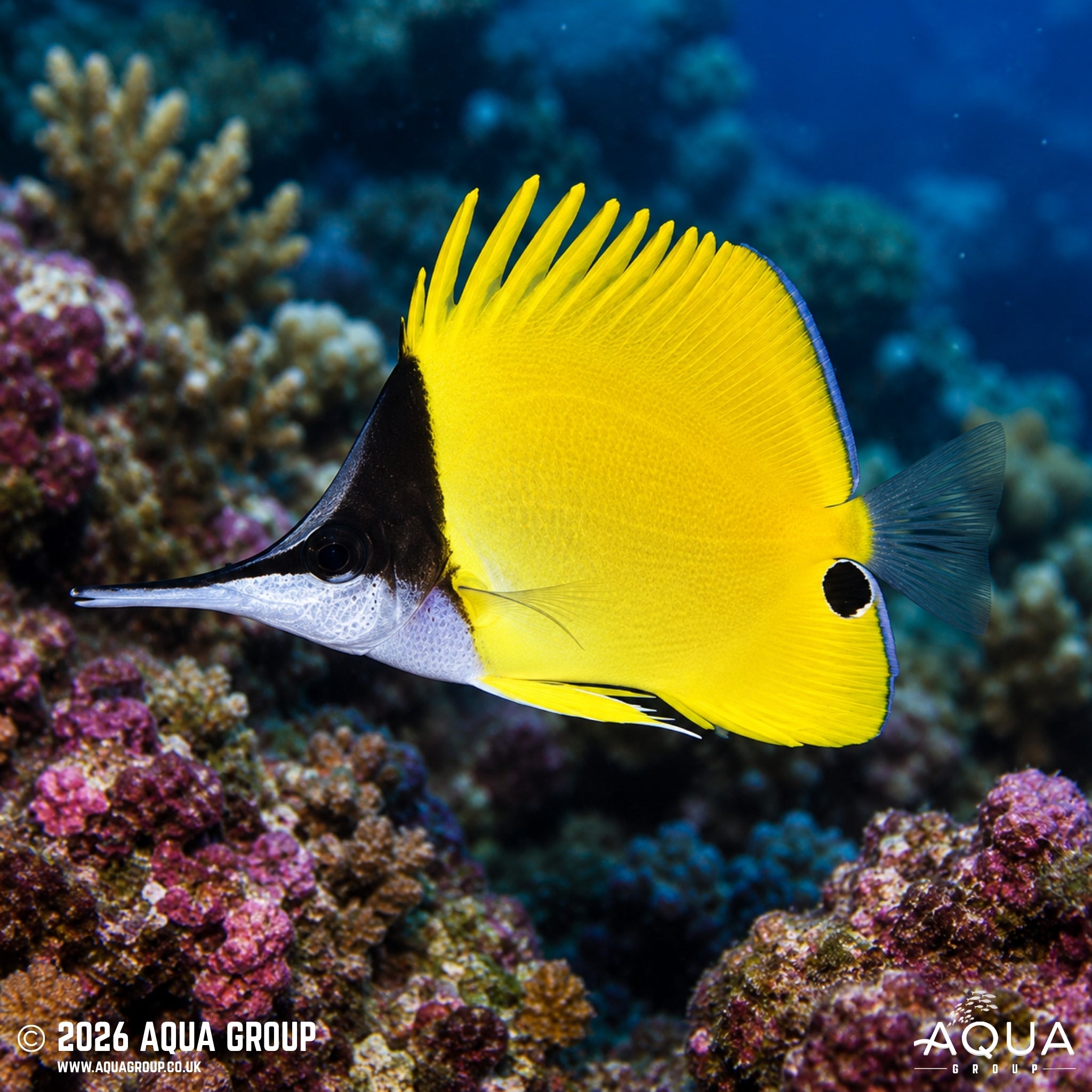
The Longnose Butterflyfish, Forcipiger longirostris, is an elegant and unusual marine butterflyfish, admired for its bright yellow body, black upper head, pale lower face and exceptionally long, fine snout. More accurately known as the Big Longnose Butterflyfish, this species is less commonly seen than the standard Yellow Longnose Butterflyfish, Forcipiger flavissimus, and is best recognised by its longer snout, darker eye/head area and fine dark spotting on the chest. It can make a beautiful feature fish for mature marine aquariums, but should be treated as reef safe with caution because it may pick at small invertebrates, tube worms, clam mantles or some coral polyps depending on the individual.
Common Name:
Longnose Butterflyfish, Big Longnose Butterflyfish, Big Long-Nosed Butterflyfish, Long-Snouted Butterflyfish, Yellow Longnose Butterflyfish, Longnose Butterfly.
Scientific Name (Latin):
Forcipiger longirostris
Maximum Size:
Up to around 22 cm, making it a medium-sized butterflyfish that requires good swimming space and long-term planning.
Water Type:
Marine
Origin / Natural Habitat:
Found across the tropical Indo-Pacific, including coral reef regions of the Indian Ocean, Western Pacific, Central Pacific and Hawaiian reef systems. In the wild, Big Longnose Butterflyfish are usually associated with seaward reefs, reef slopes, coral-rich habitats and rocky reef structure, often occurring at greater depth than many common butterflyfish. They are usually seen singly or in pairs, using their very long snout to reach tiny prey hidden deep within crevices and branching coral.
Water Parameters:
Temperature: 24–27°C
pH Range: 8.1–8.4
Hardness or Salinity: SG 1.020–1.025
Temperament:
Peaceful to semi-aggressive. Longnose Butterflyfish are usually manageable with suitably sized marine fish, but they can be shy when first introduced and should not be housed with aggressive feeders or bullying tank mates. Best kept with peaceful to moderately robust marine fish in a mature aquarium with plenty of rockwork and open swimming space.
Diet:
Carnivorous micro-predator with omnivorous tendencies. In the wild, this species uses its long snout to take tiny invertebrates, especially small crustaceans, from narrow crevices and branching corals. In the aquarium, offer a varied diet including frozen mysis shrimp, enriched brineshrimp, finely chopped clam, mussel, cockle, prawn, squid, copepod-based foods, quality marine pellets and suitable butterflyfish preparations. Small food pieces are important due to the narrow mouth. Several smaller feeds per day are ideal, especially while newly introduced specimens are settling.
Minimum Tank Size:
A practical minimum of around 400–500 litres is recommended for a single specimen, with larger aquariums preferred for long-term adult care. Provide open swimming space, mature rockwork, caves, ledges and plenty of natural crevices for foraging behaviour.
Behaviour & Activity:
An active but refined butterflyfish that spends much of its time cruising around rockwork and inspecting narrow gaps for food. Its extra-long snout allows it to reach foods that many other fish cannot access. It may be cautious at first, but usually becomes more visible once feeding confidently. Forcipiger longirostris is often confused with Forcipiger flavissimus, but typically has a longer, finer snout, darker eye/head detail and fine spotting on the chest. A secure lid is recommended, as startled marine fish can jump.
Reef Safe:
Reef Safe with Caution
Longnose Butterflyfish may be kept in some reef aquariums, but individual behaviour can vary. They do not usually behave like heavy coral-feeding butterflyfish, but they may pick at feather dusters, tube worms, small ornamental invertebrates, clam mantles, LPS corals, zoanthids or other sessile invertebrates. They are best suited to FOWLR systems or carefully planned mature reefs where the aquarist accepts some risk.
Special Requirements or Care Notes:
Best kept in a mature marine aquarium with stable water quality, plenty of rockwork and regular small feeds. Newly imported specimens should be observed carefully to ensure they are feeding, as some butterflyfish can be slow to adapt to prepared foods. Avoid aggressive tank mates during the settling period. Correct identification is important, as Forcipiger longirostris is less common than Forcipiger flavissimus and is often confused with it in the trade.
Suitable for:
Intermediate fishkeepers
Availability:
Occasionally available in the marine aquarium trade / Less common than Forcipiger flavissimus / Availability can vary depending on collection, import, size and supplier
All images are a visual representation of the fish you will receive, made to be as accurate as possible. Please note that Mother Nature is a wonderful thing, and variation in patterns and colours will occur — that is part of the unique beauty of these animals.
Order and get 55 reward points
Earn points by signing up for our rewards program