

Description
Tiger Barb (Puntigrus tetrazona)
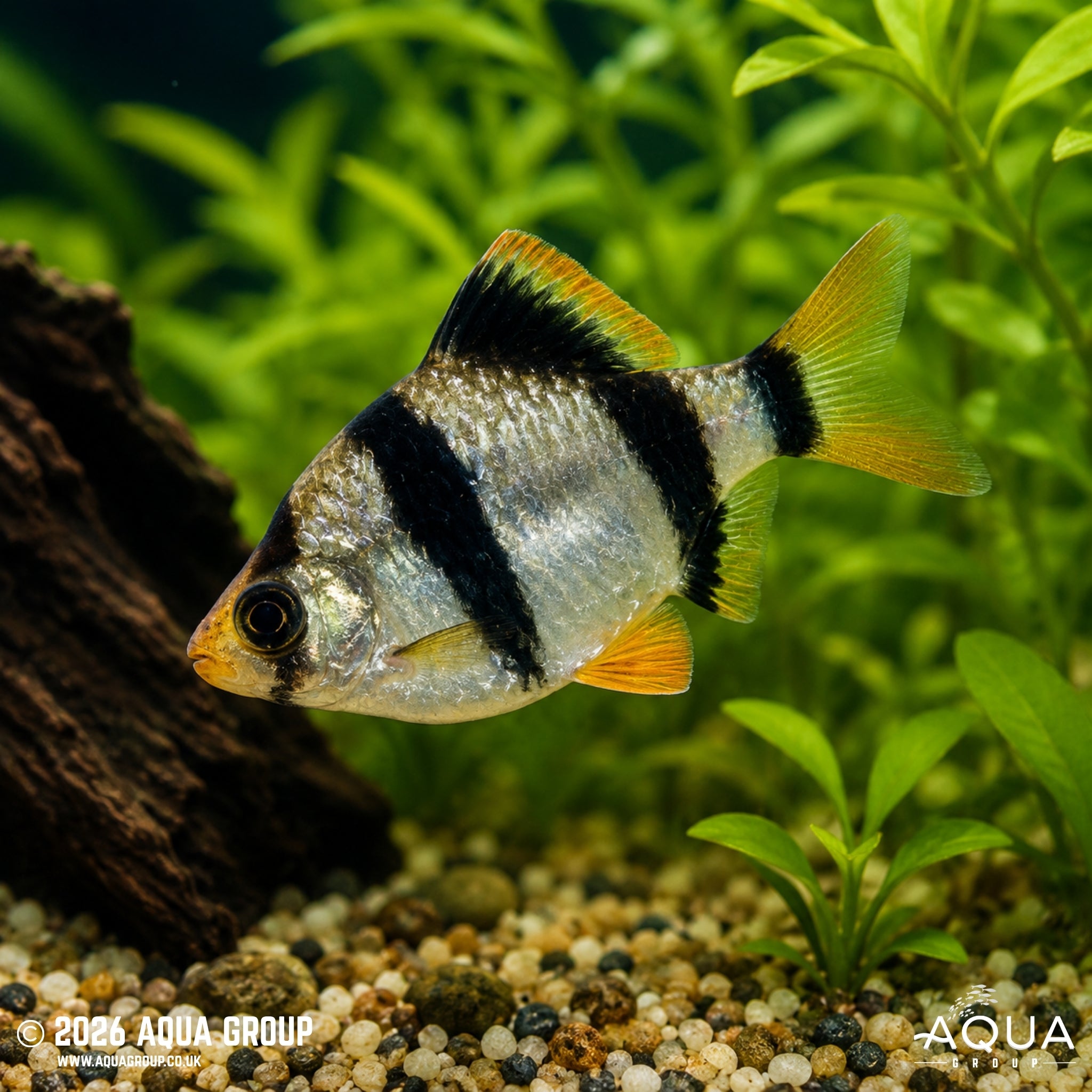
The Tiger Barb is a bold, lively and instantly recognisable freshwater fish, loved for its golden-orange body, four dark vertical tiger-like bars and active shoaling behaviour. This is one of the most popular barb species in the aquarium hobby, but it should be kept in the right setup. Tiger Barbs are energetic, social and sometimes fin-nippy, so they are best kept in a proper group with robust, active tank mates rather than slow or long-finned community fish.
Common Name:
Tiger Barb. Also commonly referred to as Sumatra Barb, Partbelt Barb, Tigerbarb or Four-Banded Barb.
Scientific Name (Latin):
Puntigrus tetrazona
Previously referenced in the aquarium trade as Puntius tetrazona, Barbus tetrazona and Capoeta tetrazona.
Maximum Size:
Around 6–7 cm in captivity, with mature females usually becoming slightly fuller-bodied than males.
Water Type:
Freshwater
Origin / Natural Habitat:
Native to Southeast Asia, especially Sumatra and Borneo. In the wild, Tiger Barbs are associated with tropical freshwater streams, rivers and vegetated habitats where they live in groups among plants, roots, submerged wood and open swimming areas. Most Tiger Barbs available in the aquarium trade are captive-bred.
Temperature: 20–26°C
pH Range: 6.0–8.0
Hardness: soft to moderately hard water, around 5–19 dH
Temperament:
Semi-aggressive. Tiger Barbs are active, boisterous shoaling fish and can be fin-nippy, especially if kept in small numbers or cramped aquariums. Keeping them in a larger group helps spread their social behaviour and reduces the chance of them targeting other fish.
Diet:
Omnivorous. In nature, Tiger Barbs feed on worms, small crustaceans and plant matter. In the aquarium they should be offered a varied diet including quality flake, small pellets, granules, frozen daphnia, brineshrimp, bloodworm, mosquito larvae and occasional vegetable-based or spirulina foods.
Minimum Tank Size:
A practical recommendation is at least 120 litres for a proper group, with a 90 cm aquarium or larger preferred due to their active swimming and social behaviour.
Behaviour & Activity:
This is a very active mid-water shoaling fish that should be kept in a group of at least 8, ideally 10 or more. In good numbers, Tiger Barbs are more confident, display better behaviour and are less likely to harass other fish. They benefit from open swimming space, planted edges, wood or rockwork for broken sight lines, good oxygenation and a secure lid.
Aquarium Category:
Semi-Aggressive
This species can work well in a robust community aquarium, but it should not be treated as a gentle nano or peaceful community fish. Suitable tank mates include other active barbs, danios, rainbowfish, loaches, larger tetras, bristlenose plecos and confident bottom-dwellers. Avoid bettas, fancy guppies, angelfish, slow gouramis, very long-finned fish, shy nano species and delicate fish that may be stressed by constant activity.
Special Requirements or Care Notes:
Best kept in a mature, well-filtered aquarium with clean, oxygen-rich water and regular maintenance. Group size is one of the most important care factors with Tiger Barbs; small groups are much more likely to become nippy and disruptive. Provide open swimming space as well as planted or decorated areas around the edges so the group can establish a natural hierarchy without constantly bothering tank mates.
Suitable for:
Beginner to intermediate fishkeepers
Availability:
Common in trade, usually as captive-bred stock
All images are a visual representation of the fish you will receive, made to be as accurate as possible. Please note that Mother Nature is a wonderful thing, and variation in patterns and colours will occur — that is part of the unique beauty of these animals.
Order and get 4 reward points
Earn points by signing up for our rewards program