

Description
Steinitz’s Prawn Goby (Amblyeleotris steinitzi)
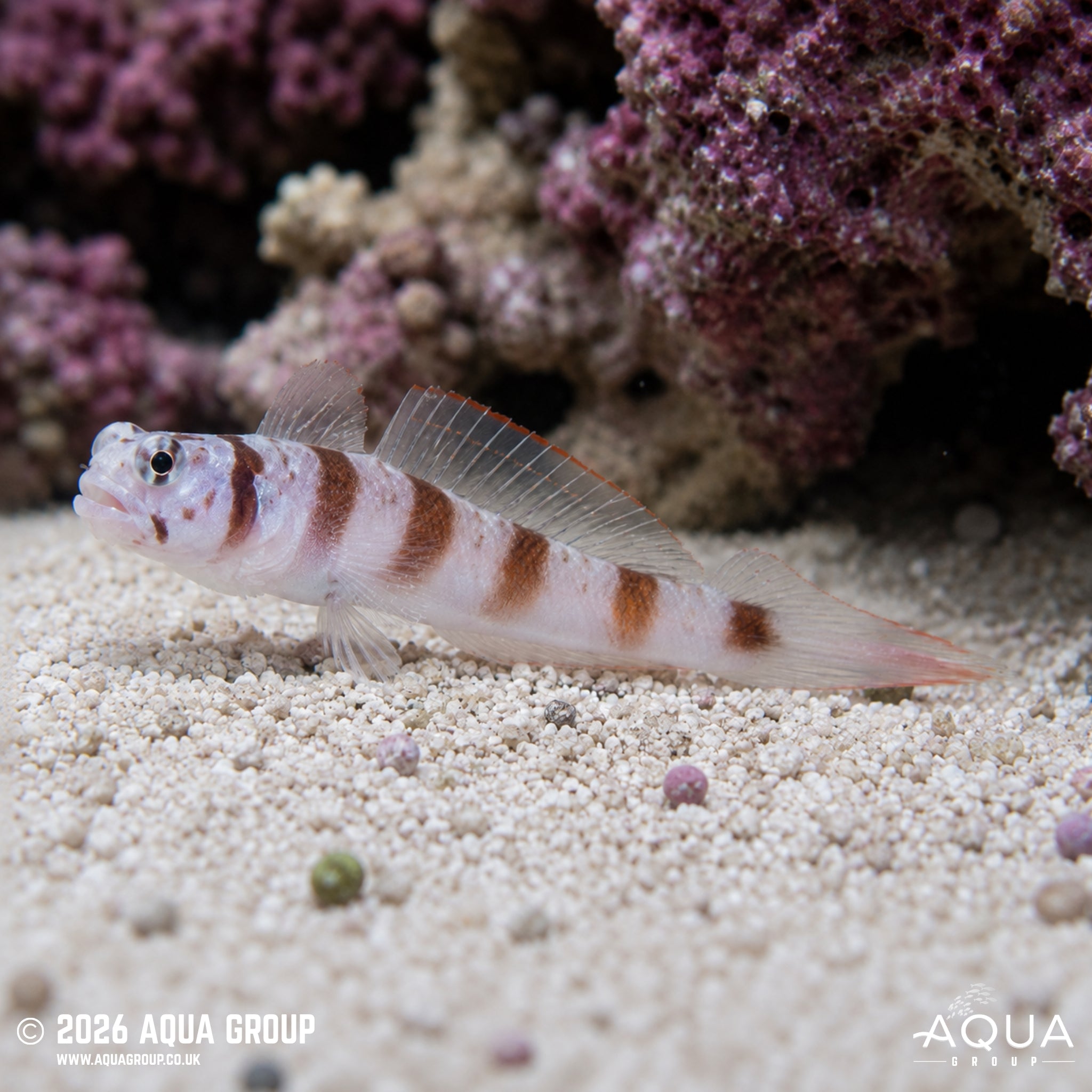
Steinitz’s Prawn Goby, Amblyeleotris steinitzi, is an attractive Indo-Pacific sand-dwelling goby recognised by its pale cream to yellowish body, broad brown vertical bars and delicate orange markings. Also known as Steinitz’s Shrimp Goby or Steinitz’s Shrimpgoby, it forms a fascinating symbiotic partnership with compatible alpheid pistol shrimps, sharing a burrow while the goby watches for approaching danger. Its peaceful temperament, engaging behaviour and compatibility with most corals make it a desirable choice for established reef aquariums with a suitable sandy substrate.
Common Name:
Steinitz’s Prawn Goby, Steinitz’s Shrimp Goby, Steinitz’s Shrimpgoby, Steinitz’ Prawn Goby.
Scientific Name (Latin):
Amblyeleotris steinitzi
Maximum Size:
Commonly around 8–10 cm in aquariums, although scientific records report a maximum length of approximately 13 cm.
Water Type:
Marine
Origin / Natural Habitat:
Widely distributed throughout the Indo-Pacific, from the Red Sea and East African region eastwards to Samoa, north to the Ryukyu and Amami Islands of southern Japan, and south to the Great Barrier Reef. Steinitz’s Prawn Gobies inhabit sandy areas of outer lagoons, coastal reefs and seaward reef slopes, generally living at the entrance of a shared burrow with an alpheid pistol shrimp.
Water Parameters:
Temperature: 24–28°C
pH Range: 8.1–8.4
Hardness or Salinity: Marine salinity 1.023–1.026 specific gravity; maintain stable salinity, alkalinity, good oxygenation and consistently high water quality.
Temperament:
Peaceful but mildly territorial around its burrow. Steinitz’s Prawn Gobies are generally suitable for calm reef communities and usually ignore unrelated fish. They may show aggression towards other prawn gobies, bottom-dwelling gobies or similar species competing for the same territory, particularly in smaller aquariums.
Diet:
Carnivorous micro-predator. In the wild, this species feeds on small crustaceans, zooplankton, worms and other tiny invertebrates collected close to the burrow entrance. In the aquarium, offer enriched mysis shrimp, Artemia, copepods, finely chopped krill, prawn, clam and other small meaty marine foods. Small sinking marine pellets may also be accepted. Target feeding can be helpful because the fish may remain close to its burrow and lose food to faster tank mates.
Minimum Tank Size:
A minimum aquarium volume of approximately 100 litres is recommended for one goby or a goby and compatible pistol shrimp partnership. Larger accommodation is advisable when keeping a pair, multiple bottom-dwelling species or more territorial tank mates.
Behaviour & Activity:
A bottom-dwelling goby that spends most of its time resting on sand or watching the surrounding aquarium from the entrance of a burrow. When partnered with a compatible pistol shrimp, the shrimp maintains and excavates the shelter while keeping physical contact with the goby using its antennae. The goby signals danger with rapid body or tail movements, allowing both animals to retreat underground. It may disappear into the burrow for extended periods after introduction or when startled.
Reef Safe:
Reef Safe
Steinitz’s Prawn Gobies do not normally damage corals, anemones or other sessile reef invertebrates. Very small shrimps, tiny crustaceans or newly released shrimp larvae may be eaten, but established ornamental invertebrates are generally ignored. A partnered pistol shrimp may move sand around the base of corals or undermine unsecured decorations.
Special Requirements or Care Notes:
Provide a bed of fine sand mixed with some small pieces of coral rubble or shell material to support stable burrow construction. Position rockwork directly on the aquarium base rather than loosely on top of the sand, as a pistol shrimp may excavate underneath it. A compatible alpheid pistol shrimp is strongly recommended to encourage natural behaviour, although the goby can be maintained without one. Not every goby and shrimp will pair immediately, and compatibility cannot be guaranteed. Avoid aggressive or highly competitive tank mates and use a secure, tightly fitting aquarium cover because prawn gobies can jump, particularly when newly introduced. Ensure food reaches the burrow area and never attempt to uncover the fish by disturbing an established burrow.
Suitable for:
Beginner to intermediate marine fishkeepers
Availability:
Occasional in trade
All images are a visual representation of the fish you will receive, made to be as accurate as possible. Please note that Mother Nature is a wonderful thing, and variation in patterns and colours will occur — that is part of the unique beauty of these animals.
Order and get 30 reward points
Earn points by signing up for our rewards program