

Description
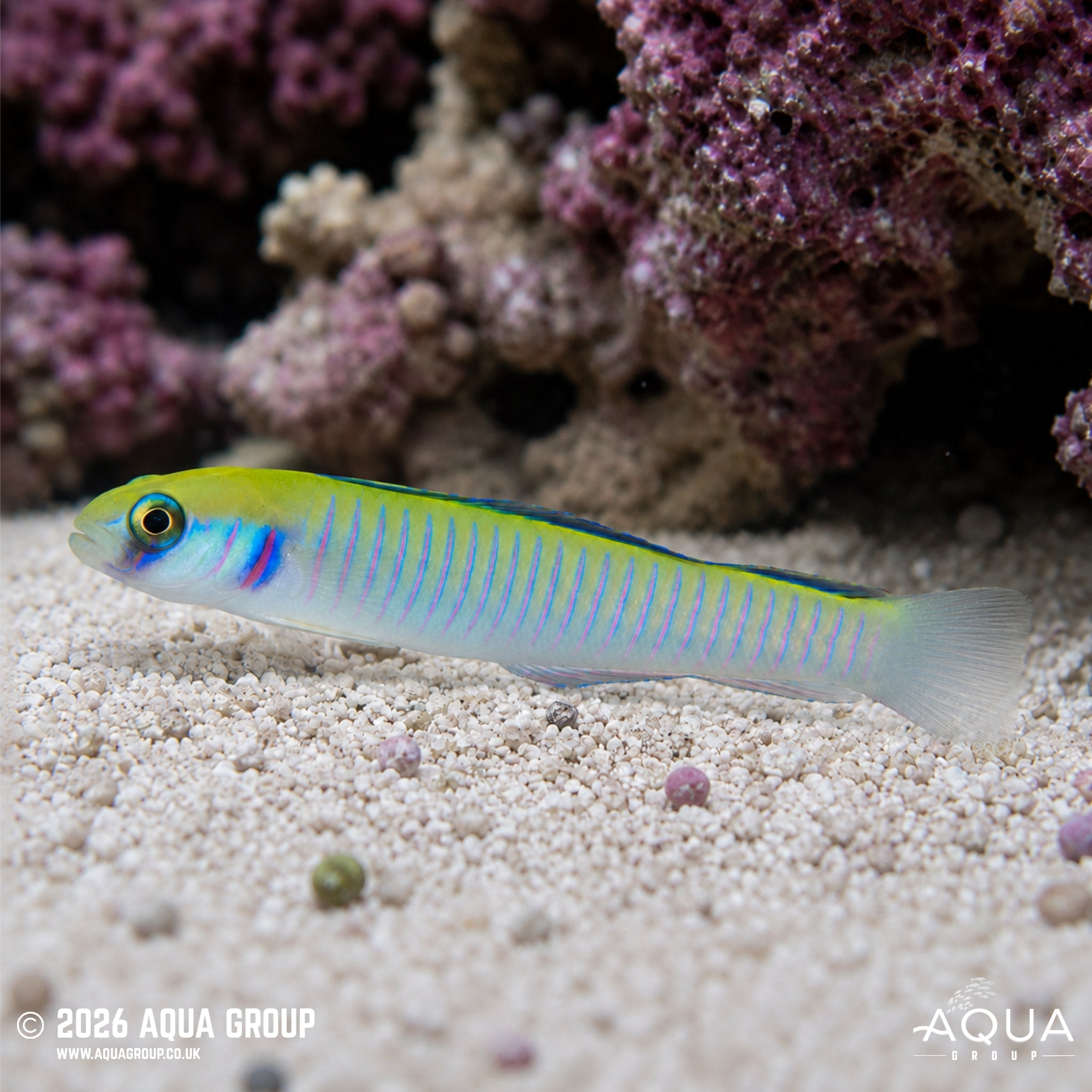
Shotsilk Goby (Ptereleotris zebra)
The Shotsilk Goby, Ptereleotris zebra, is a graceful Indo-Pacific dartfish named for its reflective, silk-like colouration, which can appear green, yellow, blue or bronze depending on the viewing angle. Also known as the Zebra Dartfish, Chinese Zebra Goby or Zebra Hovergoby, it has a slender body decorated with fine vertical markings and bright blue facial accents. This peaceful, social planktivore naturally forms groups above shallow, current-swept reefs and makes an attractive addition to mature reef aquariums with calm tank mates, strong oxygenation and a completely secure cover.
Common Name:
Shotsilk Goby, Shot Silk Goby, Zebra Dartfish, Zebra Dartgoby, Zebra Barred Dartfish, Chinese Zebra Goby, Zebra Hovergoby, Bar Goby, Zebra Wormfish.
Scientific Name (Latin):
Ptereleotris zebra
Maximum Size:
Usually around 10–12 cm when fully grown.
Water Type:
Marine
Origin / Natural Habitat:
Widely distributed throughout the Indo-Pacific, from the Red Sea and western Indian Ocean eastwards to the Line and Marquesas Islands, north to the Ryukyu Islands and south to the southern Great Barrier Reef. Shotsilk Gobies inhabit shallow, exposed seaward reefs over hard substrates, often in areas with strong currents. Groups hover above the reef to feed and retreat rapidly into shared holes, caves and crevices when threatened.
Water Parameters:
Temperature: 23–28°C
pH Range: 8.1–8.4
Hardness or Salinity: Marine salinity 1.023–1.026 specific gravity; maintain stable salinity, alkalinity, brisk water movement, strong oxygenation and consistently good water quality.
Temperament:
Peaceful, social and easily intimidated. Shotsilk Gobies should be housed with calm reef fish that will not chase them or dominate feeding. They can be kept singly, but display more natural and confident behaviour as a compatible pair or group. All group members should be introduced together to reduce territorial disputes.
Diet:
Carnivorous planktivore. In the wild, this species feeds primarily on zooplankton carried through the water column. In the aquarium, offer enriched mysis shrimp, Cyclops, copepods, Artemia, finely chopped krill, small marine pellets and quality flakes. Feed small portions at least twice daily, with more frequent feeding beneficial for newly introduced fish or larger groups.
Minimum Tank Size:
A minimum aquarium volume of approximately 120 litres is recommended for a compatible pair. A mature aquarium of at least 200–250 litres is preferable for a small group, providing greater swimming space, multiple retreats and reduced competition.
Behaviour & Activity:
An active midwater dartfish that hovers close to reef structure while facing into the current and picking planktonic food from the water. When startled, the fish retreat rapidly into caves or rock crevices and may remain hidden for several days after introduction. Shotsilk Gobies are naturally social and often share the same refuge. They do not normally excavate their own permanent burrows, so suitable hiding places must be provided.
Reef Safe:
Reef Safe
Shotsilk Gobies do not normally damage corals, anemones, clams or ornamental invertebrates. They feed mainly from the water column and are suitable for peaceful mixed reef aquariums. Very small planktonic crustaceans and larvae may form part of their natural diet.
Special Requirements or Care Notes:
A tightly fitting aquarium lid is essential, as Shotsilk Gobies are exceptionally capable jumpers and may escape through small openings around cables or equipment. Provide mature live rock containing numerous caves, holes and overhangs, together with a fine sandy substrate and open swimming space. Moderate to strong, well-distributed current is beneficial, but sheltered resting areas should also be available. Keep away from aggressive damsels, large wrasses, boisterous tangs and other fish likely to frighten or outcompete them. Introduce pairs or groups simultaneously and watch carefully for persistent chasing or individuals being prevented from feeding. These fish may be sensitive to harsh medication, so any treatment should be carried out cautiously in a separate quarantine or hospital aquarium.
Suitable for:
Beginner to intermediate marine fishkeepers
Availability:
Occasional in trade
All images are a visual representation of the fish you will receive, made to be as accurate as possible. Please note that Mother Nature is a wonderful thing, and variation in patterns and colours will occur — that is part of the unique beauty of these animals.
Order and get 30 reward points
Earn points by signing up for our rewards program