

Description
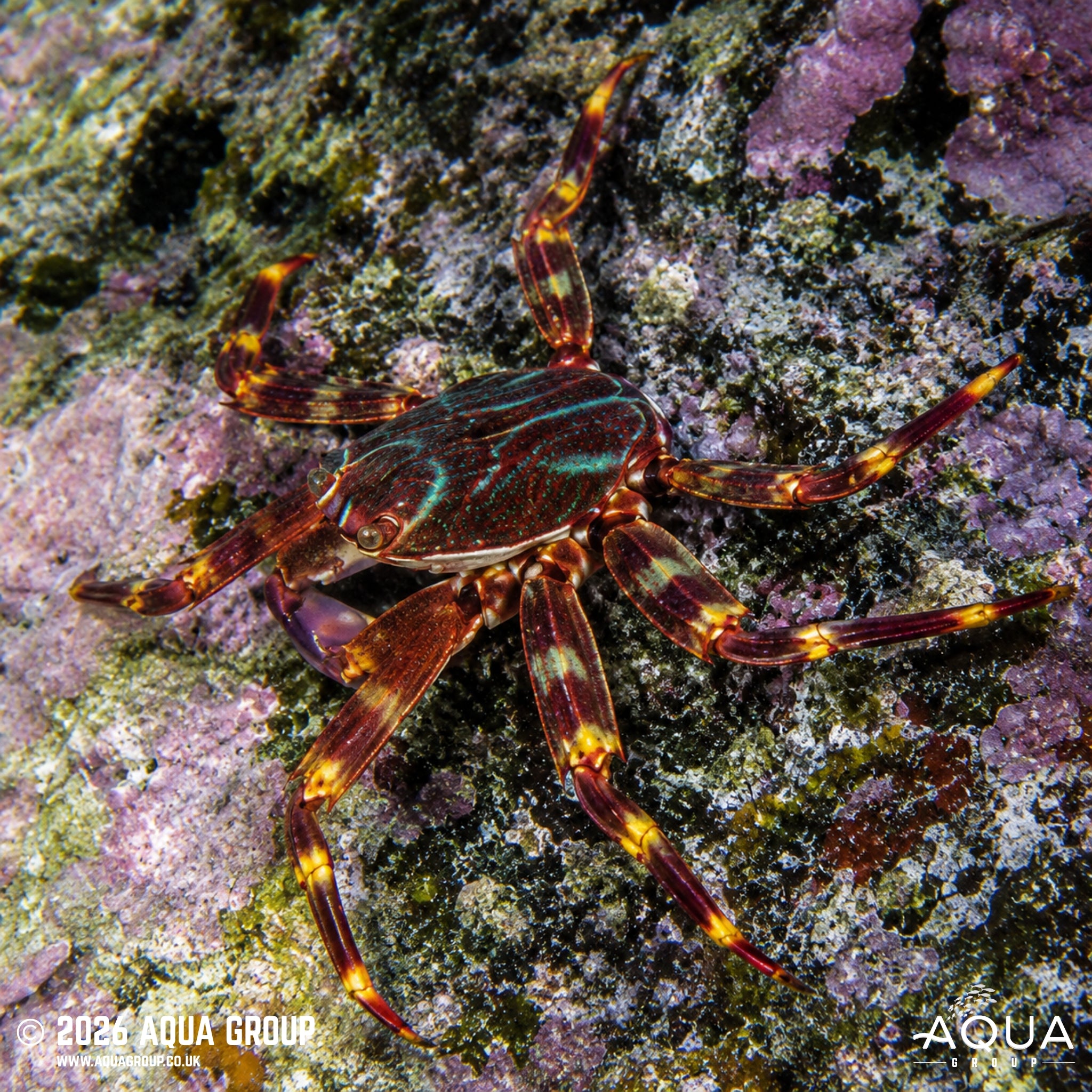
Sally Lightfoot Crab (Percnon gibbesi)
The Sally Lightfoot Crab is a fast-moving and highly active marine crab valued for its striking striped legs, flattened body and constant grazing behaviour. It spends much of its time moving quickly across rockwork in search of algae, detritus and leftover food, making it a useful addition to some established marine aquariums. Although generally manageable, it is an opportunistic omnivore and should be considered reef safe with caution, particularly around very small fish and vulnerable invertebrates.
Common Name:
Sally Lightfoot Crab, Nimble Spray Crab, Spray Crab
Scientific Name (Latin):
Percnon gibbesi
Maximum Size:
Approximately 3 cm carapace width
Water Type:
Marine
Origin / Natural Habitat:
Percnon gibbesi has a very broad distribution, with records from the Atlantic, Caribbean, Mediterranean and eastern Pacific regions. It typically inhabits shallow rocky coastal areas, where its flattened body and long legs allow it to move rapidly over rock surfaces and into narrow crevices. ReefLex records the species from shallow marine habitats and notes its occurrence across areas including the Caribbean, Gulf of Mexico, Canary Islands, Mediterranean and eastern Pacific.
Water Parameters:
Temperature: 24–26°C
pH Range: 8.1–8.4
Salinity: SG 1.024–1.026
Nitrate: Low and stable
Copper: Must be avoided
Temperament:
Semi-Aggressive / Opportunistic
Sally Lightfoot Crabs are active and generally spend their time grazing and scavenging rather than deliberately attacking suitable tankmates. However, they are opportunistic feeders and larger individuals may investigate very small fish, shrimp or other vulnerable invertebrates if the opportunity arises.
They are best housed with robust, healthy reef inhabitants and should be monitored as they mature.
Diet:
Omnivore / Algae Grazer
The Sally Lightfoot Crab is an active grazer and scavenger. It feeds on algae, detritus, carrion and a variety of animal-based foods. Aquarium references also record small fish, shrimp and worms within its broader opportunistic diet.
In the aquarium, provide naturally occurring algae alongside quality algae wafers, nori, sinking marine pellets and occasional meaty foods such as mysis, chopped prawn or other marine-based preparations.
Minimum Tank Size:
Approximately 160 litres
A mature aquarium with substantial rockwork and grazing surfaces is recommended. ReefLex suggests an aquarium of around 160 litres or larger for this species.
Behaviour & Activity:
The Sally Lightfoot Crab is exceptionally quick and agile, moving rapidly across rockwork and using narrow crevices for shelter.
It spends much of its active period grazing surfaces and searching for edible material. Its long legs and flattened body allow it to reach areas that many bulkier crabs cannot access.
Provide secure rockwork with plenty of caves, gaps and shaded retreat areas. A tightly covered aquarium is also advisable because agile crabs can sometimes explore surprisingly high within the system.
Reef Safe:
With Caution
The Sally Lightfoot Crab can be useful in reef aquariums because of its algae-grazing and scavenging behaviour, but it should not be regarded as completely reef safe.
Healthy corals are not usually its primary food source, but its opportunistic nature means small crustaceans, tiny fish, weakened animals or other vulnerable invertebrates may be at risk.
Keeping the crab well fed and providing plenty of natural grazing material can help reduce unwanted predatory behaviour, but compatibility can never be guaranteed.
Special Requirements or Care Notes:
Provide a mature aquarium with stable salinity, established rockwork and plenty of natural grazing surfaces.
Like all marine crustaceans, Sally Lightfoot Crabs are sensitive to copper-based medications, which must be avoided.
Stable water chemistry is particularly important during moulting. Newly moulted individuals are soft and vulnerable, so plenty of secure hiding places should be available.
Avoid housing the crab with predators that naturally consume crustaceans, and monitor it around very small ornamental shrimp, snails or fish.
The accepted scientific name is Percnon gibbesi, which is recognised by the World Register of Marine Species.
Suitable for:
Intermediate
Availability:
Regularly available
All images are a visual representation of the invert you will receive, made to be as accurate as possible. Please note that Mother Nature is a wonderful thing, and variation in patterns and colours will occur — that is part of the unique beauty of these animals.
Order and get 20 reward points
Earn points by signing up for our rewards program