

Description
Saddleback Butterflyfish (Chaetodon ephippium)
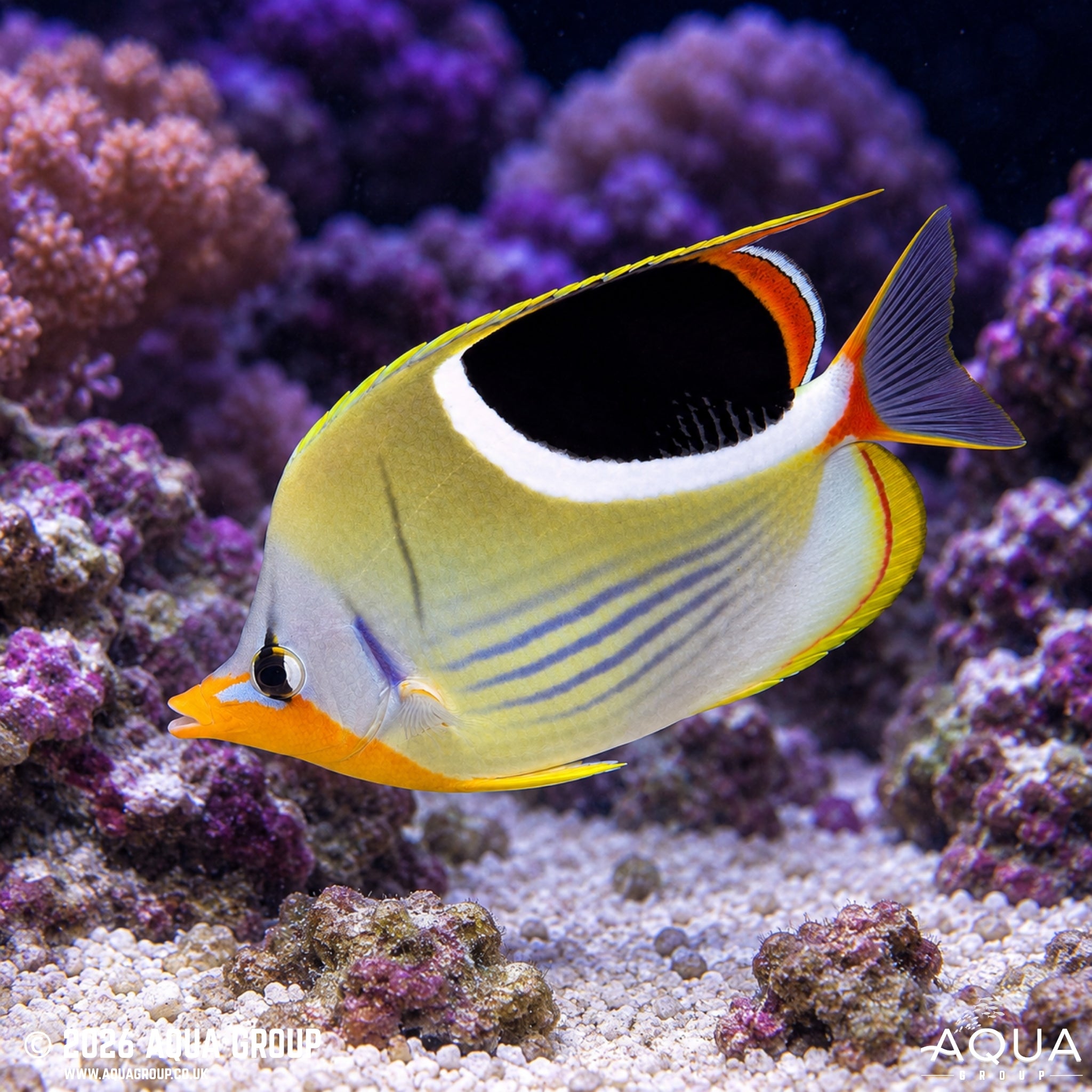
The Saddleback Butterflyfish is a large and striking Indo-Pacific butterflyfish, recognised by its yellow-grey body, fine blue wavy lines across the lower sides, bright yellow rear fins and the bold black “saddle” marking across the upper rear of the body. Also known as the Saddle Butterflyfish or Saddled Butterflyfish, this is an elegant, active marine fish best suited to a spacious mature fish-only or FOWLR-style aquarium. Although beautiful, it is not considered reef safe, as it naturally feeds on coral polyps, small invertebrates, fish eggs and algae.
Common Name:
Saddleback Butterflyfish. Also commonly referred to as the Saddle Butterflyfish, Saddled Butterflyfish, Blackblotch Butterflyfish or Saddleback Butterfly.
Scientific Name (Latin):
Chaetodon ephippium
Maximum Size:
Up to around 30 cm, making it one of the larger butterflyfish species and a fish that needs generous swimming space.
Water Type:
Marine.
Origin / Natural Habitat:
Widespread across the Indo-Pacific, from Sri Lanka and the Cocos-Keeling Islands across to Hawaii, the Marquesas and Tuamotu Islands, north to southern Japan and south to parts of Australia. In the wild it is found around clear, coral-rich lagoons, seaward reefs and reef slopes, usually singly, in pairs or in small groups.
Water Parameters:
Temperature: 24–27°C
pH Range: 8.1–8.4
Salinity: 1.020–1.025 SG
Temperament:
Generally peaceful to semi-aggressive. It is usually suitable with other robust peaceful marine fish, but may show territorial behaviour towards similar butterflyfish or closely shaped competitors, especially in smaller aquariums.
Diet:
Omnivorous reef grazer. In the wild it feeds on filamentous algae, coral polyps, small invertebrates and fish eggs. In the aquarium it should be offered a varied diet including frozen mysis, brineshrimp, krill, chopped clam, mussel, cockle, prawn, squid, quality marine pellets, marine algae and specialist butterflyfish or angel preparations. New specimens may need small, frequent feeds while settling.
Minimum Tank Size:
A practical recommendation is at least 600 litres for a single adult, with larger aquariums preferred due to its adult size and active swimming behaviour.
Behaviour & Activity:
This is an active reef-associated fish that spends much of the day swimming, browsing rockwork and investigating surfaces for small foods. Juveniles are more often solitary and inshore, while adults are commonly seen in pairs or small groups in nature. In the aquarium it benefits from open swimming space, mature live rock, shaded retreats and a calm, low-stress community.
Reef Safe:
Not Reef Safe
This species is not recommended for reef aquariums. It may nip or eat hard corals, soft corals, coral polyps, tube worms, anemones, clam mantles and other sessile invertebrates. It is much better suited to fish-only marine aquariums or FOWLR systems where coral and invertebrate damage is not a concern.
Special Requirements or Care Notes:
Best kept in a mature, stable marine aquarium with excellent filtration, strong oxygenation and plenty of swimming space. Like many butterflyfish, it can be sensitive during import and may be slow to accept prepared foods, so careful acclimation, quarantine and varied feeding are important. Avoid adding it to brand-new marine systems, aggressive predator tanks or coral-heavy reef displays.
Suitable for:
Intermediate to experienced marine fishkeepers
Availability:
Occasional in trade
All images are a visual representation of the fish you will receive, made to be as accurate as possible. Please note that Mother Nature is a wonderful thing, and variation in patterns and colours will occur — that is part of the unique beauty of these animals.
Order and get 45 reward points
Earn points by signing up for our rewards program