

Description
Red Tail Borneo Sucker (Gastromyzon sp. “Red Tail”)
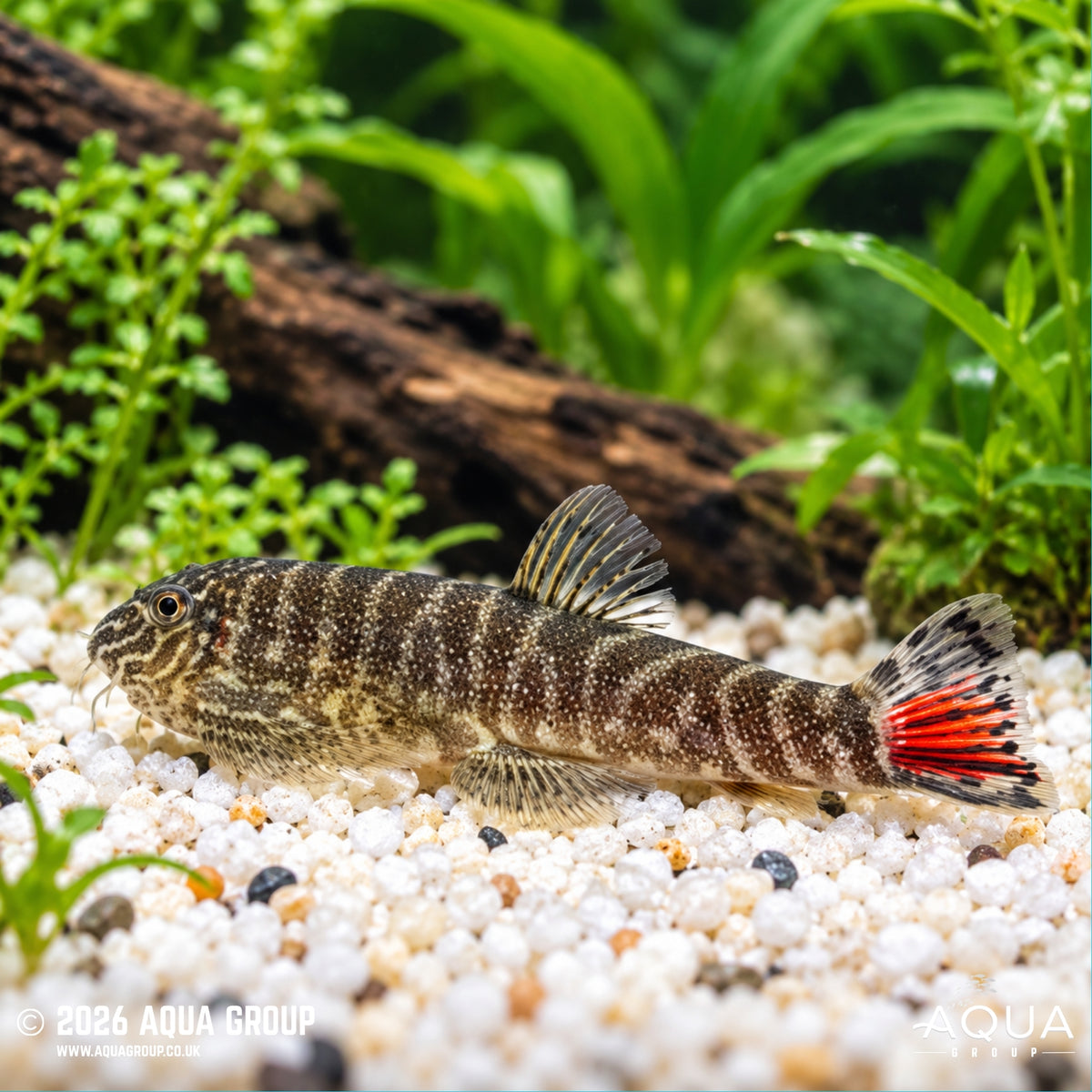
The Red Tail Borneo Sucker is a specialist freshwater hillstream loach admired for its flattened body, strong clinging fins and striking red to orange tail colouration. Also sold as the Red Tail Hillstream Loach, SK02 Red Tail Loach or Red Tail Borneo Loach, this species is best suited to mature river-style aquariums with strong flow, high oxygen levels, smooth stones and established biofilm. It is peaceful with suitable tankmates, but it should not be kept in warm, low-flow community tanks.
Common Name:
Red Tail Borneo Sucker, Red Tail Hillstream Loach, SK02 Red Tail Loach, Red Tail Borneo Loach
Scientific Name (Latin):
Gastromyzon sp. “Red Tail”
Trade / Supplier Name:
Gastromyzon sp. SK02 / Gastromyzon sp. Red Tail
Correction Note:
The supplied name Gastromyzon sahiratus could not be verified as a recognised scientific name. For product accuracy, this is best listed as Gastromyzon sp. “Red Tail” unless a confirmed supplier identification is provided.
Maximum Size:
Approximately 4–6 cm
Water Type:
Freshwater
Origin / Natural Habitat:
The Red Tail Borneo Sucker is a Borneo hillstream loach type associated with fast-flowing, rocky streams and highly oxygenated freshwater habitats.
In the wild, these loaches live on smooth stones, boulders and submerged hard surfaces where they cling against the current and graze natural biofilm, soft algae and microorganisms.
Water Parameters:
Temperature: 20–24°C
pH Range: 6.5–7.8
Hardness: Soft to moderately hard
Ammonia/Nitrite: 0 ppm
Nitrate: Kept low and stable
Oxygenation: High oxygen and strong water movement required
Temperament:
Peaceful
Red Tail Borneo Suckers are peaceful with suitable fish and spend most of their time grazing across stones, wood, glass and other hard surfaces.
They may lightly compete with one another over favourite feeding stones, but this is usually harmless when enough space, flow and grazing areas are provided.
Diet:
Omnivore / Biofilm Grazer
The Red Tail Borneo Sucker naturally feeds on biofilm, soft algae, aufwuchs, microorganisms and fine food particles from hard surfaces.
Supplement natural grazing with sinking algae wafers, spirulina foods, gel foods, fine sinking pellets, blanched vegetables and occasional frozen foods such as daphnia, cyclops or brineshrimp.
Do not rely on natural aquarium algae alone. A mature aquarium with established biofilm is strongly recommended.
Minimum Tank Size:
Approximately 75–90 litres for a small group
A longer aquarium with good bottom space is preferred over a tall tank.
Strong filtration, surface movement, additional aeration and plenty of smooth stones are more important than volume alone.
Behaviour & Activity:
The Red Tail Borneo Sucker spends much of its time attached to stones, glass, wood and other hard surfaces.
It moves in short bursts between grazing areas and often chooses places with steady flow and high oxygen levels.
In a mature river-style aquarium, a settled group can become active and visible throughout the day, especially around favourite feeding stones.
Community Suitability:
Specialist Community Fish
The Red Tail Borneo Sucker is best kept in a specialist hillstream or cool-to-moderate tropical community aquarium.
Suitable tankmates include White Cloud Mountain Minnows, peaceful danios, hillstream-suitable rasboras, small gobies from similar habitats and other compatible hillstream loaches where space allows.
Avoid goldfish, large cichlids, aggressive loaches, fin-nippers, slow warm-water fish, discus, angelfish, gourami and any species that requires still, warm or low-oxygen water.
Special Requirements or Care Notes:
This species needs clean, mature, oxygen-rich water with strong flow.
A river-style aquarium with smooth stones, rounded pebbles, driftwood, open grazing surfaces and good surface agitation is strongly recommended.
Avoid newly set up aquariums, poor water quality, warm stagnant conditions and sharp substrate.
Do not keep this species in tanks maintained constantly at high tropical temperatures, as low oxygen and heat stress can become a problem.
Provide mature biofilm growth and supplement the diet regularly with specialist sinking foods.
Make sure food reaches the bottom, as faster midwater fish may take food before the loaches can graze.
Stable water quality, high oxygenation and regular water changes are essential for long-term success.
Suitable for:
Intermediate
Availability:
Availability can vary depending on season, supplier and import batch. Red Tail forms are often sold under trade names rather than fully confirmed species names.
All images are a visual representation of the fish you will receive, made to be as accurate as possible. Please note that Mother Nature is a wonderful thing, and variation in patterns and colours will occur — that is part of the unique beauty of these animals.
Order and get 10 reward points
Earn points by signing up for our rewards program