
Description
Red Rainbowfish (Glossolepis incisa)
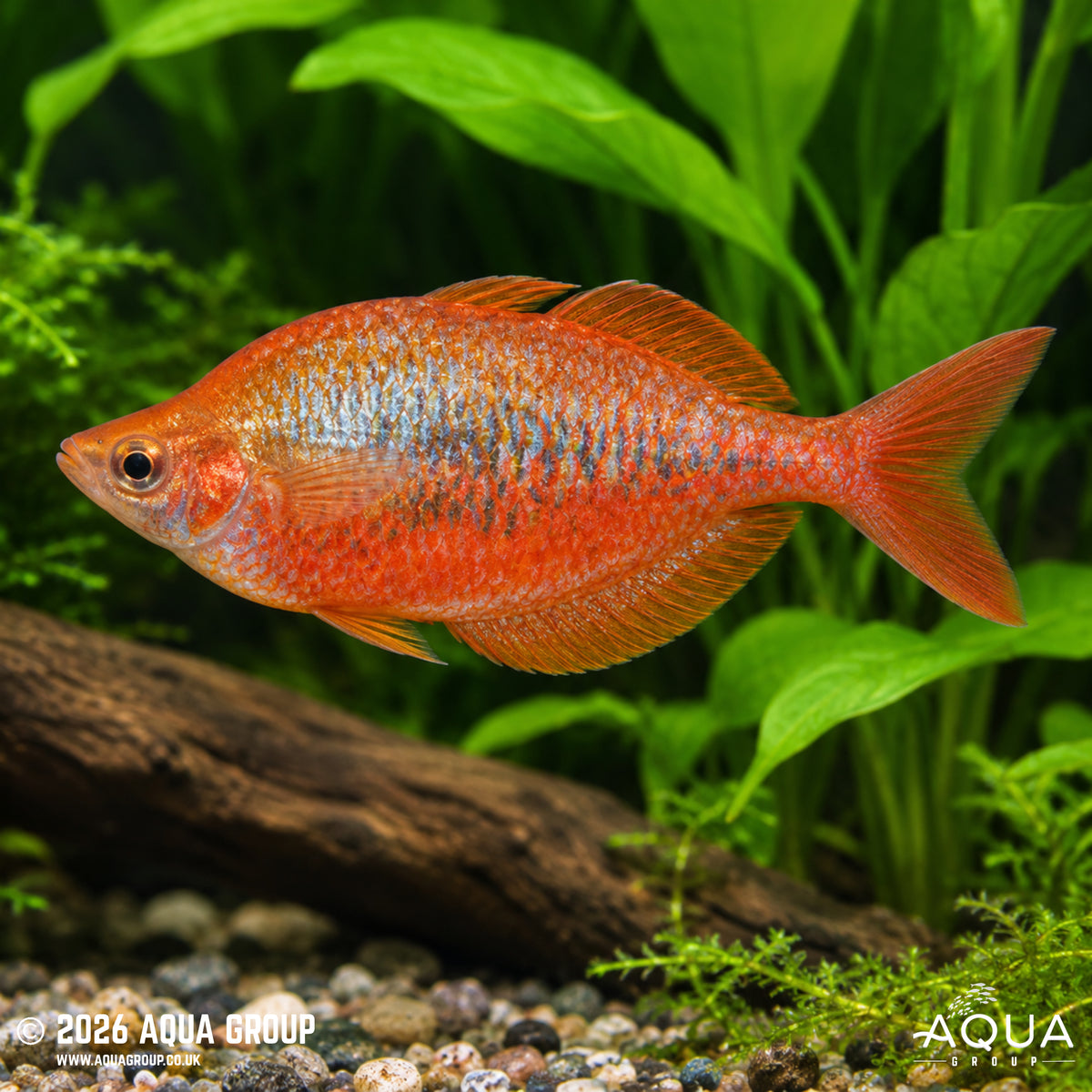
The Red Rainbowfish is a stunning freshwater species admired for its brilliant crimson colouration, deep-bodied appearance and energetic swimming behaviour. Also known as the Salmon Red Rainbowfish or New Guinea Red Rainbowfish, this impressive species develops particularly intense red colouring in mature males, while females display softer golden, olive and silvery tones. Native to Lake Sentani in Indonesian New Guinea, the Red Rainbowfish is a peaceful but highly active shoaling species that requires generous swimming space and the company of its own kind. Its striking appearance and lively personality make it an excellent centrepiece for spacious planted aquariums and carefully planned tropical freshwater communities.
Common Name:
Red Rainbowfish, Salmon Red Rainbowfish, New Guinea Red Rainbowfish, Lake Sentani Rainbowfish
Scientific Name (Latin):
Glossolepis incisa (formerly Glossolepis incisus)
Maximum Size:
Approximately 12–15 cm, with mature males developing noticeably deeper bodies than females
Water Type:
Freshwater
Origin / Natural Habitat:
The Red Rainbowfish is endemic to Lake Sentani and its surrounding connected waters in northern New Guinea, within Papua Province, Indonesia.
Wild Glossolepis incisa inhabit freshwater lake environments, particularly sheltered margins containing dense aquatic vegetation and areas of open water.
Lake Sentani is a large tropical freshwater lake surrounded by hills, where natural vegetation provides shelter, feeding opportunities and suitable areas for reproduction.
These fish are naturally associated with groups swimming around planted lake margins, moving into more open areas while searching for food.
Their natural habitat generally contains neutral to alkaline, mineral-rich water rather than the very soft, acidic conditions associated with some other tropical freshwater species.
The Red Rainbowfish has a highly restricted natural distribution and is classified as Endangered in the wild, making responsible captive breeding and conservation particularly important.
Water Parameters:
Temperature: 24–28°C
pH Range: 7.0–8.0
Hardness: Moderately Hard to Hard, approximately 10–20 dGH
Ammonia/Nitrite: 0 ppm
Nitrate: Kept low and stable
Temperament:
Peaceful
Red Rainbowfish are generally peaceful, active and sociable freshwater fish that are well suited to spacious community aquariums containing similarly sized species.
They should be maintained in groups of at least 6–8 individuals, with larger groups recommended wherever sufficient aquarium space is available.
Although not typically aggressive, mature males may display towards one another and engage in brief chasing behaviour while establishing social dominance.
These interactions are generally harmless when the aquarium provides adequate swimming space and the group contains a suitable balance of individuals.
Their relatively large adult size and energetic swimming behaviour can intimidate very small, shy or slow-moving tankmates.
Avoid aggressive cichlids, large predators and particularly delicate species that may become stressed by their constant activity.
Diet:
Omnivore
Red Rainbowfish naturally consume a varied diet containing small aquatic invertebrates, insect larvae, insects and other available organic food material.
In the aquarium, provide high-quality tropical flakes, appropriately sized rainbowfish pellets and nutritious granules as their staple diet.
Supplementary foods can include frozen or live brine shrimp, daphnia, bloodworm, mosquito larvae and other suitably sized aquatic invertebrates.
Vegetable-based foods, including spirulina-enriched flakes and pellets, can also be included to provide additional nutritional variety.
A balanced diet containing both animal and plant-based ingredients helps maintain healthy growth, strong body condition and natural colour development.
Regularly offering frozen or live foods can be particularly beneficial for encouraging the rich red colouration associated with mature males.
Feed appropriate portions once or twice daily, ensuring food is distributed throughout the group without allowing excessive waste to accumulate.
Minimum Tank Size:
Approximately 250 litres
An aquarium measuring at least 120 cm in length is recommended for a group of Red Rainbowfish, with larger aquariums preferable for fully grown adults.
For substantial groups or mixed freshwater communities, aquariums of approximately 300 litres or more provide additional swimming space and help accommodate their energetic behaviour.
Red Rainbowfish are strong, active swimmers that benefit from long, uninterrupted areas of open water.
Provide planted sections around the edges and rear of the aquarium while leaving generous space through the centre for natural group swimming.
Although juveniles may initially appear suitable for smaller aquariums, their substantial adult size and active nature must be considered when planning long-term accommodation.
Behaviour & Activity:
The Red Rainbowfish is an energetic midwater swimmer that spends much of its time moving through the middle and upper regions of the aquarium.
Its most impressive feature is the intense red colouration developed by mature males, particularly dominant individuals displaying towards other males or courting females.
Adult males develop a noticeably deep, laterally compressed body with a rounded back and rich salmon-red to crimson colouring across the body and fins.
Females are generally slimmer and display more subdued golden, olive or silvery-green tones.
Juvenile fish may initially appear relatively plain, with their characteristic colours becoming more noticeable as they mature.
Males frequently display enhanced colouration and extended fins during social interactions, creating an attractive spectacle when maintained in a suitable group.
Red Rainbowfish naturally form loose shoals and are most confident when surrounded by others of their own species.
They are active during daylight hours and regularly explore open swimming areas, occasionally moving among plants for shelter.
Like many rainbowfish, this species is capable of jumping when startled, making a secure aquarium lid or suitable cover advisable.
During breeding, females scatter small adhesive eggs among fine-leaved vegetation or suitable spawning materials.
Community Suitability:
Community Fish
Red Rainbowfish are excellent candidates for spacious tropical freshwater community aquariums containing peaceful, similarly sized fish.
Suitable companions include other medium to large rainbowfish, appropriately sized peaceful barbs, robust tetras, larger danios and compatible bottom-dwelling catfish.
They are particularly attractive when maintained alongside other peaceful rainbowfish species that share their preference for moderately hard to hard water.
Avoid very small fish, delicate long-finned varieties and slow-moving species that may become intimidated or outcompeted during feeding.
Large predatory fish and aggressive territorial cichlids are also unsuitable companions.
Although generally peaceful, their energetic swimming behaviour and substantial adult size mean they are better suited to larger community aquariums rather than compact setups.
Maintaining a sufficiently large group encourages natural social interactions and allows mature males to display their impressive colouration.
Special Requirements or Care Notes:
Provide a mature, spacious freshwater aquarium with stable water chemistry, efficient biological filtration and good oxygenation.
Red Rainbowfish are active swimmers and require generous horizontal swimming space, with an aquarium length of at least 120 cm recommended.
Maintain groups of at least 6–8 individuals, with larger groups particularly rewarding when sufficient aquarium space is available.
Moderately hard to hard water with a neutral to slightly alkaline pH is preferable, reflecting the natural conditions associated with Lake Sentani.
Avoid very soft, strongly acidic water, as this species is better suited to more mineral-rich freshwater environments.
Include live aquarium plants, driftwood and natural shelter while retaining substantial open areas for swimming.
Aquatic plants such as Vallisneria, Java Fern and other robust species can provide useful cover without restricting movement.
Maintain good filtration and oxygenation, although excessively strong currents are unnecessary. Gentle to moderate water movement is generally suitable.
Regular partial water changes are essential for maintaining excellent water quality, particularly in aquariums containing larger groups of active rainbowfish.
Provide a varied diet containing quality prepared foods alongside frozen or live aquatic invertebrates to support healthy development and strong natural colouration.
Mature males develop their most impressive red colouring as they age, so younger specimens may initially appear less colourful.
A secure aquarium lid is recommended because rainbowfish may jump when startled.
Select peaceful, similarly sized tankmates that can comfortably accommodate their energetic swimming behaviour.
The Red Rainbowfish is listed as Endangered in its natural habitat, largely due to environmental pressures affecting Lake Sentani.
Captive-bred specimens should be selected wherever possible to reduce pressure on wild populations.
Where locality-specific breeding lines are available, these should be maintained separately from other rainbowfish varieties to preserve their genetic identity.
As with other rainbowfish, individual colour intensity, body depth and fin development can vary naturally according to age, sex, breeding line and environmental conditions.
Suitable for:
Beginner to Intermediate
Availability:
Occasional / Captive-bred / Specialist Rainbowfish Availability
All images are a visual representation of the fish you will receive, made to be as accurate as possible. Please note that Mother Nature is a wonderful thing, and variation in patterns and colours will occur — that is part of the unique beauty of these animals.
Order and get 9 reward points
Earn points by signing up for our rewards program