

Description
Rectangle Triggerfish (Rhinecanthus rectangulus)
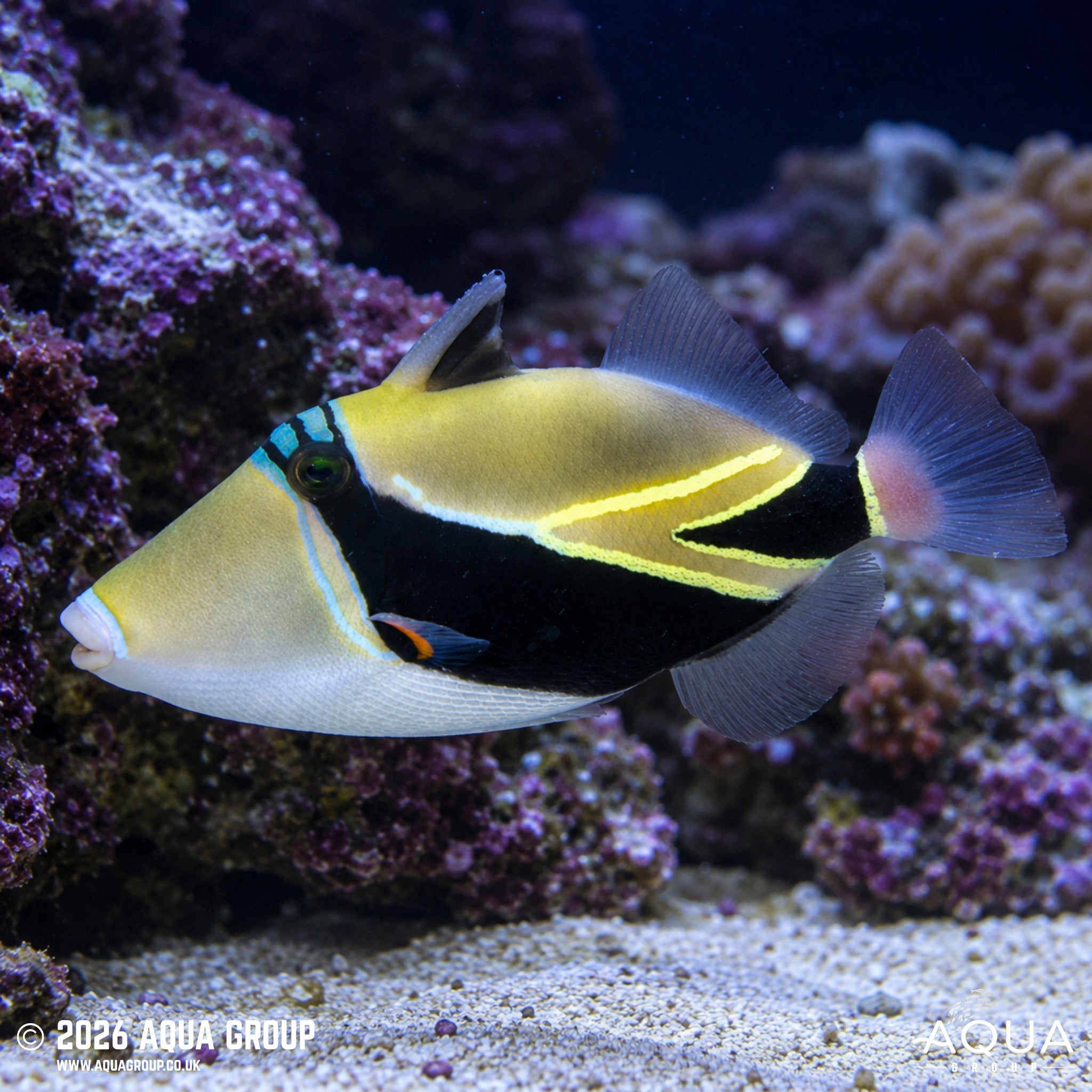
The Rectangle Triggerfish (Rhinecanthus rectangulus) is a bold and highly distinctive Indo-Pacific marine fish recognised by its pale body, vivid blue and yellow facial lines, dark wedge-shaped tail marking and prominent black rectangular patch across the rear flanks. Also known as the Reef Triggerfish, Wedgetail Triggerfish or Humuhumunukunukuāpuaʻa, it inhabits shallow coral reefs, rocky shorelines and surge zones where it searches for crustaceans, molluscs and other hard-shelled prey. Intelligent and full of character, this powerful triggerfish requires a large fish-only aquarium, robust tank mates and an experienced keeper prepared for its territorial behaviour.
Common Name:
Rectangle Triggerfish, Rectangular Triggerfish, Reef Triggerfish, Wedgetail Triggerfish, Wedge-Tail Triggerfish, Humuhumunukunukuāpuaʻa
Scientific Name (Latin):
Rhinecanthus rectangulus
Maximum Size:
Up to approximately 30 cm in total length. Aquarium specimens may remain somewhat smaller, but adults are deep-bodied, powerful fish requiring substantial permanent accommodation.
Water Type:
Marine
Origin / Natural Habitat:
Widely distributed throughout the tropical Indo-Pacific, including the eastern Indian Ocean, Southeast Asia, southern Japan, northern Australia, Hawaii and numerous central and eastern Pacific islands.
It is commonly associated with shallow coral and rocky reefs, reef flats, lagoons and exposed surge zones. Individuals often establish territories around caves, coral structures or rocky crevices and forage across nearby sand and rubble.
Water Parameters:
Temperature: 24–28°C
pH Range: 8.1–8.4
Salinity: 1.020–1.025 SG
Temperament:
Aggressive, territorial and highly assertive. Juveniles may initially appear manageable in a community aquarium, but behaviour often becomes substantially more dominant as the fish matures.
The Rectangle Triggerfish may attack smaller fish, similarly shaped triggerfish and newly introduced tank mates. It should be kept with robust species of a comparable size that can tolerate its energetic and territorial nature.
Diet:
A carnivorous omnivore that naturally feeds on crustaceans, molluscs, sea urchins, worms, small fish, algae and other benthic organisms.
In the aquarium, provide a varied diet of shell-on prawns, mussels, clams, cockles, crab, squid, krill and pieces of marine fish. Marine algae and quality omnivore pellets may also be included.
Regular hard-shelled foods are important because the teeth grow continuously and require natural wear. Feed controlled portions once or twice daily, adjusting quantity according to the fish’s size and body condition.
Minimum Tank Size:
A minimum aquarium volume of approximately 700 litres is recommended for long-term care, with a tank length of at least 180 cm strongly preferred.
A larger aquarium is advisable when keeping the fish alongside other large or territorial marine species. Open swimming space and a broad footprint are more important than aquarium height alone.
Behaviour & Activity:
An active and highly inquisitive daytime fish that patrols the aquarium, investigates equipment and searches rockwork and substrate for food.
The Rectangle Triggerfish uses its powerful jaws to turn over rubble, bite rocks and crush hard-shelled prey. It may rearrange unsecured decorations, move small rocks and excavate around preferred caves.
When threatened or resting, it raises its strong first dorsal spine and locks it into place with a smaller second spine. This allows the fish to wedge itself securely inside a cave or crevice where predators cannot easily remove it.
Established specimens may recognise their keeper and become highly responsive at feeding time. However, large individuals may also bite hands or maintenance tools, so care is necessary when working inside the aquarium.
Reef Safe:
Not Reef Safe
The Rectangle Triggerfish is unsuitable for a conventional reef aquarium. It will prey upon ornamental shrimps, crabs, snails, clams, worms, sea urchins and other mobile invertebrates.
Corals may also be bitten, overturned or damaged while the fish searches for food and rearranges rockwork. It is best maintained in a large fish-only or fish-only-with-live-rock aquarium.
Special Requirements or Care Notes:
Provide extensive open swimming space alongside large caves and stable rock structures. All rockwork should be securely positioned because this strong fish may move rubble or excavate around the base of decorations.
Powerful biological filtration, efficient protein skimming and strong oxygenation are essential. Triggerfish are messy feeders and produce a considerable waste load.
Protected heaters, cables and internal equipment are strongly recommended. An inquisitive triggerfish may bite electrical cables, airline tubing, pump fittings and other exposed components.
A tightly fitted aquarium cover should be used. Although not among the most frequent jumpers, a frightened or excited specimen may leave an uncovered aquarium.
Choose tank mates conservatively. Avoid small fish, ornamental invertebrates, timid species and long-finned fish likely to be harassed. Other aggressive triggerfish may also fight severely unless housed in an exceptionally large system.
The fish should normally be added after peaceful or moderately assertive tank mates so it cannot immediately claim the entire aquarium as its territory.
Never hand-feed an adult specimen. Its strong teeth can inflict a serious bite, and the fish may associate hands with food. Use long feeding tongs and remain aware of its position during aquarium maintenance.
Provide hard-shelled marine foods regularly to support natural tooth wear. Overgrown teeth can interfere with feeding and may require specialist veterinary attention.
Care is needed during capture because the locking dorsal spine can become caught in conventional nets. A rigid submerged container is generally safer when moving the fish.
Suitable for:
Experienced fishkeepers
Availability:
Occasional in trade
All images are a visual representation of the fish you will receive, made to be as accurate as possible. Please note that Mother Nature is a wonderful thing, and variation in patterns and colours will occur — that is part of the unique beauty of these animals.
Order and get 35 reward points
Earn points by signing up for our rewards program