

Description
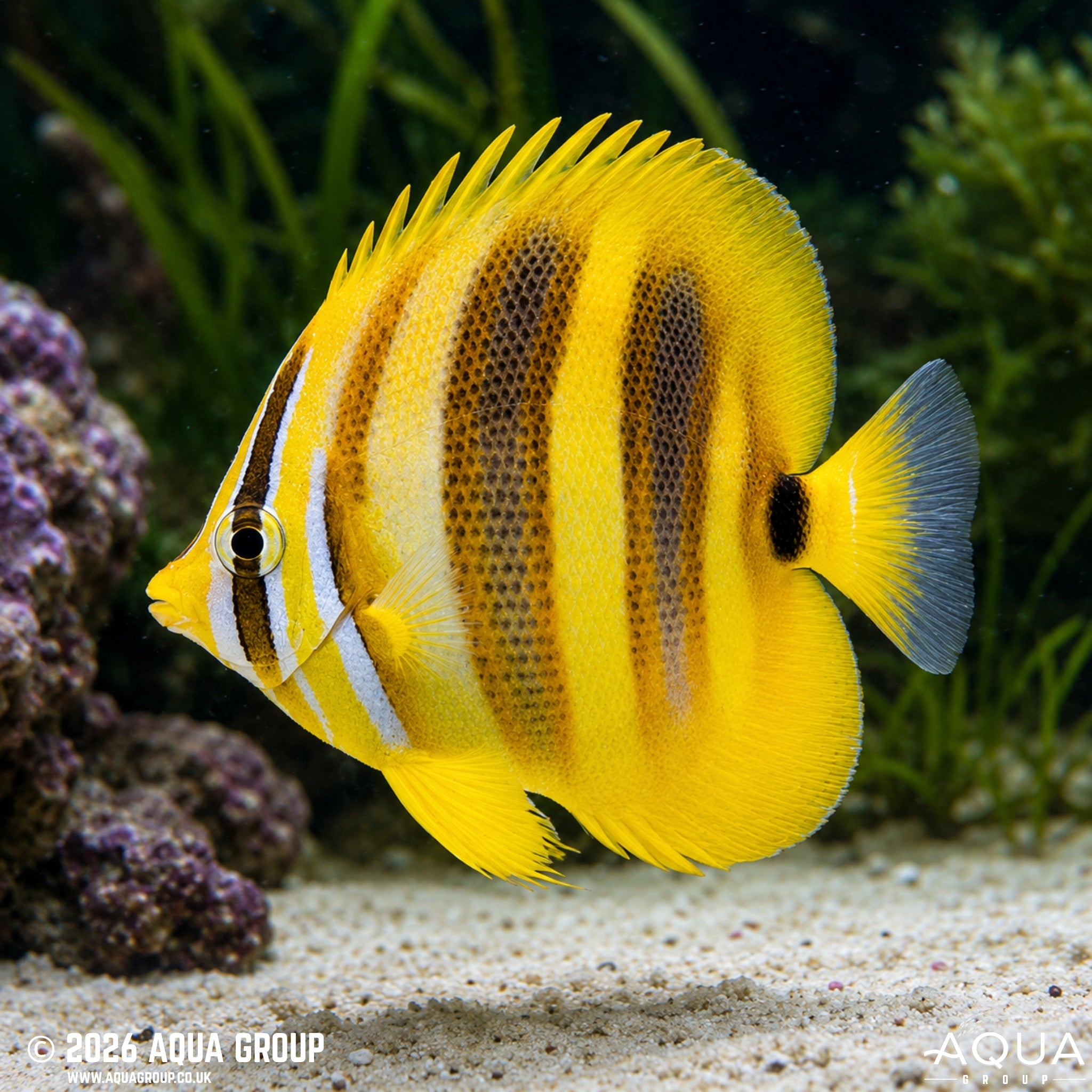
Rainford’s Butterflyfish (Chaetodon rainfordi)
The Rainford’s Butterflyfish is a beautiful and highly specialist Australian butterflyfish, recognised by its yellow body, orange facial bar, blue-grey body bands and delicate reef-associated patterning. Also known as Rainford’s Butterfly or Gold-Barred Butterflyfish, this species is rarely seen in the trade and is best suited to expert marine keepers only. Although it stays smaller than many butterflyfish, it has specialist feeding requirements and is not suitable for standard reef aquariums with corals.
Common Name:
Rainford’s Butterflyfish. Also commonly referred to as Rainford’s Butterfly, Rainford Butterflyfish, Gold-Barred Butterflyfish or Northern Butterflyfish.
Scientific Name (Latin):
Chaetodon rainfordi
Maximum Size:
Around 15 cm, making it a smaller to medium-sized butterflyfish.
Water Type:
Marine.
Origin / Natural Habitat:
Found in the south-western Pacific, particularly around the Great Barrier Reef, Queensland, northern New South Wales, Lord Howe Island and southern Papua New Guinea. In the wild it is associated with coral reefs, coastal reefs, offshore reefs and areas of sparse coral growth, often in pairs or small territories.
Water Parameters:
Temperature: 24–27°C
pH Range: 8.1–8.4
Salinity: 1.020–1.025 SG
Temperament:
Generally peaceful to semi-aggressive. It is not usually a highly aggressive fish, but it may be territorial towards similar butterflyfish and should not be kept with aggressive or boisterous tank mates that may prevent it from feeding.
Diet:
Specialist reef grazer / corallivore. In the wild, it is strongly associated with coral feeding, with some references also noting algae and small benthic invertebrates. In captivity it can be difficult to convert onto prepared foods. It should be offered a wide variety of small frequent feeds including finely chopped clam, mussel, prawn, mysis, brineshrimp, specialist butterflyfish foods, marine algae, sponge-based foods and food pressed into coral skeleton or rock surfaces to encourage grazing. Only purchase if feeding has been confirmed.
Minimum Tank Size:
A practical recommendation is at least 350–450 litres for a single specimen, with a mature, stable system and plenty of established rockwork. Larger aquariums are preferred due to its grazing behaviour and sensitivity during acclimation.
Behaviour & Activity:
This is an active reef-associated butterflyfish that spends much of the day browsing reef surfaces and investigating rockwork for food. It benefits from open swimming space, mature live rock, low-stress tank mates and plenty of natural grazing surfaces. Newly imported specimens may be shy, slow to feed and delicate, so a quiet settling period is important.
Reef Safe:
Not Reef Safe
This species is not suitable for coral reef aquariums. It may feed on hard coral polyps and may also pick at other sessile reef invertebrates. It is best suited to expert-only fish-only systems, specialist FOWLR aquariums, or carefully managed systems where coral damage is not a concern.
Special Requirements or Care Notes:
This is a specialist butterflyfish and should not be treated as a standard community marine fish. It should only be attempted in a mature, stable aquarium with excellent water quality, strong oxygenation, peaceful tank mates and a clear plan for frequent specialist feeding. Quarantine and careful acclimation are strongly recommended, but the fish must be encouraged to feed early. Avoid new tanks, aggressive communities and coral-heavy reef displays.
Suitable for:
Expert marine fishkeepers only
Availability:
Rare / occasional in trade
All images are a visual representation of the fish you will receive, made to be as accurate as possible. Please note that Mother Nature is a wonderful thing, and variation in patterns and colours will occur — that is part of the unique beauty of these animals.
Order and get 95 reward points
Earn points by signing up for our rewards program