

Description
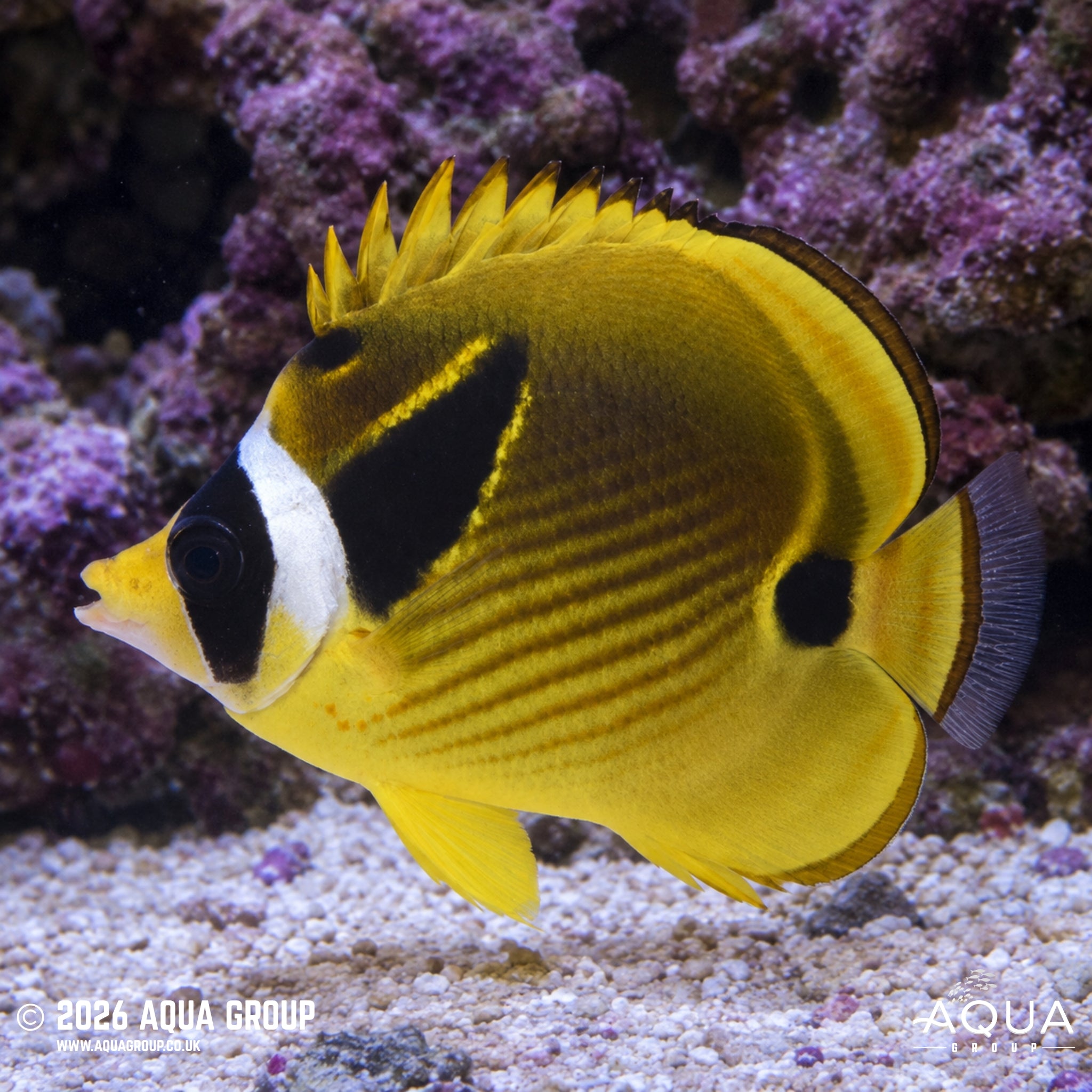
Raccoon Butterflyfish (Chaetodon lunula)
The Raccoon Butterflyfish, Chaetodon lunula, is a striking Indo-Pacific marine fish recognised by its bold black facial mask, pale crescent-shaped marking behind the eyes, yellow body and fine reddish-orange diagonal lines. Also known as the Halfmoon Butterflyfish, Crescent-masked Butterflyfish or Lunule Butterflyfish, it inhabits coral-rich lagoons, reef flats and rocky coastal reefs across a vast tropical range. This active nocturnal and crepuscular forager searches reef surfaces for worms, coral polyps and other small invertebrates. Although generally hardy once established, its adult size, territorial behaviour and appetite for corals make it best suited to a spacious fish-only or FOWLR aquarium.
Common Name:
Raccoon Butterflyfish, Raccoon Butterfly, Halfmoon Butterflyfish, Crescent-masked Butterflyfish, Lunule Butterflyfish, Moon Butterflyfish.
Scientific Name (Latin):
Chaetodon lunula
Maximum Size:
Usually around 18–20 cm when fully grown.
Water Type:
Marine
Origin / Natural Habitat:
Widely distributed throughout the tropical Indo-Pacific, from East Africa and the Red Sea eastwards to the Hawaiian, Marquesas and Ducie Islands, north to southern Japan and south to Lord Howe Island and Rapa.
Raccoon Butterflyfish inhabit shallow coral reefs, rocky reefs, lagoons, reef flats and protected coastal habitats. Juveniles may occur in shallow tide pools and sheltered reef areas, while adults are frequently found around coral-rich reef structure. Individuals may occur alone, in pairs or in small groups.
Water Parameters:
Temperature: 24–28°C
pH Range: 8.1–8.4
Hardness or Salinity: Marine salinity 1.023–1.026 specific gravity; maintain stable salinity, alkalinity, strong oxygenation and consistently high water quality.
Temperament:
Generally peaceful to moderately assertive. Raccoon Butterflyfish usually coexist well with suitably sized, confident marine fish but may become territorial towards other butterflyfish or similarly shaped species.
They can be maintained singly or as a confirmed compatible pair. Keeping several butterflyfish together requires a considerably larger aquarium with extensive rockwork, visual barriers and multiple feeding areas.
Diet:
Omnivorous reef browser with a strong preference for animal-based foods. In the wild, this species feeds on coral polyps, tubeworms, marine worms, small crustaceans, molluscs and other benthic invertebrates, together with some algae and organic material.
In the aquarium, offer enriched mysis shrimp, Artemia, chopped marine prawn, clam, mussel, cockle, krill and specialist butterflyfish preparations. Sponge-containing marine foods, spirulina, algae-based flakes and high-quality pellets can also be included.
Feed varied portions at least two or three times daily. Newly introduced specimens may respond well to food presented within rock crevices or on a feeding grid that encourages natural picking behaviour.
Minimum Tank Size:
A minimum aquarium volume of approximately 400 litres is recommended for one adult, with a long swimming area, extensive mature rockwork and several sheltered caves. A larger aquarium is required for a compatible pair or when keeping it alongside other butterflyfish.
Behaviour & Activity:
An active reef fish that patrols the lower and middle areas of the aquarium while closely inspecting rockwork, coral surfaces and crevices for food. Activity often increases during subdued lighting, around dusk and after dark.
Raccoon Butterflyfish may initially remain close to shelter but usually become bold and visible once established. They use their narrow snout to extract worms and other prey from small gaps that are inaccessible to many larger fish.
Juveniles may live alone in shallow sheltered habitats, while adults are often encountered as pairs or small groups. A compatible aquarium pair may swim and forage closely together.
Reef Safe:
Not Reef Safe
Raccoon Butterflyfish may consume or repeatedly nip soft corals, stony coral polyps, zoanthids, anemones, tubeworms, feather dusters and clam mantles. Ornamental shrimps and other small mobile invertebrates may also be investigated.
Although individual behaviour varies, this species should not be considered suitable for a valuable mixed reef aquarium. It is most reliably maintained in a spacious fish-only or FOWLR system.
Special Requirements or Care Notes:
Introduce only to a mature, stable aquarium with extensive live rock, sheltered caves and generous open swimming space. Mature rockwork provides natural grazing opportunities and helps newly introduced fish settle.
Confirm that the specimen is feeding before purchase whenever possible. Offer several varied meals daily during acclimation and monitor the abdomen and area behind the head for signs of weight loss. Butterflyfish can lose condition quickly if they fail to accept prepared foods.
Avoid highly aggressive tank mates that may prevent the fish from feeding, but do not combine it with exceptionally timid species likely to be intimidated by its active behaviour. Introduce other butterflyfish carefully and use an acclimation box where appropriate.
Rockwork should be securely positioned, with caves and overhangs large enough for the fish to retreat without damaging its fins. Moderate to strong, well-distributed water movement and excellent oxygenation are beneficial.
Quarantine is strongly recommended. Butterflyfish can be vulnerable to external parasites and transport-related stress. Monitor for rapid breathing, scratching, white spots, cloudy eyes, damaged mouth tissue or reduced appetite.
A tightly fitted aquarium cover is recommended, particularly while the fish is newly introduced or unsettled. Avoid exposure to sudden changes in temperature, salinity or water chemistry.
Suitable for:
Intermediate fishkeepers
Availability:
Occasional in trade
All images are a visual representation of the fish you will receive, made to be as accurate as possible. Please note that Mother Nature is a wonderful thing, and variation in patterns and colours will occur — that is part of the unique beauty of these animals.
Order and get 40 reward points
Earn points by signing up for our rewards program