

Description
Panda Loach – Garra flavatra
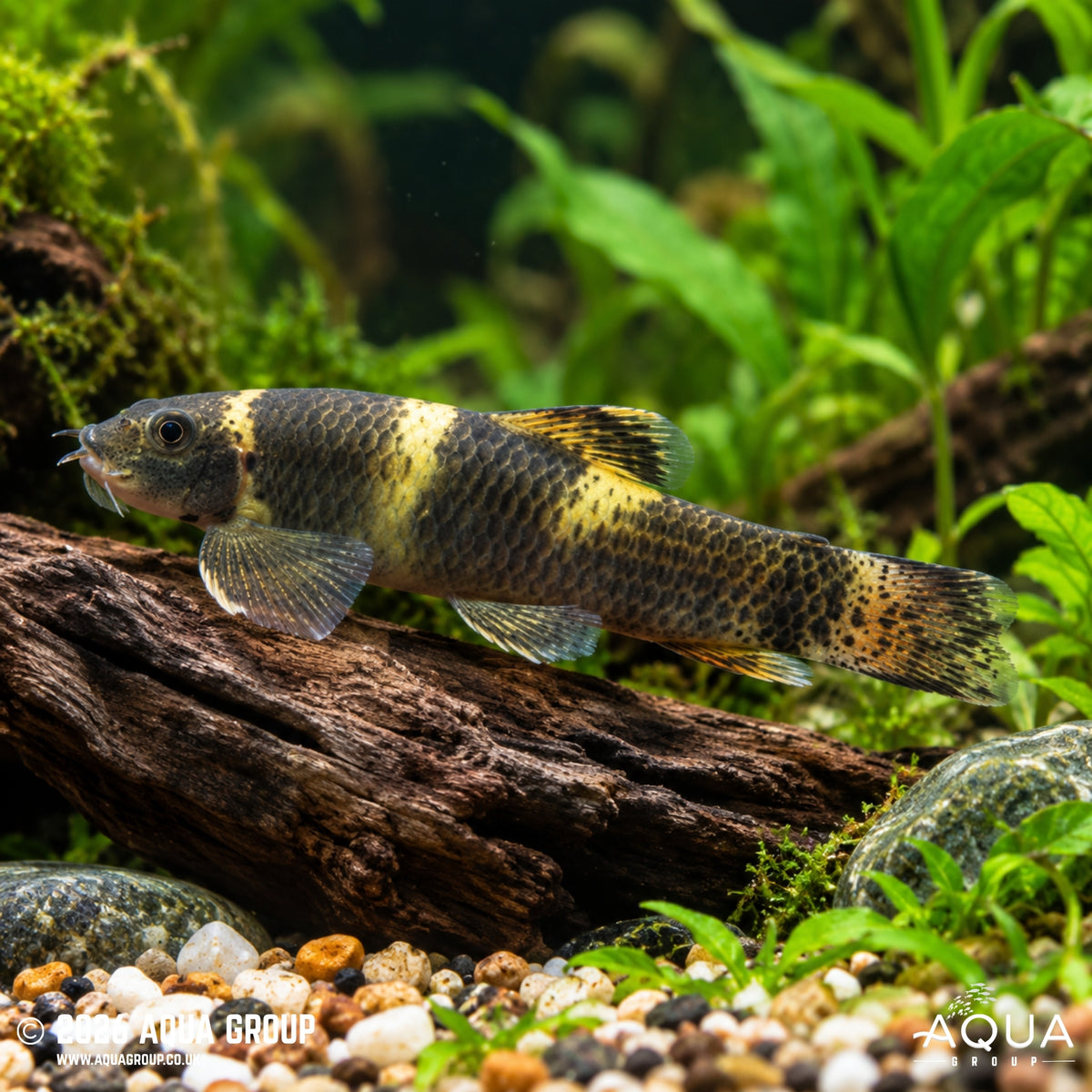
The Panda Loach is a striking freshwater fish admired for its distinctive black and yellow markings, vibrant orange-red fin highlights and energetic grazing behaviour. Also known as the Panda Garra or Rainbow Garra, this attractive species is an excellent addition to mature river-style aquariums and carefully planned tropical community setups. Active, inquisitive and full of personality, Panda Loaches thrive in well-oxygenated aquariums with smooth stones, flowing water and plenty of established biofilm.
Common Name:
Panda Loach, Panda Garra, Rainbow Garra, Panda Garra Loach
Scientific Name (Latin):
Garra flavatra
Maximum Size:
Approximately 8–9 cm
Water Type:
Freshwater
Origin / Natural Habitat:
The Panda Loach originates from western Myanmar, particularly the Rakhine Yoma mountain region.
In the wild, it inhabits clear, fast-flowing streams and rivers with rocky substrates, smooth stones and highly oxygenated water.
These habitats provide abundant natural grazing surfaces where fish feed on biofilm, algae and small aquatic organisms.
In the aquarium, Panda Loaches thrive in mature river-style setups with smooth stones, rounded pebbles, driftwood, open swimming areas and strong water movement.
Water Parameters:
Temperature: 22–27°C
pH Range: 6.5–7.5
Hardness: Soft to moderately hard (approximately 2–12 dGH)
Ammonia/Nitrite: 0 ppm
Nitrate: Kept low and stable
Flow: Moderate to strong preferred
Oxygenation: High oxygen levels and good surface movement essential
Temperament:
Peaceful / Occasionally Territorial
Panda Loaches are generally peaceful towards other aquarium species but may display territorial behaviour towards their own kind.
Individuals may chase one another or defend favourite grazing stones and resting areas.
These interactions are usually manageable when the aquarium provides sufficient space, hiding places and multiple feeding surfaces.
They are best maintained either individually or in appropriately sized groups, where natural social behaviour can develop without concentrating aggression on one or two fish.
Diet:
Omnivore / Algae & Biofilm Grazer
Panda Loaches naturally graze biofilm, soft algae, microorganisms and small aquatic invertebrates from rocks and other hard surfaces.
Offer high-quality sinking algae wafers, spirulina-based foods, specialist bottom-feeder pellets and suitable gel foods as their staple diet.
Supplement with frozen or live foods such as bloodworm, daphnia, brineshrimp, tubifex and other small aquatic invertebrates.
Blanched courgette, spinach and other suitable vegetables can also be offered.
Although Panda Loaches graze algae, they should not be expected to survive on aquarium algae alone.
A varied diet containing both vegetable matter and protein helps maintain healthy growth, strong colouration and overall condition.
Minimum Tank Size:
Approximately 90–120 litres for a single specimen or suitably managed small group, with larger aquariums strongly recommended for groups of five or more.
A longer aquarium with a footprint of approximately 90 × 30 cm or greater is preferred.
Provide plenty of swimming space, smooth stones and separate grazing areas to reduce competition between individuals.
Behaviour & Activity:
The Panda Loach is an energetic, inquisitive fish that spends much of its time exploring rocks, driftwood, aquarium glass and substrate.
It uses its specialised mouth structure to grip surfaces and graze natural biofilm.
Unlike more secretive bottom-dwelling fish, Panda Loaches are frequently active and visible throughout the day.
Individuals may establish favourite resting stones and occasionally chase one another during social interactions.
Their contrasting dark body markings and bright yellow-orange fins make them particularly attractive against natural stones and green aquarium plants.
Community Suitability:
Peaceful Community Fish / Specialist River Aquarium
Panda Loaches are suitable for mature community aquariums containing peaceful, active fish that tolerate good water movement and high oxygen levels.
Suitable tankmates include White Cloud Mountain Minnows, Zebra Danios, larger peaceful danios, compatible rasboras, peaceful barbs and some other current-loving freshwater species.
Compatible hillstream loaches and peaceful bottom-dwelling fish may also be considered where sufficient space and grazing areas are provided.
Avoid aggressive cichlids, large predatory fish, very slow-moving species, delicate long-finned fish and tankmates that require warm, stagnant water.
Panda Loaches may become competitive around favourite grazing surfaces, so care should be taken when keeping them with other similarly shaped bottom dwellers.
Special Requirements or Care Notes:
Panda Loaches require a mature aquarium with excellent water quality, strong filtration and good oxygenation.
A river-style aquarium containing smooth stones, rounded pebbles, driftwood and established biofilm is strongly recommended. Provide moderate to strong water movement and good surface agitation to replicate their natural stream environment. Avoid newly established aquariums, as this species benefits from mature grazing surfaces and stable biological filtration.
Although they tolerate tropical temperatures, consistently warm water with poor oxygenation should be avoided. Panda Loaches are social but may develop a pecking order when kept together. For group keeping, five or more individuals are recommended where aquarium size permits. Small groups of only two or three may experience persistent chasing or territorial behaviour.
Provide multiple stones, shaded retreats and separate feeding areas to reduce competition.
A secure aquarium lid is essential. Panda Loaches are excellent climbers and may escape through surprisingly small openings around filters, pipes and cables. Ensure that prepared foods reach grazing areas, especially when keeping them with fast-feeding midwater fish. Although useful algae grazers, they are not a substitute for regular aquarium maintenance. Regular partial water changes, stable conditions and a varied diet will help maintain their health and colouration.
Suitable for:
Intermediate
Availability:
Occasional, depending on supplier, season and availability of responsibly sourced or captive-bred specimens.
All images are a visual representation of the fish you will receive, made to be as accurate as possible. Please note that Mother Nature is a wonderful thing, and variation in patterns and colours will occur — that is part of the unique beauty of these animals.
Order and get 5 reward points
Earn points by signing up for our rewards program