
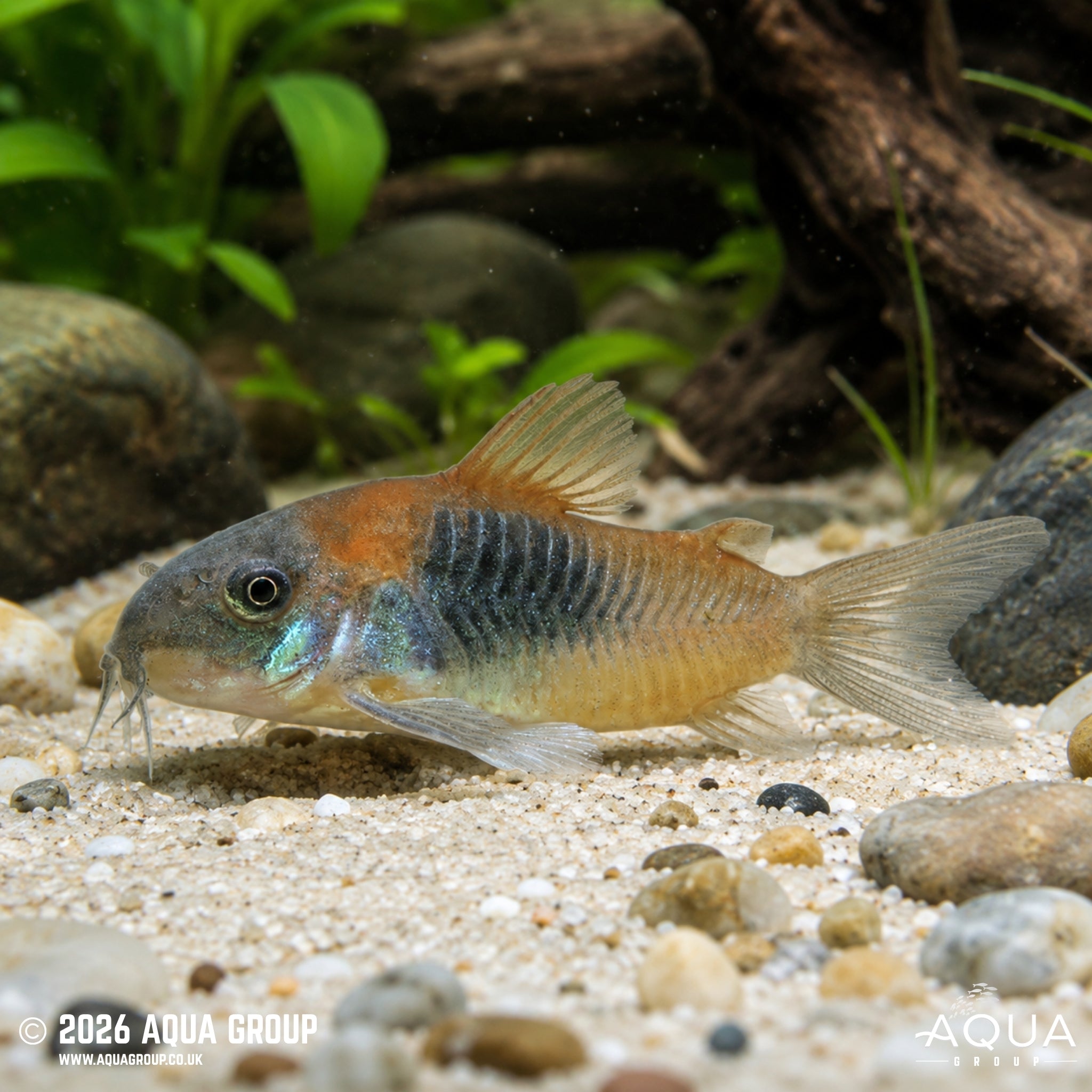

Description
Orange Venezuelan Corydora (Osteogaster venezuelanus)
The Orange Venezuelan Corydora, Osteogaster venezuelanus, is a peaceful cory-type catfish admired for its warm orange to copper body colour, darker metallic shoulder patch and active bottom-dwelling behaviour. Also sold as the Orange Venezuelan Cory, Venezuelan Orange Corydoras or Corydoras aeneus “Venezuela Orange,” this attractive form is ideal for mature community aquariums with soft sand, clean water and a proper group of its own kind. It is a hardy and rewarding catfish when kept correctly, but like all cory-type catfish, it needs good substrate hygiene and should never be kept alone.
Common Name:
Orange Venezuelan Corydora, Orange Venezuelan Corydoras, Venezuelan Orange Cory, Venezuelan Orange Corydoras, Corydoras aeneus “Venezuela Orange.”
Scientific Name (Latin):
Osteogaster venezuelanus
Also treated by FishBase and Eschmeyer’s Catalog as a synonym of Osteogaster aenea; still widely traded as Corydoras venezuelanus or Corydoras aeneus “Venezuela Orange.”
Maximum Size:
Usually around 5–6 cm.
Water Type:
Freshwater
Origin / Natural Habitat:
The trade form is closely associated with the Bronze Corydoras group and is commonly supplied as captive-bred stock. The name venezuelanus refers to Venezuelan material historically associated with northern Venezuelan drainages, while the wider Osteogaster aenea group is broadly South American. In nature, these cory-type catfish live close to the substrate in quiet shallow waters, soft-bottomed areas, marginal vegetation, leaf litter and gentle river or floodplain habitats.
Water Parameters:
Temperature: 22–26°C
pH Range: 6.0–7.8
Hardness or Salinity: Soft to moderately hard freshwater; adaptable when captive-bred, but clean and stable water is essential.
Temperament:
Peaceful and sociable. Orange Venezuelan Corydoras are excellent community fish and should be kept in groups. They do best with calm tank mates and may become stressed by aggressive, large or very boisterous fish.
Diet:
Omnivorous bottom-feeder. Offer sinking catfish pellets, fine granules, small wafers, frozen bloodworm, daphnia, cyclops, brineshrimp and other small meaty foods. They will search the substrate for food, but should not be expected to survive only on leftovers from fish feeding above them.
Minimum Tank Size:
A minimum of 75 litres is recommended for a small group, with larger aquariums preferred for community setups. A longer aquarium footprint is more useful than extra height, as this species spends most of its time on or near the bottom.
Behaviour & Activity:
An active bottom-level shoaler that spends much of the day sifting sand, resting together and exploring shaded areas. Keep at least 6 individuals, with 8 or more preferred for confidence and natural behaviour. Like other cory-type catfish, it may occasionally dart to the surface to gulp air, so always leave clear access to the water surface.
Aquarium Category:
Community Fish
Suitable with peaceful tetras, rasboras, pencilfish, small barbs, livebearers, dwarf cichlids with care, gouramis, rainbowfish and other non-aggressive community fish. Avoid large predatory fish, aggressive cichlids, fin-nippers, rough bottom-dwellers and any fish large enough to swallow them.
Special Requirements or Care Notes:
Soft sand is strongly recommended to protect the barbels and underside while foraging. Keep the substrate clean, as cory-type catfish can suffer from barbel erosion or infection if kept on sharp or dirty gravel. Provide plants, driftwood, leaf litter, caves, shaded areas and open sand patches. This form can vary between suppliers, especially in the strength of orange colour, copper tone and shoulder sheen. Add only to a mature, stable aquarium with regular water changes.
Suitable for:
Beginner to intermediate fishkeepers
Availability:
Common to occasional in trade / Captive-bred strain
All images are a visual representation of the fish you will receive, made to be as accurate as possible. Please note that Mother Nature is a wonderful thing, and variation in patterns and colours will occur — that is part of the unique beauty of these animals.
Order and get 6 reward points
Earn points by signing up for our rewards program