

Description
Orange Spotted Rabbitfish (Siganus guttatus)
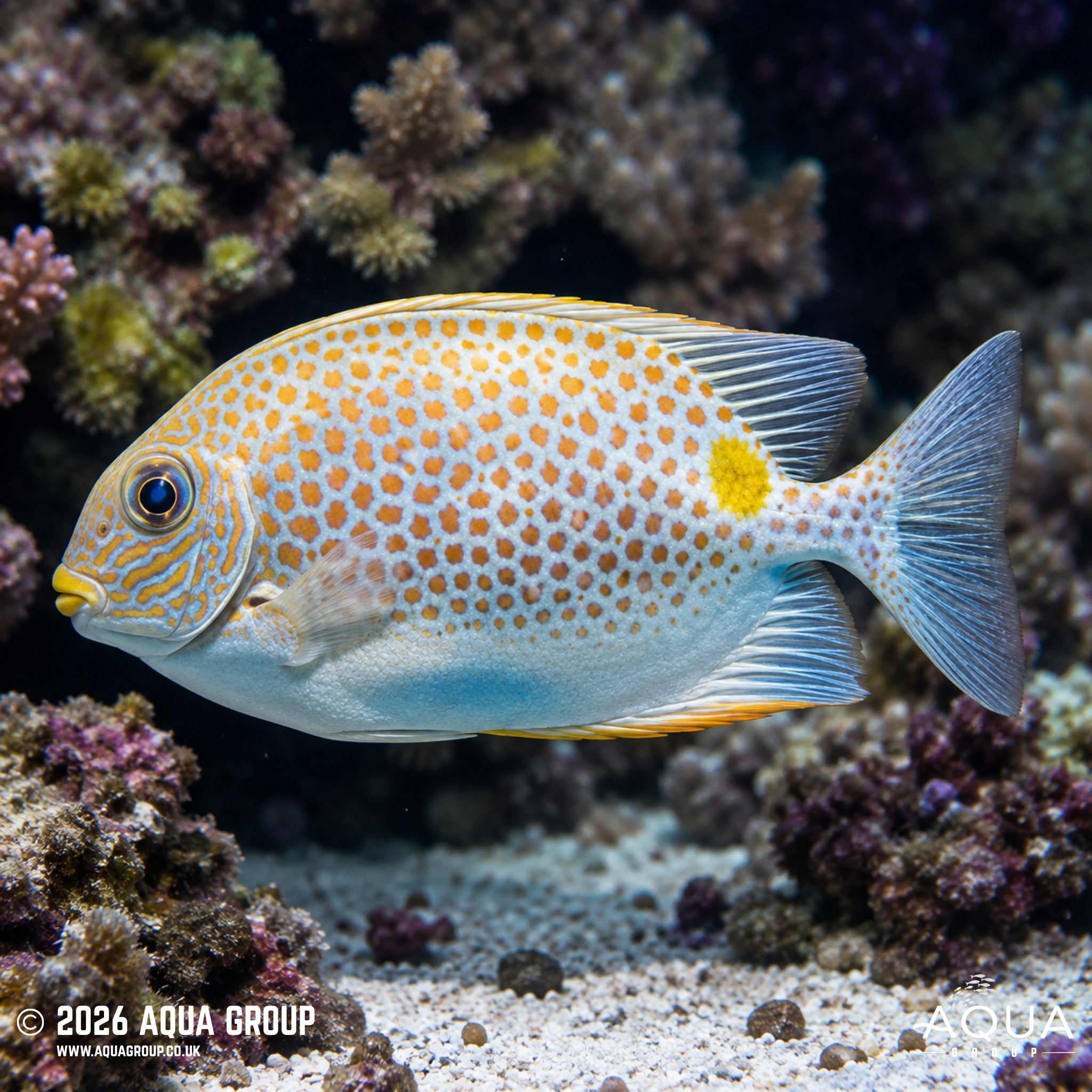
The Orange-spotted Rabbitfish, Siganus guttatus, is a large and distinctive Indo-West Pacific marine fish recognised by its deep yellow to bronze body, numerous orange spots and darker saddle-like marking behind the head. Also known as the Orange-spotted Spinefoot or Golden Rabbitfish, it inhabits coastal reefs, lagoons, mangrove areas and estuaries where it grazes algae and other plant material from rockwork and submerged surfaces. Its active behaviour and useful appetite for marine algae can make it an impressive display fish, although its substantial adult size, venomous fin spines and potential to nip corals require a spacious, carefully planned aquarium.
Common Name:
Orange-spotted Rabbitfish, Orange-spotted Spinefoot, Golden Rabbitfish, Gold-saddle Rabbitfish.
Scientific Name (Latin):
Siganus guttatus
Maximum Size:
Capable of reaching approximately 42 cm in total length when fully grown.
Water Type:
Marine
Origin / Natural Habitat:
Indo-West Pacific, ranging from the Persian Gulf and Gulf of Oman eastwards through Southeast Asia to Palau, Yap and Papua New Guinea, north to the Ryukyu Islands of Japan and south to northern Australia.
Orange-spotted Rabbitfish inhabit shallow coastal waters, lagoons, sheltered reefs, estuaries and mangrove-associated habitats. Juveniles may gather in sheltered inshore areas, while larger adults move through reef flats, coastal reef zones and areas containing abundant algae-covered structure.
Water Parameters:
Temperature: 24–28°C
pH Range: 8.1–8.4
Hardness or Salinity: Marine salinity 1.023–1.026 specific gravity; maintain stable salinity, alkalinity, strong oxygenation and consistently high water quality.
Temperament:
Generally peaceful to moderately assertive. Orange-spotted Rabbitfish usually coexist well with suitably sized marine community fish but may intimidate smaller or timid species through their large adult size and active feeding behaviour.
They may become territorial towards other rabbitfish, particularly similarly shaped adults. Juveniles may tolerate companions more readily, but mature fish require extensive space and separate feeding areas.
Diet:
Primarily herbivorous and omnivorous. In the wild, this species grazes marine algae, seagrass, plant material, detritus and associated microorganisms from reef and coastal surfaces.
In the aquarium, provide marine algae sheets, nori, spirulina flakes, herbivore pellets and frozen preparations containing marine algae. Supplement with small portions of mysis shrimp, Artemia, krill and other marine foods to provide dietary variety.
Vegetable-based foods should form the foundation of the diet. Feed moderate portions two or three times daily and maintain natural algal growth on selected areas of mature rockwork.
Minimum Tank Size:
A minimum aquarium volume of approximately 900 litres is recommended for one adult, with a long swimming area, extensive mature rockwork and generous open space.
A substantially larger aquarium is advisable when keeping more than one rabbitfish or combining it with other large, active marine species.
Behaviour & Activity:
An active daytime fish that spends much of its time swimming through the middle and lower areas of the aquarium while grazing algae from rockwork and other hard surfaces.
Juveniles may occur in groups in sheltered coastal habitats, while larger individuals may swim alone, in pairs or in loose aggregations. In the aquarium, an established specimen often becomes confident and quickly learns established feeding routines.
Colouration can change according to lighting, mood and stress. A resting or frightened fish may become considerably darker or develop irregular blotching, particularly after the aquarium lights are switched off.
Like other rabbitfish, it possesses strong dorsal, pelvic and anal-fin spines connected to venom glands. These spines are normally held close to the body but may be raised defensively when the fish is frightened, restrained or threatened.
Reef Safe:
Reef Safe with Caution
Orange-spotted Rabbitfish primarily graze algae and do not normally target healthy coral tissue when adequately fed. However, individual fish may nip soft corals, fleshy large-polyp stony corals, zoanthids, clam mantles and other sessile invertebrates.
The risk of coral grazing may increase when natural algae and vegetable-based foods are limited. Its large adult size and constant browsing can also disturb loose coral frags or delicate aquascaping.
Special Requirements or Care Notes:
The dorsal, pelvic and anal-fin spines are venomous and can cause an extremely painful injury. Never handle the fish directly or attempt to restrain it by hand.
Use a rigid submerged container rather than a conventional net whenever transfer is unavoidable. The strong fin spines can become caught in mesh, causing injury to the fish and placing the keeper at risk.
Take particular care during aquarium maintenance, especially when working near caves or shaded areas where the fish may be resting. Always confirm its location before placing hands into the aquarium.
In the event of a spine puncture, leave the aquarium safely, clean the wound and seek appropriate medical advice. Hot-water immersion may help reduce pain from marine-fish venom, but it should not replace professional medical assessment, particularly where pain is severe, the wound is deep or signs of an allergic reaction develop.
Provide extensive mature rockwork with broad algae-covered surfaces, caves and visual barriers. Leave a substantial uninterrupted swimming area along the full length of the aquarium.
Offer vegetable-rich foods several times daily. Do not rely on nuisance algae alone, as visible algae may disappear quickly and may not provide complete nutrition.
A well-fed specimen is generally less likely to investigate coral tissue, although coral compatibility can never be guaranteed. Monitor soft corals, zoanthids, fleshy stony corals and clam mantles after introduction.
Avoid housing with highly aggressive triggerfish, large predatory wrasses or species likely to bite its fins. Suitable companions should be robust, appropriately sized and capable of feeding without persistent conflict.
Select only an alert specimen with clear eyes, intact fins, even breathing and a well-filled body. A hollow abdomen, rapid breathing, faded colour or refusal to graze may indicate stress or poor condition.
Quarantine is strongly recommended. Monitor for marine white spot, velvet, flukes, scratching, cloudy eyes or reduced appetite. Provide algae-based foods and sufficient shelter throughout quarantine.
Maintain powerful biological filtration, efficient protein skimming and regular water changes. A fully grown specimen consumes substantial quantities of food and can produce a significant organic waste load.
A secure aquarium cover is recommended because frightened rabbitfish may jump or collide with aquarium structures during sudden bursts of swimming.
Suitable for:
Experienced marine fishkeepers with very large aquariums
Availability:
Rare or occasional in trade
All images are a visual representation of the fish you will receive, made to be as accurate as possible. Please note that Mother Nature is a wonderful thing, and variation in patterns and colours will occur — that is part of the unique beauty of these animals.
Order and get 45 reward points
Earn points by signing up for our rewards program