

Description
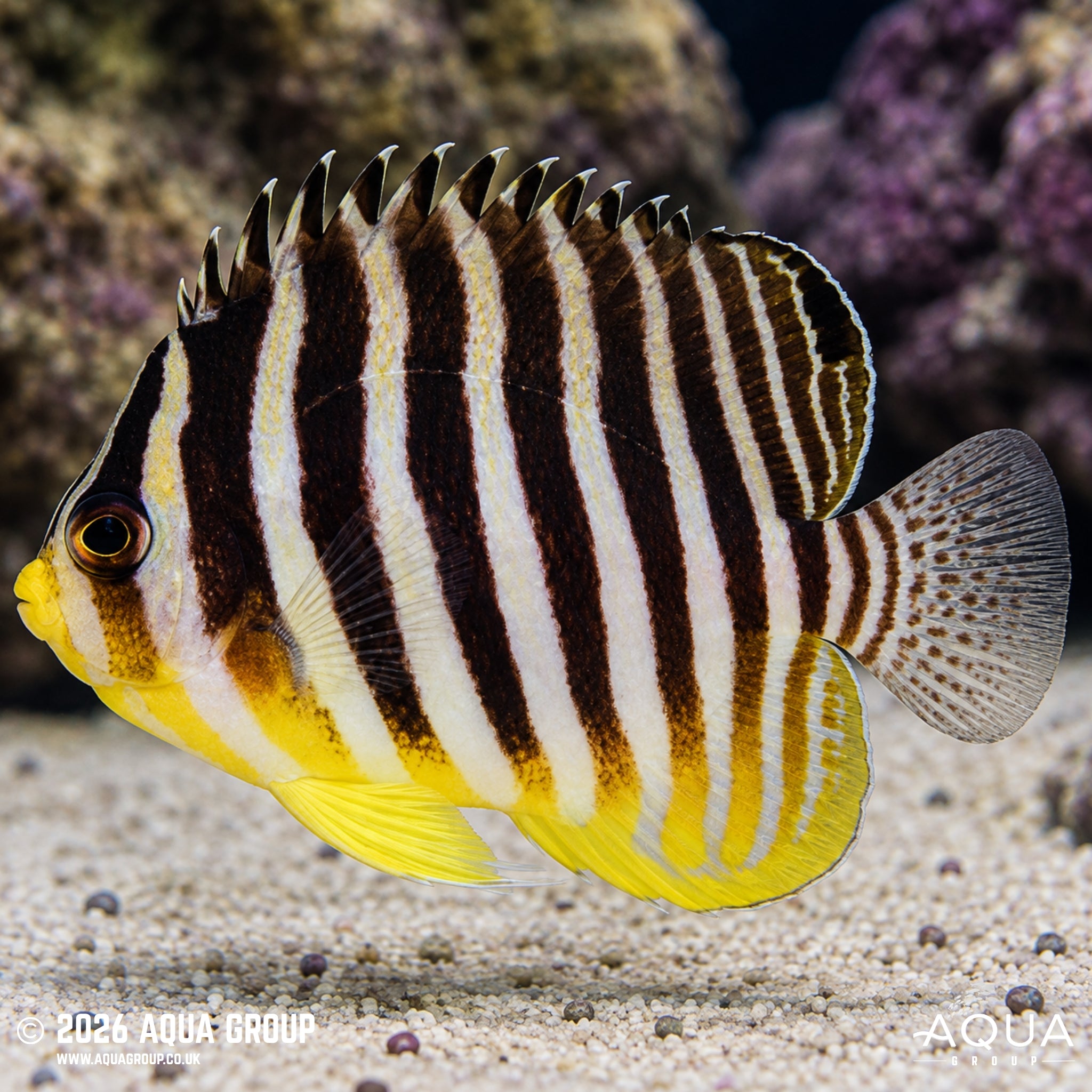
Yellow Multibar Angelfish (Centropyge multifasciata)
The Yellow Multibar Angelfish, Centropyge multifasciata, is a beautifully patterned dwarf marine angelfish recognised by its creamy white body, numerous dark vertical bands and contrasting yellow mouth, underside and lower fins. Still widely known in the aquarium trade as Paracentropyge multifasciata, it is also called the Multibarred Angelfish, Many-banded Angelfish or Barred Angelfish. This secretive Indo-Pacific reef species naturally remains close to caves, ledges and shaded crevices, where it grazes algae, sponges, tunicates and small invertebrates. Although peaceful compared with many marine angelfish, it can be difficult to establish and is best suited to a mature aquarium managed by an experienced fishkeeper.
Common Name:
Yellow Multibar Angelfish, Multibar Angelfish, Multibarred Angelfish, Many-banded Angelfish, Barred Angelfish, Multibanded Pygmy Angelfish.
Scientific Name (Latin):
Centropyge multifasciata
Widely listed in the aquarium trade as Paracentropyge multifasciata.
Maximum Size:
Usually around 10–12 cm when fully grown.
Water Type:
Marine
Origin / Natural Habitat:
Indo-Pacific, ranging from the eastern Indian Ocean and Cocos Islands eastwards through Southeast Asia and the western Pacific to the Society Islands, north to southern Japan and south to the Great Barrier Reef.
Multibar Angelfish inhabit clear lagoon reefs and steep outer reef slopes, usually around caves, ledges, overhangs and narrow crevices. They are highly secretive and normally remain close to shelter, often occurring as pairs or small social groups.
The “Yellow” designation is an aquarium trade description rather than a recognised geographical strain. Yellow colour around the mouth, belly, pelvic fins and anal fin is a normal feature of the species and can vary in intensity.
Water Parameters:
Temperature: 23–26°C
pH Range: 8.1–8.4
Hardness or Salinity: Marine salinity 1.023–1.026 specific gravity; stable salinity, alkalinity, strong oxygenation and consistently excellent water quality are essential.
Temperament:
Generally peaceful, shy and less aggressive than many dwarf angelfish. It is best housed with calm but confident reef fish that will not chase it or prevent it from feeding.
Established specimens may defend their chosen cave from similar dwarf angelfish. Avoid combining several Centropyge species unless the aquarium is large, extensively structured and introductions are carefully managed.
Diet:
Omnivorous specialist reef browser. In the wild, Multibar Angelfish graze algae, sponges, tunicates, coral-associated material, small crustaceans and other organisms from shaded reef surfaces.
In the aquarium, offer specialist marine angelfish foods containing sponge material, enriched mysis shrimp, Artemia, finely chopped clam, mussel and prawn, spirulina, marine algae and small high-quality pellets. Live copepods, live Artemia or foods pressed into crevices may help encourage a newly introduced specimen to feed.
Provide at least three small meals daily during acclimation. Natural grazing from mature live rock is highly beneficial and may be essential for specimens that are initially reluctant to accept prepared foods.
Minimum Tank Size:
A minimum aquarium volume of approximately 250 litres is recommended for one adult, with extensive mature live rock, numerous shaded caves and sufficient grazing surfaces. A larger aquarium of at least 350 litres is preferable for a compatible pair or when keeping it with another dwarf angelfish.
Behaviour & Activity:
A shy, deliberate reef fish that spends much of its time close to caves, overhangs and narrow rock crevices. It may swim vertically or upside down beneath ledges while grazing and commonly retreats immediately when startled.
Newly introduced specimens may remain hidden for extended periods and often become more visible during subdued lighting or at feeding time. A well-settled individual may gradually become confident but usually remains closely associated with secure rockwork.
Multibar Angelfish may occur in pairs or small harems in nature. Like other dwarf angelfish, they are protogynous hermaphrodites, with females capable of transitioning into males when social conditions allow.
Reef Safe:
Reef Safe with Caution
Multibar Angelfish may nip soft corals, large-polyp and small-polyp stony corals, zoanthids, clam mantles, sponges and tunicates. Some individuals coexist successfully with established corals, while others become persistent browsers.
Their natural dependence on sponge, tunicate and encrusting reef foods means complete coral safety cannot be guaranteed. The species is most predictable in a mature FOWLR aquarium or a carefully monitored reef where occasional coral nipping can be accepted.
Special Requirements or Care Notes:
Introduce only to a mature, biologically established aquarium containing abundant live rock, natural algal growth and shaded grazing surfaces. Sterile aquariums and bare quarantine systems can make feeding establishment particularly difficult.
Select only an alert specimen with a rounded body profile and no damage around the mouth. Whenever possible, confirm that it is eating prepared food before purchase. This species has a history of refusing food after import and can lose body condition quickly.
Provide numerous deep caves, shaded ledges and narrow retreats. Initially dimming the aquarium lighting can help a new specimen settle before normal illumination is restored gradually.
Offer varied foods several times daily and place some food close to the fish’s shelter. Monitor the abdomen and area behind the head closely for weight loss. Avoid boisterous, aggressive or extremely fast-feeding tank mates.
An acclimation box may be useful when introducing it to an aquarium containing established angelfish. Quarantine should be managed carefully, with suitable shelter and established grazing material where practical. Slow acclimation is recommended, and copper treatment should only be used when clearly required and carefully monitored.
Suitable for:
Experienced fishkeepers
Availability:
Rare or occasional in trade / Captive-bred where available
All images are a visual representation of the fish you will receive, made to be as accurate as possible. Please note that Mother Nature is a wonderful thing, and variation in patterns and colours will occur — that is part of the unique beauty of these animals.
Order and get 95 reward points
Earn points by signing up for our rewards program