
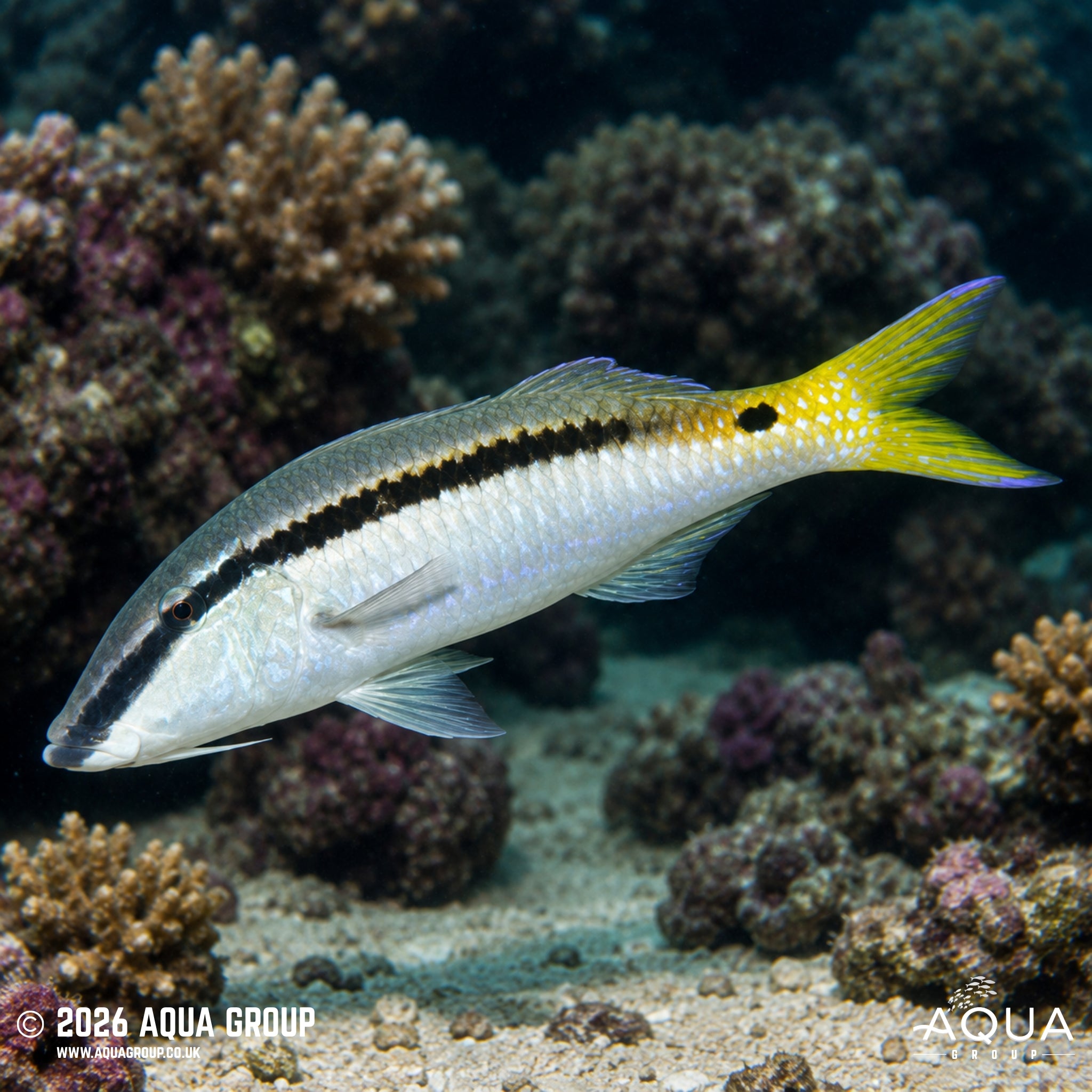

Description
Minstrel Goatfish (Parupeneus rubescens)
The Minstrel Goatfish (Parupeneus rubescens) is an unusual and active Indo-West Pacific marine fish recognised by its elongated body, variable rosy-red to grey-brown coloration and pair of sensitive chin barbels. Also known as the Rosy Goatfish, it uses these specialised barbels to probe sand and sediment for crustaceans, worms and other hidden prey. Its constant searching behaviour makes it fascinating to observe, but its large adult size, predatory diet and tendency to disturb the substrate mean it requires an exceptionally spacious fish-only or robust marine aquarium.
Common Name:
Minstrel Goatfish, Rosy Goatfish
Scientific Name (Latin):
Parupeneus rubescens
Maximum Size:
Up to approximately 43 cm in total length, although around 23 cm is more commonly recorded in the wild. Aquarium accommodation should be planned around a large, powerful adult rather than the size at which juveniles are offered.
Water Type:
Marine
Origin / Natural Habitat:
Widely distributed throughout the Indo-West Pacific, from the Red Sea and Persian Gulf southwards along East Africa to South Africa, and eastwards into the western Pacific.
It inhabits sandy and silty coastal bottoms, sheltered bays, reef margins and murkier marine habitats. Individuals spend much of their time close to the seabed, using their chin barbels to detect prey concealed beneath the substrate.
Water Parameters:
Temperature: 23–27°C
pH Range: 8.1–8.4
Salinity: 1.020–1.025 SG
Temperament:
Generally peaceful towards fish too large to be eaten, but strongly predatory towards small fish and mobile invertebrates.
The Minstrel Goatfish is not usually territorial in the same manner as many large reef predators, but its constant foraging and substantial adult size may disturb shy or bottom-dwelling tank mates. Small gobies, blennies, ornamental shrimps, crabs and other animals that can be swallowed should be considered at risk.
Diet:
A carnivorous bottom feeder that naturally consumes crustaceans, worms, molluscs and other benthic animals detected beneath sand and sediment.
In the aquarium, offer a varied diet of chopped prawn, mussel, clam, cockle, squid, krill, mysis shrimp and pieces of marine fish. Sinking carnivore pellets may also be accepted once the fish is settled.
Food should be distributed close to the substrate to encourage natural searching behaviour. Feed juveniles two or three modest meals daily, while larger adults can be maintained on controlled portions appropriate to their body condition.
Minimum Tank Size:
A minimum aquarium volume of approximately 1,000 litres is recommended for long-term care, with a long, wide footprint and a substantial open sand area.
A considerably larger aquarium is preferable for a fully grown adult or when the fish is maintained alongside other large, active marine species.
Behaviour & Activity:
An active daytime forager that spends most of its time swimming close to the aquarium floor and probing the substrate with its two chin barbels.
The barbels contain sensory structures that allow the fish to locate crustaceans, worms and other prey hidden beneath sand or silt. During feeding, it may disturb significant areas of substrate and create clouds of fine sediment.
It requires extensive open bottom space as well as caves and overhangs for shelter. Although frequently seen near the substrate, it is also a capable swimmer and needs an unobstructed aquarium footprint.
Reef Safe:
Not Reef Safe
The Minstrel Goatfish does not primarily feed on coral tissue, but it is unsuitable for a conventional reef aquarium. Ornamental shrimps, crabs, small snails, worms, brittle stars and small fish may be eaten.
Its persistent substrate searching can bury low-positioned corals, overturn loose coral pieces and disturb established sand-bed communities. It is best maintained in a large fish-only or fish-only-with-live-rock aquarium.
Special Requirements or Care Notes:
Provide a broad area of fine to medium marine sand that allows the fish to search naturally without damaging its barbels. Avoid sharp, coarse gravel that may cause abrasions around the mouth and chin.
Rockwork must be stable and positioned directly on the aquarium base or secure supports. Goatfish may undermine loose structures while probing and moving the substrate.
Powerful biological filtration, efficient protein skimming and strong oxygenation are essential. This large carnivorous fish produces a considerable waste load and may release fine debris into the water while feeding.
Mechanical filtration should be maintained regularly to remove suspended sediment and uneaten food. Moderate to strong circulation is useful, but calmer areas should remain available near the substrate.
Choose tank mates that are robust and too large to swallow. Avoid delicate bottom dwellers, ornamental crustaceans and aggressive fish likely to damage the goatfish’s sensitive barbels.
Select an alert specimen with intact barbels, clear eyes, normal breathing and a full body profile. Damaged or shortened barbels may impair natural feeding behaviour.
A securely covered aquarium is recommended, particularly during transport, introduction and periods of disturbance.
Suitable for:
Experienced fishkeepers
Availability:
Rare or occasional in trade
All images are a visual representation of the fish you will receive, made to be as accurate as possible. Please note that Mother Nature is a wonderful thing, and variation in patterns and colours will occur — that is part of the unique beauty of these animals.
Order and get 25 reward points
Earn points by signing up for our rewards program