

Description
Michael’s Pistol Shrimp (Alpheus soror)
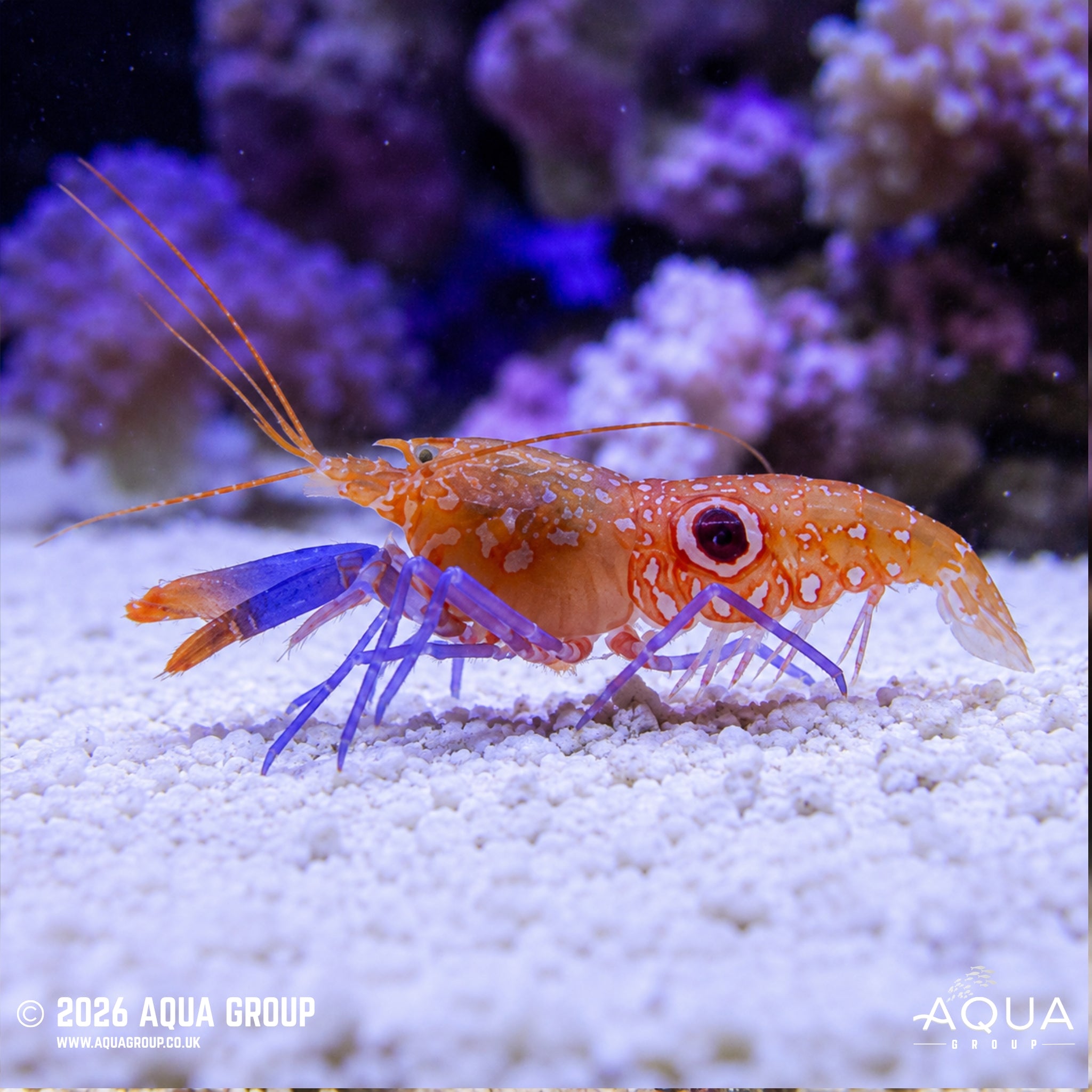
Michael’s Pistol Shrimp, Alpheus soror, is a colourful marine snapping shrimp recognised by its contrasting orange-yellow body, purple to blue-toned legs and claws, and distinctive dark circular marking on the abdomen. Also known as the Bullseye Pistol Shrimp, Blue-spot Snapping Shrimp or Soror Pistol Shrimp, it uses one greatly enlarged claw to create a rapid cavitation snap for defence, communication and the capture of small prey. This secretive Indo-West Pacific crustacean spends much of its time beneath rockwork or inside a sheltered retreat. Its unusual colouration, scavenging behaviour and fascinating snapping ability make it an appealing reef aquarium animal, although small invertebrates and unstable rockwork require careful consideration.
Common Name:
Michael’s Pistol Shrimp, Bullseye Pistol Shrimp, Soror Pistol Shrimp, Blue-spot Snapping Shrimp, Spot Snapping Shrimp.
Scientific Name (Latin):
Alpheus soror
Maximum Size:
Usually around 3–5 cm in body length when fully grown, excluding the extended antennae.
Water Type:
Marine
Origin / Natural Habitat:
Indo-West Pacific, with the species originally described from Sri Lanka. Aquarium and marine-life records also associate it with tropical reef regions farther east within the Indo-Pacific.
Michael’s Pistol Shrimp is a free-living snapping shrimp associated with reef rock, rubble and sheltered seabed habitats. It occupies natural cavities or excavated retreats beneath rockwork where it can remain protected while searching the surrounding substrate for food.
Water Parameters:
Temperature: 24–28°C
pH Range: 8.1–8.4
Hardness or Salinity: Marine salinity 1.023–1.026 specific gravity; maintain stable salinity, alkalinity and consistently good water quality. Avoid copper-based medications.
Temperament:
Generally secretive but territorial and opportunistic. Michael’s Pistol Shrimp normally remains close to its shelter and uses its enlarged snapping claw when threatened or when defending its territory.
It may attack very small shrimps, crabs or other animals entering its retreat. More than one pistol shrimp should not normally be kept in a confined aquarium unless they are known to be compatible and have sufficient separated territories.
Diet:
Omnivorous scavenger and opportunistic micro-predator. In the aquarium, it consumes leftover fish food, detritus, small crustaceans, worms and other edible organic material found around the substrate and rockwork.
Offer enriched mysis shrimp, finely chopped marine prawn, krill, clam, mussel, sinking crustacean pellets and small pieces of marine algae-based food. Target feeding near the entrance to its shelter during the evening can help ensure it receives enough food.
Minimum Tank Size:
A minimum aquarium volume of approximately 75 litres is recommended for one adult, provided the aquarium is mature and contains secure rockwork, suitable substrate and several sheltered crevices. A larger aquarium reduces territorial conflict and provides more natural foraging opportunities.
Behaviour & Activity:
A secretive bottom-dwelling shrimp that spends much of its time beneath rockwork, inside caves or within a self-maintained retreat. It may move sand, small stones, shell fragments and coral rubble while modifying the entrance to its shelter.
One front claw is greatly enlarged and specially adapted to produce a powerful snap. The rapid claw movement creates a high-speed water jet and collapsing cavitation bubble, producing the characteristic clicking sound associated with pistol shrimps.
Snapping may be heard during feeding, territorial defence or after the aquarium lights dim. Occasional clicking is normal and does not necessarily indicate that the shrimp is trapped or attacking another animal.
Unlike several commonly sold prawn-goby pistol shrimps, Alpheus soror is considered free living. It should not be purchased with the expectation that it will form a symbiotic partnership with a goby.
Reef Safe:
Reef Safe
Michael’s Pistol Shrimp does not normally consume healthy coral tissue and is generally compatible with established corals. However, very small ornamental shrimps, tiny crabs, worms and other delicate invertebrates may be attacked if they enter its territory.
Its digging and rearranging behaviour may undermine unsecured rockwork, cover low-positioned corals with sand or move loose coral frags and rubble.
Special Requirements or Care Notes:
Position the main rockwork securely on the aquarium base before adding the substrate. Do not balance heavy rocks loosely on sand, as the shrimp may excavate beneath them and cause unstable structures to shift or collapse.
Provide fine marine sand mixed with small pieces of shell and coral rubble that the shrimp can move while constructing or modifying its retreat. Include caves and shaded crevices where it can remain concealed.
Do not assume this species will pair with a prawn goby. It was described as a free-living snapping shrimp, and a compatible goby partnership is not considered a normal requirement for its care.
Target feed near its shelter after the aquarium lights dim. Regular supplementary feeding can reduce competition and discourage excessive predatory behaviour, although small invertebrates can never be considered completely safe.
Avoid keeping it with triggerfish, puffers, hawkfish, larger predatory wrasses and other crustacean-eating fish. Very small decorative shrimps and crabs should also be avoided.
Acclimate slowly because marine crustaceans are sensitive to sudden changes in salinity and water chemistry. Never expose the shrimp to copper-based medication. Iodine should not be added solely to encourage moulting unless dosing is supported by accurate testing.
The shrimp is particularly vulnerable after moulting, when its new shell remains soft. Provide deep, protected retreats and do not disturb the rockwork in an attempt to locate it. An empty shell may be a discarded moult rather than a dead shrimp.
Protect pump and overflow intakes, and use a secure aquarium cover. Be cautious when moving rockwork because the shrimp may remain concealed inside a small cavity and can produce a startling snap when disturbed.
Suitable for:
Intermediate marine fishkeepers
Availability:
Rare or occasional in trade
All images are a visual representation of the animal you will receive, made to be as accurate as possible. Please note that Mother Nature is a wonderful thing, and variation in patterns and colours will occur — that is part of the unique beauty of these animals.
Order and get 69 reward points
Earn points by signing up for our rewards program