

Description
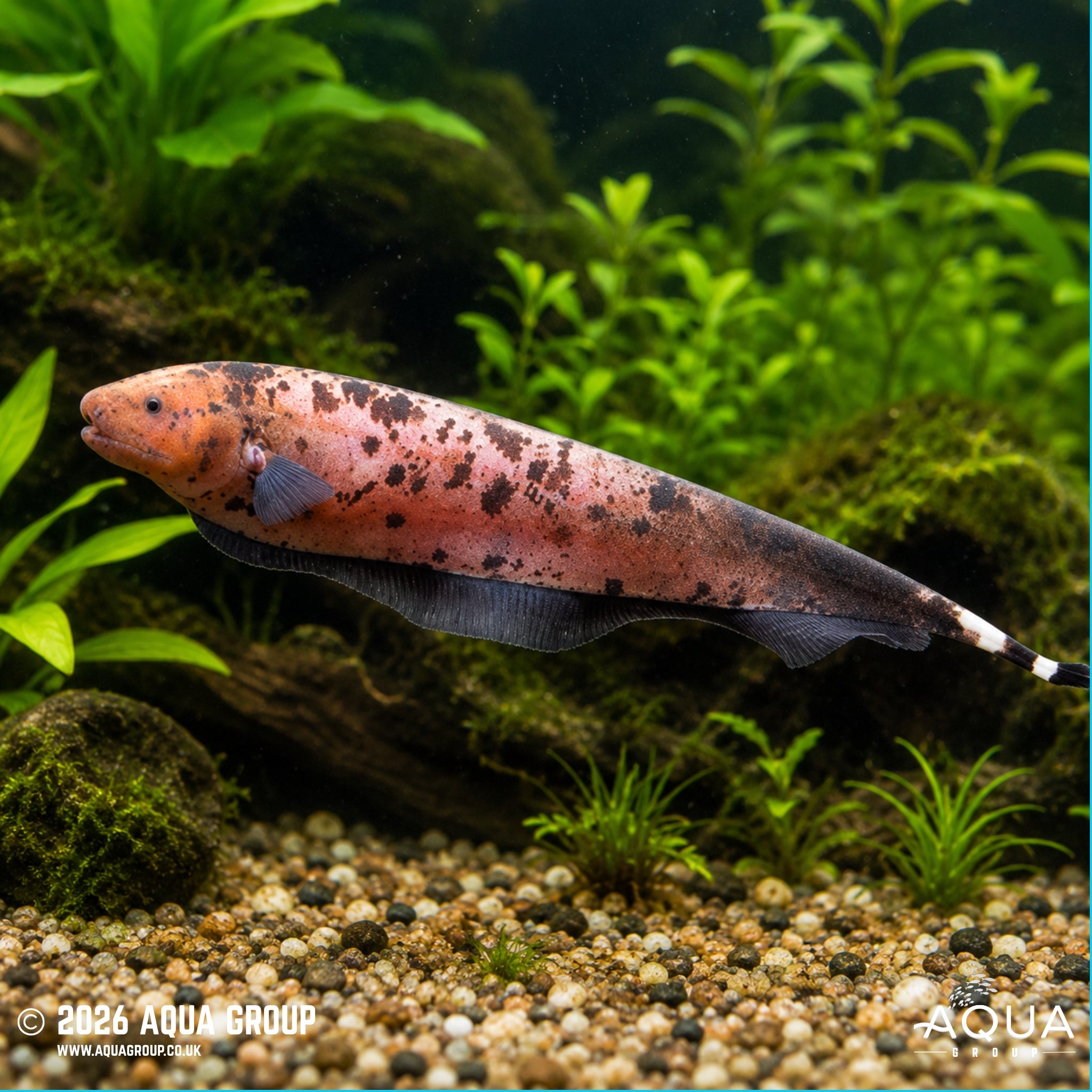
Marble Ghost Knife Fish (Apteronotus albifrons)
The Marble Ghost Knife Fish, Apteronotus albifrons, is a distinctive South American freshwater fish recognised by its elongated body, flowing anal fin and unusual ghost-like swimming style. Also known more widely as the Black Ghost Knifefish, this nocturnal species uses a weak electrical field to navigate, communicate and locate prey in dark or complex environments. Its smooth forward, backward and hovering movements make it one of the most fascinating large freshwater fish available to aquarists. Although generally peaceful towards suitably sized tank mates, its substantial adult size, nocturnal feeding habits and specialist sensory behaviour make it best suited to experienced fishkeepers with a large, mature aquarium.
Common Name:
Marble Ghost Knife Fish, Black Ghost Knifefish, Black Ghost Knife Fish, Ghost Knife Fish.
Scientific Name (Latin):
Apteronotus albifrons
Maximum Size:
Capable of reaching approximately 50 cm in total length when fully grown.
Water Type:
Freshwater
Origin / Natural Habitat:
South America, with a broad distribution extending from Venezuela through the Amazon basin and southwards towards Paraguay and the Paraná River system.
Black Ghost Knifefish inhabit tropical freshwater environments including creeks and river systems, with records from rapidly flowing waters over sandy substrates. They remain close to cover during daylight and become considerably more active after dark.
Water Parameters:
Temperature: 23–28°C
pH Range: 6.0–8.0
Hardness or Salinity: Approximately 5–19°dGH; soft to moderately hard freshwater is suitable, although stable conditions and excellent water quality are particularly important.
Temperament:
Generally peaceful towards unrelated fish but potentially territorial towards other knifefish and electrically active species.
Adults may consume fish small enough to fit into the mouth, particularly during nocturnal hunting. Very small tetras, rasboras, fry and shrimps should therefore not be considered safe tank mates.
Avoid aggressive cichlids and persistent fin-nipping species that may damage the delicate body or continuously disturb the fish while resting.
Diet:
Carnivorous micro-predator. In the wild, Apteronotus albifrons feeds on insect larvae and other small aquatic animals detected using its highly developed electrical sensory system.
In the aquarium, offer frozen or live bloodworms, mysis shrimp, Artemia, chopped prawns, krill, earthworms and other appropriately sized meaty foods. Larger adults may also accept pieces of mussel, clam and marine prawn.
High-quality carnivore pellets may be accepted once the fish is established, but some newly imported specimens initially respond more readily to live or frozen foods.
Feed primarily during the evening or shortly after the aquarium lights are dimmed. Food can be delivered close to the fish’s chosen shelter using feeding tongs or a pipette.
Minimum Tank Size:
A minimum aquarium volume of approximately 500 litres is recommended for one adult, with a long aquarium footprint, substantial open swimming space and several large sheltered retreats.
Larger accommodation is preferable for a fully grown specimen, particularly when maintained with other large community fish.
Behaviour & Activity:
A predominantly nocturnal fish that spends much of the daytime concealed beneath wood, inside caves or within shaded sections of the aquarium.
After dark, the Marble Ghost Knife Fish becomes considerably more active and glides through the aquarium while searching for food. It propels itself using continuous wave-like movements of the long anal fin, allowing extremely precise forward, backward and hovering movements.
Unlike most aquarium fish, Apteronotus albifrons possesses a weak electric organ. It generates a continuous low-voltage electrical field around the body and detects disturbances in that field using specialised electroreceptors.
This electrical sensory system allows the fish to navigate and locate objects or prey in darkness and in habitats where visibility is poor. The electrical discharge is weak and harmless to aquarists.
Aquarium Category:
Semi-Aggressive
Marble Ghost Knife Fish can be maintained in a carefully planned large community aquarium containing peaceful or moderately assertive fish that are too large to be swallowed.
Suitable companions may include larger peaceful tetras, silver dollars, Geophagus, peaceful medium-sized cichlids, larger Corydoras, robust plecos and other calm species with compatible water requirements.
Very small fish and shrimps may eventually be eaten.
Special Requirements or Care Notes:
Provide several large, dark retreats using driftwood, smooth caves, pipes or dense planting. The fish should always have access to a shelter large enough to accommodate its entire body comfortably.
Avoid transparent tubes as the only available shelter. Although these are sometimes used to make knifefish visible during the day, secure shaded retreats are important for reducing long-term stress.
Use a soft sand substrate and avoid sharp gravel or abrasive decorations. The fish has delicate skin and may injure itself when squeezing between rough rocks or decorations.
Maintain excellent water quality through oversized biological filtration, regular partial water changes and good oxygenation. Large adults produce a substantial waste load and do poorly in unstable or poorly maintained aquariums.
Provide moderate water movement but ensure quiet areas are available for resting. Wild fish can occur in flowing environments, but continuous powerful current throughout the entire aquarium is unnecessary.
Use subdued lighting and provide floating plants, wood or tall vegetation to create shaded areas. Sudden bright lighting may cause the fish to retreat rapidly or collide with aquarium structures.
Introduce food after lights-out while newly acquired specimens acclimate. Once established, many individuals learn feeding routines and may become confident enough to emerge during daylight.
Avoid keeping multiple Black Ghost Knifefish together in ordinary home aquariums. Their electrical signals and territorial behaviour may result in chronic stress or aggression unless the system is exceptionally large.
Electrical interference from other weakly electric fish may also affect behaviour, so combining several electric fish species should only be attempted by experienced keepers.
Select only a specimen with smooth skin, clear eyes, an intact tail region and a well-filled body. White patches, abrasions, rapid breathing or a hollow abdomen can indicate poor condition.
Black Ghost Knifefish are scaleless and can be sensitive to certain aquarium medications. Avoid full-strength treatments unless they are known to be suitable for scaleless fish, and always follow carefully measured treatment instructions.
A secure aquarium cover is essential. Knifefish can escape through surprisingly small openings, particularly when startled or exploring after dark.
Suitable for:
Experienced freshwater fishkeepers
Availability:
Occasional in trade
All images are a visual representation of the fish you will receive, made to be as accurate as possible. Please note that Mother Nature is a wonderful thing, and variation in patterns and colours will occur — that is part of the unique beauty of these animals.
Order and get 13 reward points
Earn points by signing up for our rewards program