

Description
Lyretail Hogfish (Bodianus anthioides)
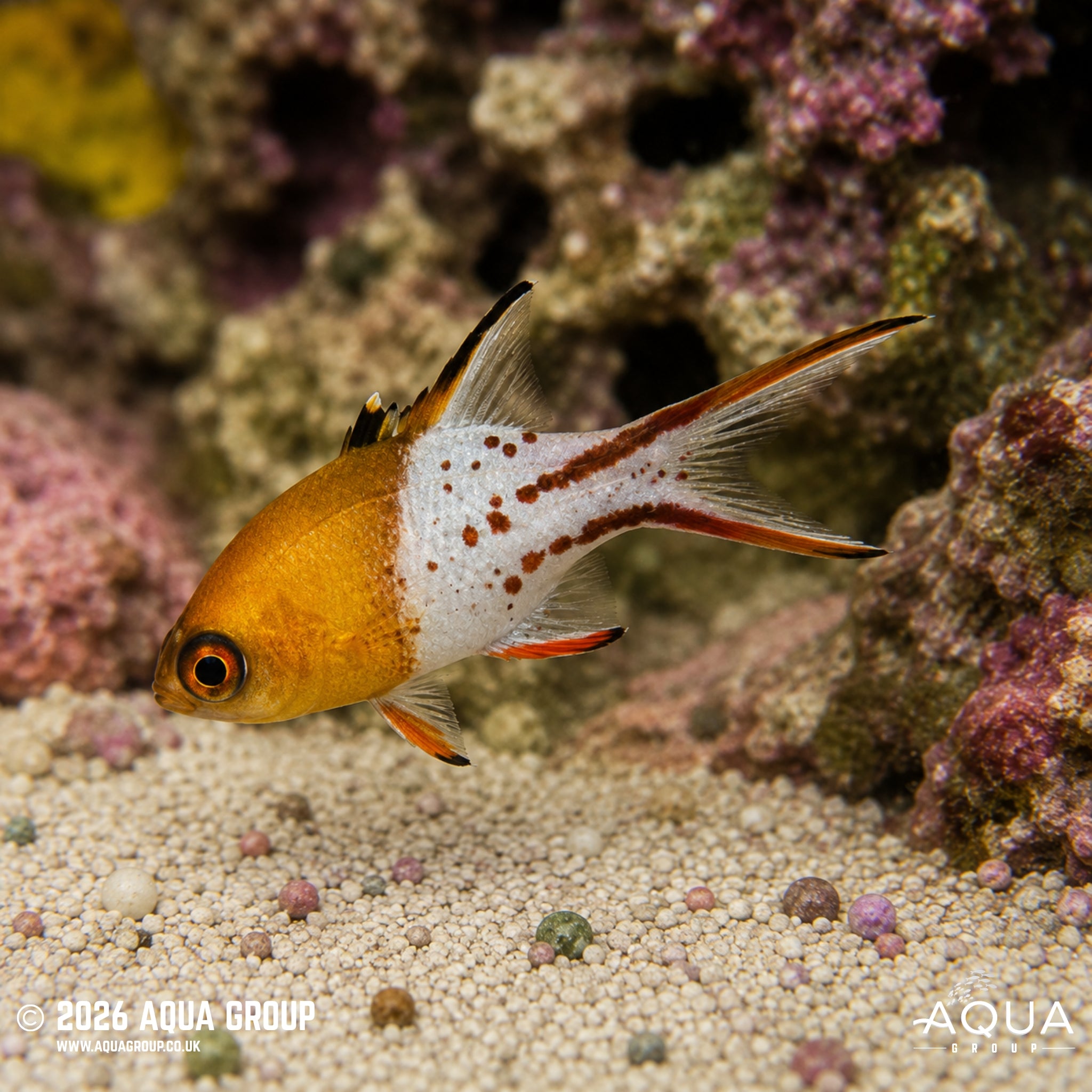
The Lyretail Hogfish, Bodianus anthioides, is a striking Indo-Pacific marine wrasse recognised by its dark reddish-brown front half, contrasting pale rear body and deeply forked, lyre-shaped tail. Also known as the Lyretail Pigfish or Black-and-White Hogfish, it inhabits coral-rich reef slopes and deeper offshore reef habitats where it searches rockwork for crustaceans, molluscs and other small invertebrates. Juveniles are attractive and relatively reserved, but adults become larger, bolder and increasingly predatory, making this species best suited to a spacious fish-only or carefully planned reef aquarium with robust tank mates.
Common Name:
Lyretail Hogfish, Lyretail Hog, Lyretail Pigfish, Black-and-White Hogfish.
Scientific Name (Latin):
Bodianus anthioides
Maximum Size:
Usually around 20–24 cm when fully grown.
Water Type:
Marine
Origin / Natural Habitat:
Widely distributed throughout the tropical Indo-Pacific, from the Red Sea and East African coast eastwards through the Indian Ocean and western Pacific to island groups of the central Pacific. Lyretail Hogfish inhabit clear coral and rocky reefs, particularly steep outer reef slopes, drop-offs and deeper reef habitats. They are frequently found close to caves, ledges and coral formations at depths of approximately 6–60 metres.
Water Parameters:
Temperature: 24–28°C
pH Range: 8.1–8.4
Hardness or Salinity: Marine salinity 1.023–1.026 specific gravity; stable salinity, alkalinity, strong oxygenation and efficient filtration are important.
Temperament:
Semi-aggressive and increasingly territorial with maturity. Juveniles may initially appear shy, but established adults can become assertive towards smaller, timid or similarly shaped fish. They are generally best housed with robust, suitably sized marine species and should not be mixed with very small gobies, dartfish or other fish that may be intimidated or viewed as prey. Only one hogfish is recommended unless a compatible pair is obtained for a very large aquarium.
Diet:
Carnivorous benthic predator. In the wild, the Lyretail Hogfish feeds on crustaceans, molluscs, worms, echinoderms and other small reef invertebrates collected from rockwork and the substrate. In the aquarium, offer a varied diet of enriched mysis shrimp, krill, chopped prawn, clam, mussel, squid, marine fish flesh and quality sinking carnivore pellets. Feed juveniles once or twice daily, with controlled portions for adults to prevent obesity and excessive waste production.
Minimum Tank Size:
A minimum aquarium volume of approximately 400 litres is recommended for one adult, with a long swimming area and substantial mature rockwork. Larger accommodation is preferable when keeping the species with other active or territorial marine fish.
Behaviour & Activity:
An active daytime wrasse that patrols the lower and middle areas of the aquarium while inspecting live rock, caves and the substrate for food. Juveniles may remain close to shelter when first introduced, while adults usually become confident and highly visible. Lyretail Hogfish do not normally bury themselves in sand to sleep, instead retreating into caves or rock crevices at night or when alarmed.
Reef Safe:
Reef Safe with Caution
Lyretail Hogfish do not normally consume coral tissue, but ornamental shrimps, crabs, snails, small hermit crabs, tubeworms and other mobile invertebrates may be hunted or eaten. Large established invertebrates may be tolerated, but compatibility becomes less reliable as the fish matures. Small fish may also be at risk from a large adult.
Special Requirements or Care Notes:
Provide a mature aquarium with extensive secure rockwork, caves and open swimming space. Rock structures should be firmly positioned because larger adults may move loose rubble while searching for food. Choose robust tank mates that are too large to swallow and avoid small, shy or slow-feeding species. Introduce the Lyretail Hogfish after more peaceful fish have become established, as it may dominate newly added tank mates. A tightly fitting cover is essential because hogfish can jump when startled. Monitor ornamental invertebrates carefully and do not assume that a juvenile which ignores them will remain trustworthy as an adult.
Suitable for:
Intermediate to experienced fishkeepers
Availability:
Rare or occasional in trade
All images are a visual representation of the fish you will receive, made to be as accurate as possible. Please note that Mother Nature is a wonderful thing, and variation in patterns and colours will occur — that is part of the unique beauty of these animals.
Order and get 53 reward points
Earn points by signing up for our rewards program