
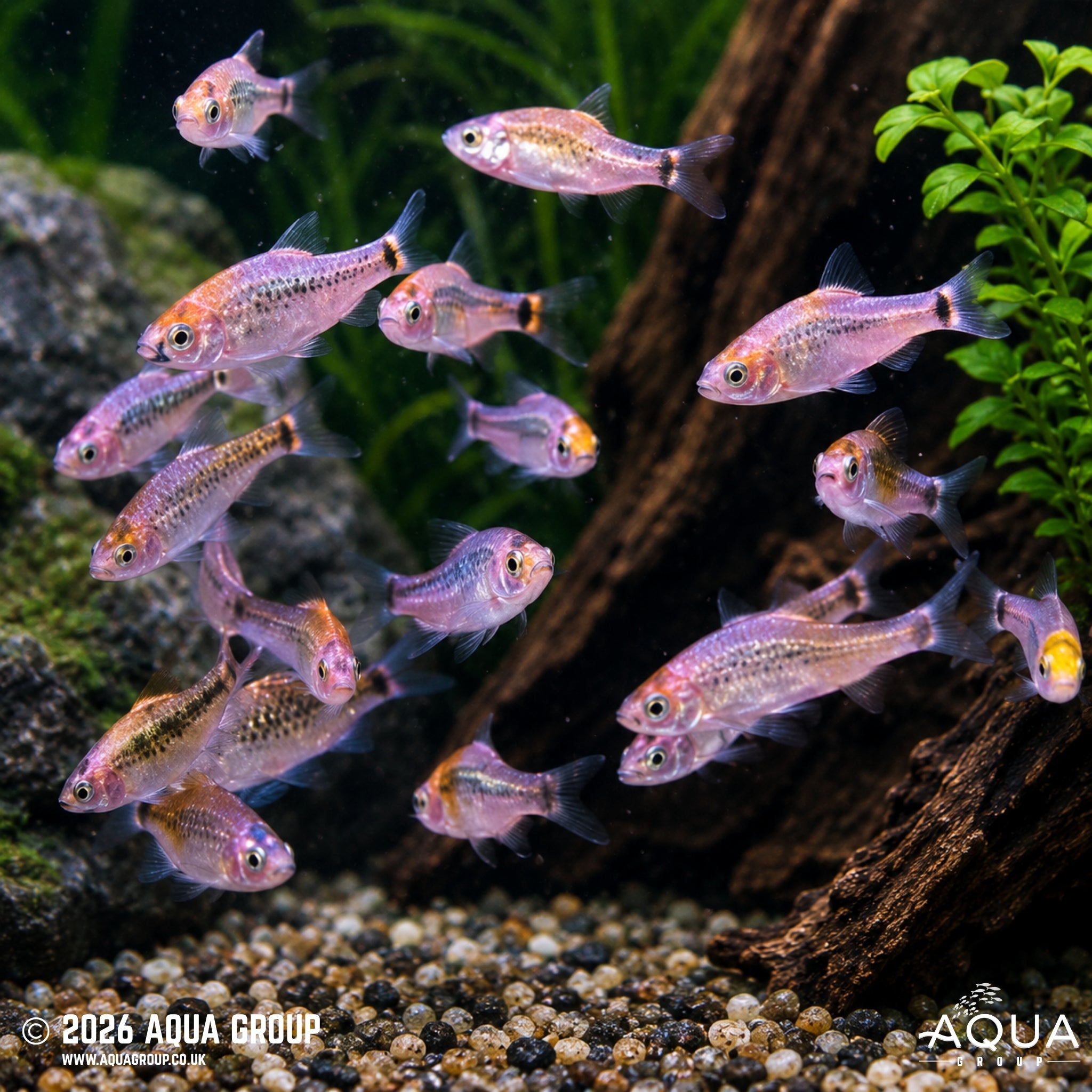

Description
Koi Golden Barb (Barbodes semifasciolatus)
The Koi Golden Barb, Barbodes semifasciolatus, is a colourful captive-bred form of the Gold Barb, selected for bright golden-yellow colour with variable orange, red, white or koi-like patterning depending on the strain and individual fish. Also known as the Golden Barb, Chinese Barb, Schuberti Barb or Gold Barb, this peaceful shoaling species is a hardy and active choice for planted community aquariums. It is best kept in groups, where its colour, movement and calm barb behaviour can be properly appreciated.
Common Name:
Koi Golden Barb, Golden Barb, Gold Barb, Chinese Barb, Schuberti Barb, Half-banded Barb.
Scientific Name (Latin):
Barbodes semifasciolatus
Formerly known as Puntius semifasciolatus, Barbus semifasciolatus and Barbus schuberti.
Maximum Size:
Usually around 6–7 cm in aquariums, with some references recording up to around 7.5 cm.
Water Type:
Freshwater
Origin / Natural Habitat:
The koi golden form is captive-bred and does not occur as a natural wild population. The wild species is naturally a greenish to yellowish barb from East and Southeast Asia, including southern China and northern Viet Nam, where it occurs in freshwater rivers, streams, canals and vegetated areas with gentle to moderate flow. The gold form is long-established in the aquarium trade and is now far more commonly seen than the wild-type fish.
Water Parameters:
Temperature: 18–24°C
pH Range: 6.0–8.0
Hardness or Salinity: Soft to moderately hard freshwater; adaptable, but best in stable, clean, well-filtered water.
Temperament:
Peaceful, active and sociable. Koi Golden Barbs are generally much calmer than many larger or more boisterous barbs. They should be kept in a group, as single fish or pairs may become nervous or behave less naturally.
Diet:
Omnivorous forager. In nature, Barbodes semifasciolatus feeds on small insects, worms, crustaceans, plant matter, algae and detritus. In the aquarium, offer quality flakes, small pellets, granules, frozen daphnia, brineshrimp, cyclops, bloodworm and occasional vegetable or spirulina-based foods. A varied diet helps maintain colour, condition and activity.
Minimum Tank Size:
A minimum of 90 litres is recommended for a group, with larger aquariums preferred for a bigger shoal or mixed community setup. A longer aquarium with open swimming space is better than a small tall tank.
Behaviour & Activity:
An active mid-water shoaling fish that spends much of its time swimming in open areas, exploring plants and foraging around the aquarium. Keep at least 6 individuals, with 8–10 or more preferred for confidence and natural behaviour. Males may show stronger colour and display activity when settled, while females are often fuller-bodied.
Aquarium Category:
Community Fish
Suitable with peaceful community fish such as danios, rasboras, medium tetras, other calm barbs, Corydoras, peaceful loaches, gouramis, rainbowfish and non-aggressive catfish. Avoid large predators, aggressive cichlids, very timid nano fish and persistent fin-nippers.
Special Requirements or Care Notes:
Keep in groups rather than singly or in pairs. Provide a mature aquarium with good filtration, open swimming space, plants, wood and shaded areas. This species prefers cooler tropical conditions and should not be kept long term in very warm aquariums. It is hardy once settled, but still needs regular water changes and stable water quality. Colour and koi patterning vary naturally between individuals and batches.
Suitable for:
Beginner to intermediate fishkeepers
Availability:
Common to occasional in trade / Captive-bred colour form
All images are a visual representation of the fish you will receive, made to be as accurate as possible. Please note that Mother Nature is a wonderful thing, and variation in patterns and colours will occur — that is part of the unique beauty of these animals.
Order and get 4 reward points
Earn points by signing up for our rewards program