

Description
Golden Crossback Shrimp (Neocaridina spp.)
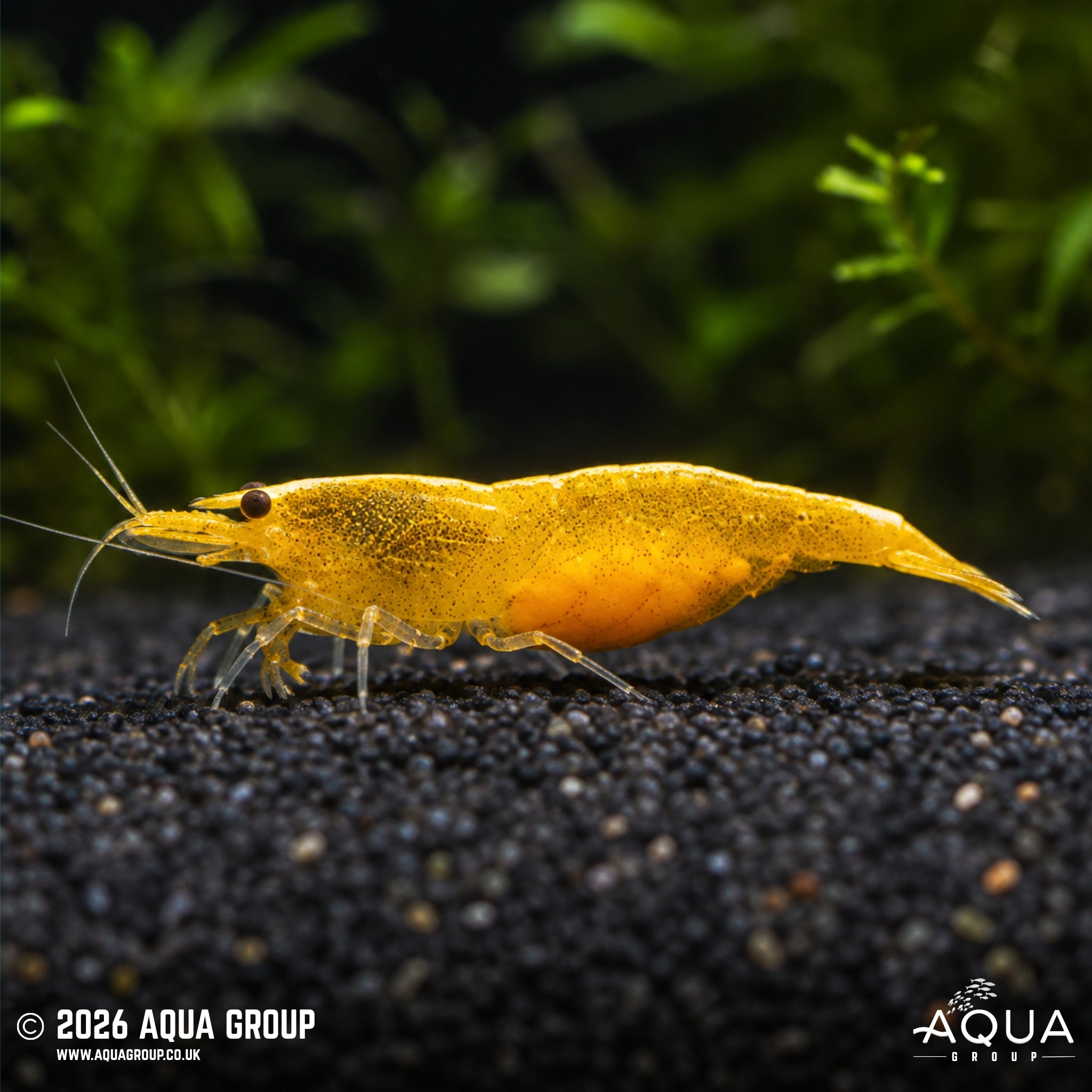
The Golden Crossback Shrimp, Neocaridina spp., is a bright selectively bred freshwater dwarf shrimp recognised by its vivid yellow body and contrasting golden stripe running along the back. Also known as the Golden Back Yellow Shrimp or Yellow Golden Back Shrimp, it is a colourful Neocaridina variety developed for ornamental aquariums. This peaceful grazing shrimp spends much of the day picking at biofilm, algae and microscopic food from plants, wood and hard surfaces. Its compact size, simple care requirements and willingness to breed in freshwater make it an excellent choice for planted aquariums and dedicated shrimp colonies.
Common Name:
Golden Crossback Shrimp, Golden Back Yellow Shrimp, Yellow Golden Back Shrimp, Goldenback Shrimp, Yellow Goldenback Neocaridina.
Scientific Name (Latin):
Neocaridina spp.
Most Golden Back Yellow shrimp in the aquarium trade are selectively bred forms of Neocaridina davidi.
Maximum Size:
Usually around 2.5–3 cm when fully grown, with adult females generally becoming larger and more heavily built than males.
Water Type:
Freshwater
Origin / Natural Habitat:
The Golden Crossback Shrimp is a selectively bred aquarium strain rather than a naturally occurring wild colour form.
Its wild Neocaridina ancestors originate from freshwater habitats in East Asia, where they inhabit slow-moving streams, ponds, ditches and vegetated waterways containing leaf litter, submerged plants, stones and extensive biofilm growth.
In the aquarium, they thrive in mature planted environments containing mosses, wood, leaves and other surfaces that support natural grazing.
Water Parameters:
Temperature: 18–26°C
pH Range: 6.5–8.0
Hardness or Salinity: Approximately 6–15°dGH and 3–10°dKH; stable mineral content is more important than achieving one exact value.
Temperament:
Very peaceful and sociable. Golden Crossback Shrimp do not harm fish, plants or other peaceful freshwater invertebrates.
They are best maintained in groups and become more confident when several individuals are present. They may hide frequently after introduction or during moulting but usually become highly visible once settled.
Diet:
Omnivorous grazer and scavenger. Golden Crossback Shrimp spend much of the day feeding on biofilm, soft algae, microorganisms, decaying plant matter and fine organic material.
Supplement natural grazing with high-quality shrimp pellets, algae wafers, spirulina foods, blanched vegetables and occasional protein-rich shrimp foods.
Feed sparingly. In a mature planted aquarium, natural biofilm provides an important part of the diet and excessive supplementary feeding can quickly reduce water quality.
Minimum Tank Size:
A minimum aquarium volume of approximately 20 litres is suitable for a small colony, provided the aquarium is fully cycled, mature and biologically stable.
Larger aquariums provide more stable water chemistry and are easier to maintain over the long term.
Behaviour & Activity:
An active grazing shrimp that spends much of its time walking across plants, mosses, wood, stones and aquarium glass while continuously picking at microscopic food.
Golden Crossback Shrimp are generally most visible in peaceful aquariums without predatory fish. They may gather together around food but do not normally show serious aggression towards one another.
Females become noticeably fuller than males and develop a visible saddle of eggs within the body before breeding. Once fertilised, the female carries eggs beneath the abdomen until fully developed miniature shrimp are released.
Breeding occurs entirely in freshwater and does not require a brackish larval stage. Young shrimp are miniature versions of the adults and immediately begin grazing on biofilm and microscopic foods.
Aquarium Category:
Community Shrimp
Golden Crossback Shrimp are suitable for peaceful planted community aquariums, although almost all fish are capable of eating newly hatched shrimp.
For the highest survival rate of juveniles, maintain them in a dedicated shrimp aquarium or alongside very small, peaceful species that are unlikely to hunt adult shrimp.
Special Requirements or Care Notes:
Introduce Golden Crossback Shrimp only to a fully cycled, biologically mature aquarium. Shrimp are sensitive to ammonia and nitrite, both of which should remain at zero.
Stability is more important than chasing exact water parameters. Avoid sudden changes in temperature, pH, hardness or dissolved mineral content.
Acclimate slowly, ideally using a drip-acclimation method, particularly when the water chemistry of the transport bag differs significantly from the aquarium.
Provide mosses, fine-leaved plants, driftwood, leaf litter and porous hardscape to create extensive grazing surfaces and secure hiding places.
Moulting shrimp are particularly vulnerable while the new shell remains soft. Provide dense plants and narrow refuges where freshly moulted individuals can remain protected.
Do not remove an apparently empty shrimp shell unless necessary. The discarded exoskeleton is often consumed by the colony and provides useful minerals.
Copper-containing medications can be highly toxic to freshwater shrimp. Always check medications, plant treatments and aquarium additives before use.
Avoid overfeeding. Uneaten food can rapidly deteriorate water quality and encourage excessive bacterial growth.
If maintaining the bright Golden Crossback colour line for breeding, avoid mixing with other Neocaridina colour strains. Different colour morphs can interbreed, and subsequent generations may gradually produce less predictable or wild-type colouration.
Suitable for:
Beginner freshwater fishkeepers and shrimp keepers
Availability:
Common to occasional in trade
All images are a visual representation of the animal you will receive, made to be as accurate as possible. Please note that Mother Nature is a wonderful thing, and variation in patterns and colours will occur — that is part of the unique beauty of these animals.
Order and get 3 reward points
Earn points by signing up for our rewards program