

Description
Gold Gourami (Trichopodus trichopterus)
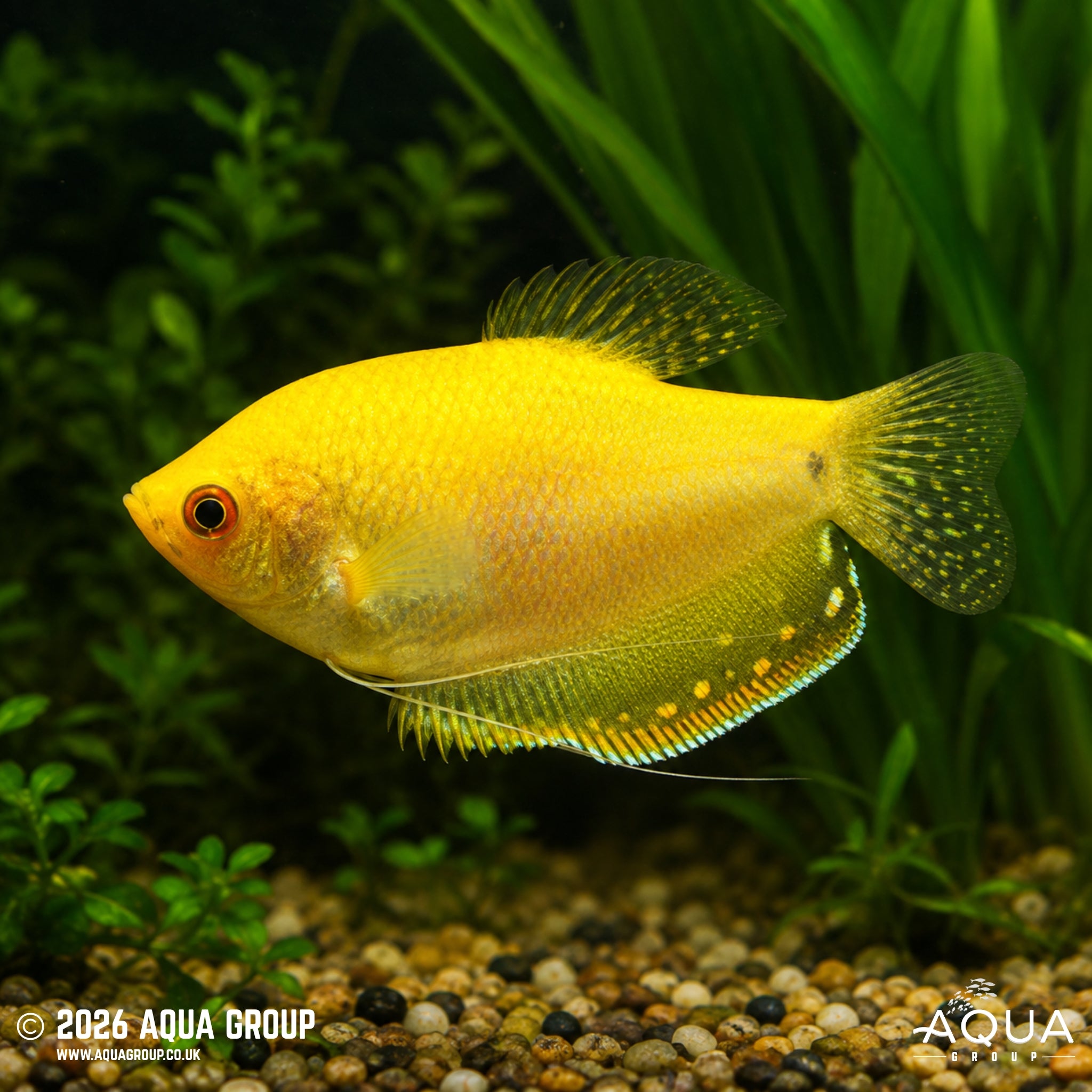
The Gold Gourami, Trichopodus trichopterus, is a selectively bred freshwater labyrinth fish recognised by its rich golden-yellow colouration, subtle marbled patterning and long thread-like pelvic fins. It is a colour form of the Three-spot Gourami and shares the same hardy nature, adaptable feeding behaviour and confident personality. Gold Gouramis are active upper- and mid-water fish that appreciate planted aquariums with floating cover, sheltered areas and open swimming room. Although generally suitable for established community aquariums, mature males can become territorial and may harass other gouramis or slower tank mates, so careful stocking and sufficient space are important.
Common Name:
Gold Gourami, Golden Gourami, Gold Three-spot Gourami, Golden Three-spot Gourami.
Scientific Name (Latin):
Trichopodus trichopterus
Formerly and still commonly listed as Trichogaster trichopterus.
Maximum Size:
Usually around 10–15 cm when fully grown.
Water Type:
Freshwater
Origin / Natural Habitat:
The Gold Gourami is a selectively bred ornamental colour form and does not occur naturally in this golden appearance.
Wild Trichopodus trichopterus originate from Southeast Asia, including the Mekong basin across Laos, Thailand, Cambodia, Vietnam and southern China, with populations also occurring elsewhere across the region.
The species inhabits slow-moving rivers, canals, ponds, marshes, floodplains and heavily vegetated waters. These habitats are often warm, calm and rich in submerged or floating vegetation.
Water Parameters:
Temperature: 22–28°C
pH Range: 6.0–8.0
Hardness or Salinity: Approximately 5–19°dGH; adaptable to soft through moderately hard freshwater provided conditions remain stable.
Temperament:
Semi-aggressive. Gold Gouramis are generally confident community fish but can become territorial, particularly mature males.
Males may chase one another or harass females during courtship. Avoid keeping several adult males together in limited accommodation unless the aquarium is large, heavily planted and contains substantial visual barriers.
They may also intimidate very timid fish or species with long flowing fins.
Diet:
Omnivorous. In nature, Three-spot Gouramis feed on insects, larvae, small crustaceans, zooplankton, algae and other available organic material.
In the aquarium, offer high-quality tropical flakes or pellets as the staple diet, supplemented with frozen or live Artemia, daphnia, mosquito larvae, bloodworms and mysis shrimp.
Include spirulina, vegetable-based foods and occasional soft vegetable matter to provide dietary variety. Feed moderate portions once or twice daily.
Minimum Tank Size:
A minimum aquarium volume of approximately 150 litres is recommended for one adult or a carefully selected group, with a tank length of at least 90 cm, dense planted areas and sufficient open swimming space.
Larger accommodation is preferable when maintaining more than one male or combining Gold Gouramis with other territorial labyrinth fish.
Behaviour & Activity:
An active middle- to upper-water fish that spends much of its time swimming between planted areas and open water.
The long thread-like pelvic fins contain sensory receptors and are continually used to investigate plants, decorations, tank mates and other objects within the aquarium.
Gold Gouramis possess a specialised labyrinth organ that allows them to breathe atmospheric air directly from the surface. Regular access to the water surface must therefore always remain unobstructed.
Mature males typically develop a longer, more pointed dorsal fin, while females have a shorter, more rounded dorsal fin and often a deeper body profile.
During breeding, the male constructs a bubble nest at the water surface, usually among floating plants. He courts the female beneath the nest and collects the released eggs, placing them into the bubbles before guarding the nest until the fry hatch.
Aquarium Category:
Semi-Aggressive
Gold Gouramis can be maintained successfully in a well-planned community aquarium containing robust, peaceful to moderately active species.
Suitable companions may include medium-sized rasboras, larger tetras, peaceful barbs, rainbowfish, Corydoras, loaches and other fish that are not excessively timid or prone to fin nipping.
Avoid very small, delicate fish and aggressive species likely to provoke territorial disputes.
Special Requirements or Care Notes:
Provide dense planting around the sides and rear of the aquarium while leaving open swimming space through the centre. Floating plants are particularly useful because they provide security and suitable locations for bubble-nest construction.
Ensure unobstructed access to the water surface at all times. The labyrinth organ allows Gold Gouramis to breathe atmospheric air, and preventing access to the surface can cause serious stress.
Gentle to moderate water movement is preferred. Avoid strong surface turbulence, particularly if attempting to breed the fish, as excessive movement can destroy bubble nests.
When maintaining males and females together, provide several females for each male where space allows. Dense planting and visual barriers help females avoid continuous courtship attention.
Avoid overcrowding. Mature males can become considerably more territorial than juveniles and may claim large sections of the aquarium.
Do not combine with aggressive fin-nipping barbs or other fish likely to damage the long pelvic fins.
Maintain stable water temperature and good filtration, but avoid excessively strong currents. Regular partial water changes help maintain long-term health and colouration.
Gold Gouramis can gulp air from the surface, which is completely normal behaviour. However, repeated frantic surface breathing combined with rapid gill movement may indicate poor water quality or inadequate oxygenation.
A secure aquarium cover is recommended. Leave a small warm, humid air space between the water surface and lid, particularly for juveniles and developing fry.
When breeding, reduce surface movement and provide floating plants. After spawning, the female should normally be removed if the male becomes highly territorial while guarding the nest.
Suitable for:
Beginner to intermediate freshwater fishkeepers
Availability:
Common in trade
All images are a visual representation of the fish you will receive, made to be as accurate as possible. Please note that Mother Nature is a wonderful thing, and variation in patterns and colours will occur — that is part of the unique beauty of these animals.
Order and get 3 reward points
Earn points by signing up for our rewards program