

Description
Ghostbuster Crab (Geosesarma rouxi)
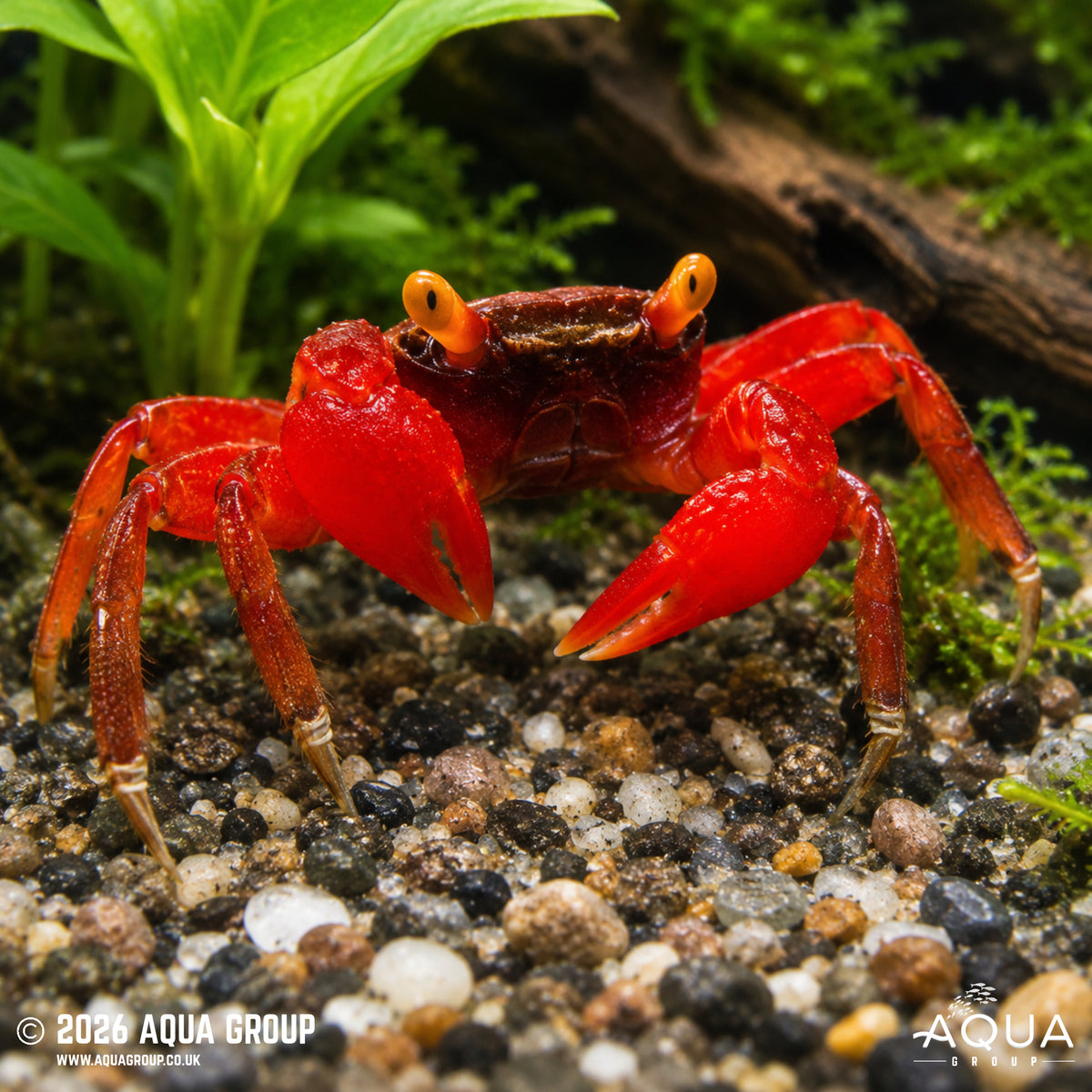
The Ghostbuster Crab is a fascinating and colourful semi-terrestrial freshwater crab admired for its striking appearance, inquisitive behaviour and unusual lifestyle. Also known as the Ghostbusters Vampire Crab, this attractive small crab belongs to the popular Geosesarma group, recognised for their contrasting body colours, prominent eyes and active foraging behaviour. Unlike fully aquatic crabs, Ghostbuster Crabs spend much of their time exploring damp land, hiding among moss, roots and leaf litter, and occasionally entering shallow freshwater areas. Their compact size and interesting behaviour make them an excellent choice for specialist tropical paludariums containing a combination of planted terrestrial areas and accessible freshwater.
Common Name:
Ghostbuster Crab, Ghostbusters Vampire Crab, Ghostbuster Vampire Crab
Scientific Name (Latin):
Geosesarma rouxi
Maximum Size:
Approximately 2–3 cm across the carapace, with a total leg span of around 4–6 cm.
Water Type:
Freshwater / Semi-Terrestrial
Requires a humid paludarium with substantial land space and a shallow freshwater area. Not suitable for a fully aquatic aquarium.
Origin / Natural Habitat:
The Ghostbuster Crab is associated with Java, Indonesia, where Geosesarma rouxi occurs in tropical environments.
This species is associated with the East Java region, with records and aquarium trade information linking it to areas around Malang.
Like other semi-terrestrial Geosesarma crabs, it is adapted to humid environments where moist soil, leaf litter, rocks and natural shelters provide protection from drying out.
These habitats allow crabs to spend much of their time on land while maintaining access to freshwater.
In captivity, a planted paludarium containing moss, damp substrate, cork bark, driftwood and shallow freshwater provides a suitable environment reflecting these requirements.
Water Parameters:
Temperature: 22–28°C, ideally around 24–26°C
pH Range: 7.0–8.0
Hardness: Moderately Hard
Humidity: Approximately 75–90%
Ammonia/Nitrite: 0 ppm
Nitrate: Kept low and stable
Temperament:
Peaceful to Semi-Aggressive / Territorial
Ghostbuster Crabs are generally shy animals that spend much of their time hiding or exploring sheltered areas within the enclosure.
Although they may coexist with others of their own species, territorial behaviour can occur, particularly between mature males.
They are best maintained individually or in carefully managed groups containing one male and multiple females, provided sufficient space and hiding places are available.
Avoid overcrowding, as competition for territory, shelter and food may result in aggression or injuries.
Different Geosesarma species should not be mixed because territorial disputes, breeding complications and species identification difficulties may arise.
Diet:
Omnivore
Ghostbuster Crabs are opportunistic omnivores that consume a variety of small invertebrates, organic material and plant-based foods.
In captivity, offer a varied diet including quality sinking crustacean pellets, small invertebrate foods and occasional plant-based supplements.
Suitable supplementary foods include small live or frozen bloodworms, brine shrimp, chopped earthworms, small crickets, fruit flies and other appropriately sized feeder insects.
Small portions of blanched vegetables, algae-based foods and suitable plant material may also be offered.
Calcium-rich foods and a suitable mineral source are beneficial for maintaining healthy shell development and supporting successful moulting.
Remove uneaten food promptly to prevent mould growth and deterioration of water quality.
Minimum Tank Size:
Approximately 45–60 litres for a small, carefully managed group, with a paludarium measuring around 60 × 30 cm or larger recommended.
A larger enclosure with a footprint of approximately 60 × 45 cm is preferable, particularly when maintaining multiple crabs.
The enclosure should consist primarily of usable terrestrial space, ideally around 70–80% land with the remaining area containing shallow freshwater.
Provide a moisture-retaining substrate, natural hiding places, climbing opportunities and easy access to the water section.
The freshwater area must include gentle slopes, rocks or other secure exit points to prevent crabs becoming trapped.
A standard fully filled aquarium is unsuitable, regardless of its water volume.
Behaviour & Activity:
The Ghostbuster Crab is a mainly terrestrial species that spends much of its time exploring the damp substrate, climbing natural decorations and searching for food.
These crabs are generally most active during the evening, at night and during periods of subdued lighting.
During the day, individuals may remain hidden beneath moss, cork bark, rocks or leaf litter.
They use their claws to investigate their surroundings, collect food and interact with other crabs.
Mature males may display territorial behaviour towards rival males, particularly around preferred hiding places.
Like other crustaceans, Ghostbuster Crabs periodically shed their exoskeleton as they grow. During moulting, they become particularly vulnerable and require secure, undisturbed hiding places.
Females may carry eggs beneath the abdomen, with young Geosesarma crabs developing directly into miniature crabs rather than passing through a free-swimming marine larval stage.
A well-established paludarium with dense planting and multiple shelters allows these behaviours to be observed naturally.
Community Suitability:
Semi-Aggressive / Specialist Paludarium Species
Ghostbuster Crabs are best maintained in a dedicated species-only paludarium rather than a conventional freshwater community aquarium.
Suitable companions are generally limited to carefully selected individuals of the same species, with sufficient space to establish separate territories.
Small springtails may be introduced as part of a bioactive enclosure to help break down waste and provide occasional natural prey.
Avoid housing them with fish, shrimp or other crabs, as predation, territorial aggression and incompatible habitat requirements may create problems.
Large aquatic areas should not be provided simply to accommodate fish, as Ghostbuster Crabs require substantial accessible land.
They are particularly suitable for specialist tropical paludariums containing mosses, terrestrial plants, cork bark and natural leaf litter.
Special Requirements or Care Notes:
Ghostbuster Crabs are semi-terrestrial animals and must not be maintained in a fully aquatic aquarium.
Provide a properly designed tropical paludarium with approximately 70–80% usable land area and a smaller, shallow freshwater section.
The terrestrial substrate should remain consistently moist without becoming waterlogged. Suitable materials include reptile-safe soil, coco fibre, sphagnum moss and natural leaf litter.
Maintain high humidity, ideally around 75–90%, while providing sufficient ventilation to prevent stagnant conditions and excessive mould growth.
The freshwater area should be clean, dechlorinated and easily accessible, with shallow edges or secure climbing routes allowing crabs to enter and leave safely.
Include numerous hiding places using cork bark, smooth rocks, driftwood, moss and dense planting.
A secure, escape-proof lid is essential because Ghostbuster Crabs are capable climbers and can escape through surprisingly small gaps.
Maintain stable tropical temperatures, avoiding prolonged exposure to cold conditions or excessive heat.
Provide a varied omnivorous diet and ensure suitable calcium and mineral availability to support successful moulting.
Avoid handling wherever possible, as these small crabs can become stressed or injured.
Never attempt to pull a crab from its old exoskeleton during moulting, and avoid disturbing individuals that are hiding while their new shell hardens.
Do not overcrowd the enclosure or maintain multiple males together without substantial space and territorial separation.
Copper-based medications and certain pesticides are highly toxic to aquatic and semi-terrestrial invertebrates and should be avoided.
Ghostbuster Crabs are best maintained separately from other crab species to reduce territorial disputes and prevent accidental hybridisation or confusion between similar-looking Geosesarma varieties.
Natural variation in body colour, leg colour and markings may occur between individuals, particularly where aquarium trade identification is uncertain.
Suitable for:
Intermediate
Availability:
Occasional / Specialist Availability / Wild-caught specimens commonly encountered
All images are a visual representation of the crab you will receive, made to be as accurate as possible. Please note that Mother Nature is a wonderful thing, and variation in patterns and colours will occur — that is part of the unique beauty of these animals.
Order and get 7 reward points
Earn points by signing up for our rewards program