

Description
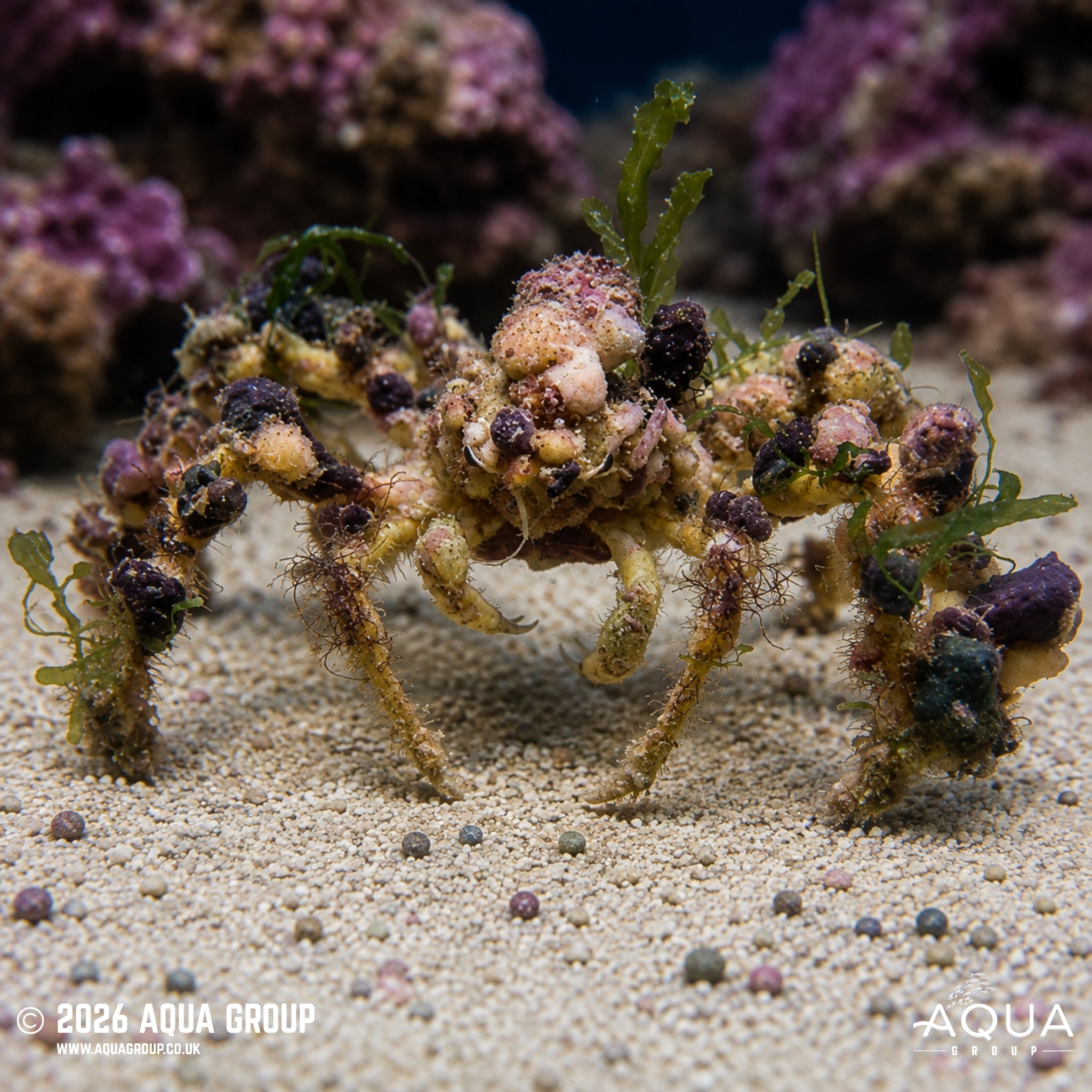
Decorator Crab (Camposcia retusa)
The Decorator Crab, Camposcia retusa, is a fascinating Indo-West Pacific marine invertebrate recognised for its long spider-like legs and extraordinary camouflage behaviour. Also known as the Spider Decorator Crab or Velcro Crab, it attaches algae, sponge, rubble and other available material to specialised hooked hairs covering its body. This creates a living disguise that changes with its surroundings and helps conceal the crab from predators. Although generally shy and useful as a scavenger, its habit of removing material from the aquarium means it should be kept in a mature reef or FOWLR system where occasional disturbance to soft corals and other sessile invertebrates can be accepted.
Common Name:
Decorator Crab, Spider Decorator Crab, Velcro Crab, Blunt Decorator Crab, Hairy Decorator Crab.
Scientific Name (Latin):
Camposcia retusa
Maximum Size:
The central shell or carapace is usually around 3–4 cm across, with the extended legs giving an overall span of approximately 8–10 cm.
Water Type:
Marine
Origin / Natural Habitat:
Widely distributed throughout the tropical Indo-West Pacific, from the Red Sea and East African coast across the Indian Ocean to southern Japan, Southeast Asia and Australia.
Decorator Crabs inhabit coral reefs, rocky and algae-covered bottoms, reef rubble, muddy coastal areas and sheltered habitats beneath rocks and boulders. They use material collected from their immediate surroundings to camouflage their body and legs.
Water Parameters:
Temperature: 24–28°C
pH Range: 8.1–8.4
Hardness or Salinity: Marine salinity 1.023–1.026 specific gravity; stable salinity, alkalinity and good water quality are important. Avoid copper-based medications.
Temperament:
Generally peaceful, shy and non-territorial, but opportunistic. Decorator Crabs normally avoid confrontation and spend much of their time concealed among rockwork.
They may take small pieces of algae, sponge, soft coral, zoanthids or other sessile organisms for camouflage. Very small, weak or slow-moving invertebrates may also be investigated, particularly when the crab is hungry.
Diet:
Omnivorous scavenger and opportunistic feeder. In the aquarium, the Decorator Crab consumes leftover fish food, detritus, algae, small invertebrates and organic material found among the rockwork.
Offer a varied diet of enriched mysis shrimp, chopped marine prawn, krill, mussel, clam, sinking marine pellets and algae-based foods. Small pieces of nori or spirulina food may also be accepted. Target feeding after the aquarium lights dim helps ensure the crab receives enough food and may reduce unwanted picking at corals.
Minimum Tank Size:
A minimum aquarium volume of approximately 100 litres is recommended for one adult, provided the aquarium is mature and contains extensive rockwork and sheltered areas. A larger aquarium provides more natural foraging opportunities and reduces the effect of its decorating behaviour on individual corals.
Behaviour & Activity:
A slow-moving, mainly nocturnal crab that often remains motionless or hidden during the day. It becomes more active after the aquarium lights dim, when it moves across rockwork and substrate searching for food and camouflage material.
The body and legs are covered with specialised hooked hairs that hold pieces of algae, sponge, coral, shell and other material. The crab deliberately selects, trims and attaches these items to itself. Decorating usually begins on the legs and helps break up the crab’s outline, providing protection from predators.
Its appearance can change significantly depending on the materials available within the aquarium. Newly moulted individuals may temporarily appear much less decorated before collecting and attaching new camouflage.
Reef Safe:
Reef Safe with Caution
Decorator Crabs do not normally consume healthy stony coral tissue as a primary food source. However, they may remove pieces of soft coral, sponge, zoanthids, macroalgae and other sessile organisms to attach to their body. Loose coral pieces and lightweight frags may also be moved or dislodged.
Their behaviour varies between individuals. They are most suitable for larger, mature reefs where minor pruning or relocation of soft coral material can be tolerated, or for FOWLR systems containing no valuable sessile invertebrates.
Special Requirements or Care Notes:
Provide extensive mature rockwork with caves, overhangs and shaded retreats. The crab may remain difficult to see because its camouflage can make it almost indistinguishable from surrounding algae and reef growth.
Offer food directly with feeding tongs or a pipette during the evening. A well-fed crab may be less likely to remove or consume desirable aquarium organisms, although decorating behaviour cannot be eliminated because it is a natural anti-predator response.
Secure loose corals, small rocks and lightweight decorations. Avoid placing valuable soft corals, zoanthids or delicate sponge growth within easy reach if their removal would be unacceptable.
Keep away from triggerfish, puffers, large predatory wrasses, hawkfish and other species likely to attack or eat crustaceans. The Decorator Crab is especially vulnerable after moulting, when its new shell remains soft. Provide deep crevices where it can remain concealed during this period.
Acclimate slowly because marine crustaceans are sensitive to sudden changes in salinity and water chemistry. Do not expose the crab to copper-based medication. Iodine should not be dosed solely for moulting unless guided by reliable testing, as excessive supplementation can be harmful.
Check pump and overflow guards carefully, as the long legs may become trapped in exposed equipment. A secure aquarium cover is also recommended.
Suitable for:
Intermediate marine fishkeepers
Availability:
Occasional in trade
All images are a visual representation of the animal you will receive, made to be as accurate as possible. Please note that Mother Nature is a wonderful thing, and variation in patterns and colours will occur — that is part of the unique beauty of these animals.
Order and get 20 reward points
Earn points by signing up for our rewards program