

Description
Dalmatian Lyretail Molly – Poecilia latipinna
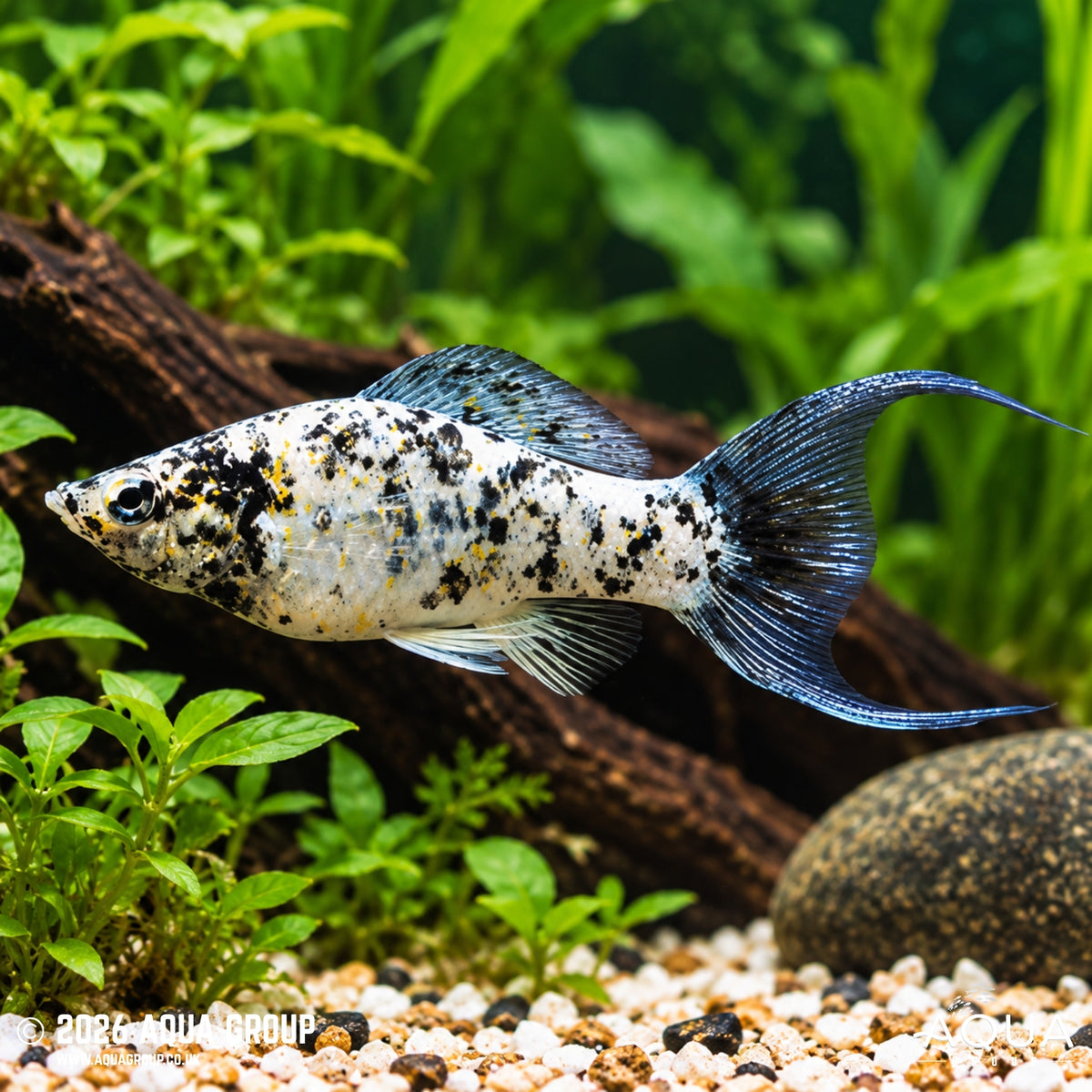
The Dalmatian Lyretail Molly is a beautiful freshwater livebearer admired for its striking black-and-white spotted colouration, elegant lyre-shaped tail and lively swimming behaviour. This attractive captive-bred variety is an excellent addition to spacious tropical community aquariums, planted displays and mixed livebearer setups. Peaceful, active and relatively easy to care for, Dalmatian Lyretail Mollies are best suited to mature aquariums with stable, mineral-rich water.
Common Name: Dalmatian Lyretail Molly, Dalmation Lyretail Molly, Dalmatian Molly, Lyretail Molly, Spotted Molly
Scientific Name (Latin): Poecilia latipinna
Strain / Form: Dalmatian Lyretail captive-bred colour and fin variety
Maximum Size: Approximately 10–12 cm, with larger individuals possible depending on breeding ancestry and fin development.
Water Type: Freshwater / Brackish-capable
Origin / Natural Habitat: Wild Poecilia latipinna originate from southern North America, including the southeastern United States and coastal regions of Mexico.
In their natural habitat, Sailfin Mollies inhabit slow-moving streams, ponds, marshes, coastal lagoons, drainage channels and vegetated freshwater or brackish environments.
These habitats commonly contain abundant aquatic vegetation, algae growth and mineral-rich water.
The Dalmatian Lyretail Molly is a selectively bred aquarium variety rather than a naturally occurring wild colour form.
In the aquarium, it thrives in spacious planted environments with open swimming areas, gentle to moderate water movement and stable, alkaline water conditions.
Water Parameters: Temperature: 22–28°C pH Range: 7.2–8.5 Hardness: Moderately hard to hard preferred (approximately 15–30 dGH) Ammonia/Nitrite: 0 ppm Nitrate: Kept low and stable Flow: Gentle to moderate preferred Salinity: Freshwater to lightly brackish, although salt is not essential when suitable mineral-rich freshwater conditions are maintained.
Temperament: Peaceful / Active
Dalmatian Lyretail Mollies are generally peaceful, sociable fish that are well suited to active community aquariums.
They enjoy swimming in small groups and interacting with other livebearers.
Males may display to females and occasionally chase rival males, particularly during breeding behaviour.
Mixed groups should contain more females than males to reduce persistent chasing and allow females to rest.
Their extended fins should be protected from aggressive or fin-nipping tankmates.
Diet: Omnivore / Herbivorous-Leaning Livebearer Diet
Dalmatian Lyretail Mollies accept a wide variety of aquarium foods but benefit from a diet containing plenty of vegetable matter.
Offer high-quality tropical flakes, livebearer pellets, spirulina flakes and algae-based foods as their staple diet.
Supplement with frozen or live foods such as daphnia, brineshrimp, bloodworm and mosquito larvae.
Blanched courgette, spinach and other suitable vegetables can also be offered occasionally.
A varied diet rich in vegetable matter helps support healthy digestion, colouration, growth and fin condition.
Minimum Tank Size: Approximately 100–120 litres for a small group
A longer aquarium with plenty of open swimming space is preferred, particularly for adult fish with extended lyretail fins.
Larger aquariums are recommended for breeding groups, multiple males or mixed livebearer communities.
Provide aquatic plants and sheltered areas alongside open swimming space.
Behaviour & Activity: The Dalmatian Lyretail Molly is an active, confident livebearer that spends much of its time exploring the middle and upper levels of the aquarium.
Its attractive black-and-white spotting creates a distinctive appearance, while the extended tail provides a flowing, elegant movement.
Males may display their fins and chase females during courtship.
Like other Mollies, this species is a livebearer, meaning females give birth to fully formed, free-swimming fry rather than laying eggs.
In well-planted aquariums, some fry may survive among dense vegetation and floating plants.
Community Suitability: Peaceful Community Fish
The Dalmatian Lyretail Molly is an excellent addition to peaceful tropical community aquariums with species that tolerate similar harder water conditions.
Suitable tankmates include platies, swordtails, guppies, other Mollies, peaceful rainbowfish, compatible danios, peaceful barbs, bristlenose plecos and other calm community fish.
Choose tankmates that are unlikely to nip the extended lyretail fins.
Avoid aggressive fish, fin-nippers, large predators, very timid nano fish and specialist soft-water species that require acidic conditions.
Special Requirements or Care Notes: Dalmatian Lyretail Mollies should be kept in mature aquariums with stable water quality, adequate filtration and regular maintenance.
They prefer moderately hard to hard, alkaline water and should not be maintained long term in very soft acidic conditions.
A group is recommended, with one male to two or three females where mixed sexes are kept.
Provide plenty of swimming space, natural plants and floating vegetation to create sheltered areas.
Because this is a lyretail variety, avoid sharp décor and fin-nipping tankmates that may damage the extended fins.
These fish breed readily and can produce fry regularly when males and females are housed together.
Dalmatian Lyretail Mollies may crossbreed with other Molly varieties, so keep breeding strains separate if maintaining specific colouration and fin characteristics is important.
Although Mollies tolerate brackish water, adding salt is not normally necessary in a properly maintained hard-water freshwater aquarium. Salt should never be added routinely without considering the requirements of other aquarium inhabitants.
Regular water changes, stable mineral levels and a varied vegetable-rich diet will help maintain their colouration, fin condition and long-term health.
Suitable for: Beginner to intermediate
Availability: Common to occasional, depending on supplier, breeding strain and fin quality.
All images are a visual representation of the fish you will receive, made to be as accurate as possible. Please note that Mother Nature is a wonderful thing, and variation in patterns and colours will occur — that is part of the unique beauty of these animals.
Order and get 3 reward points
Earn points by signing up for our rewards program