

Description
Crocodile Fish (Cymbacephalus beauforti)
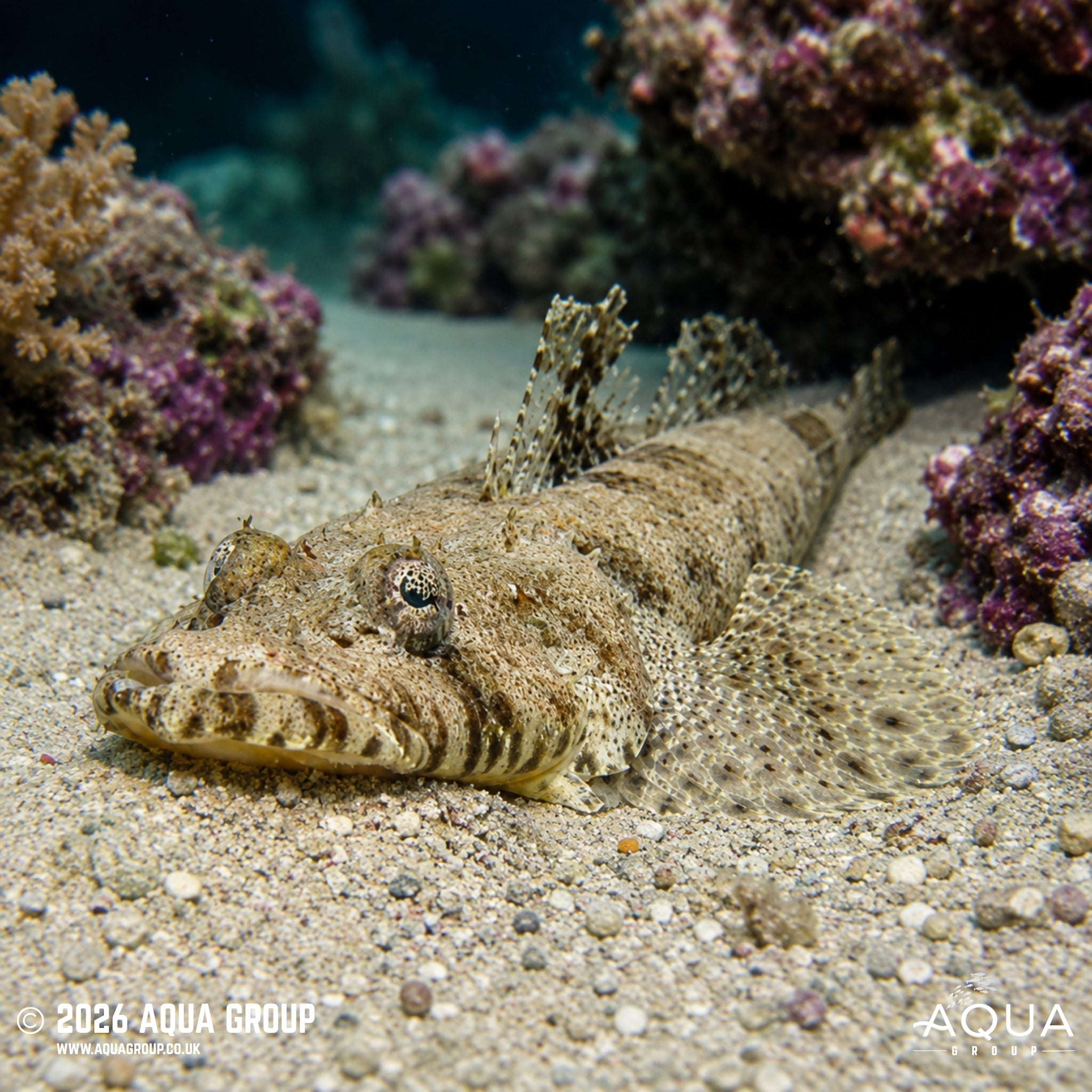
The Crocodile Fish, Cymbacephalus beauforti, is an extraordinary Western Pacific ambush predator recognised by its broad flattened head, mottled camouflage and unusual fringed eye coverings. Also known as De Beaufort’s Flathead or the Crocodile Flathead, it spends much of its time lying motionless across sand, rubble or reef surfaces while waiting for passing fish and crustaceans. Its prehistoric appearance and remarkable camouflage make it a fascinating display animal, but its large adult size, predatory behaviour and specialist bottom-dwelling requirements mean it is suitable only for very spacious marine aquariums managed by experienced fishkeepers.
Common Name:
Crocodile Fish, Crocodilefish, De Beaufort’s Flathead, Beaufort’s Crocodilefish, Crocodile Flathead.
Scientific Name (Latin):
Cymbacephalus beauforti
Maximum Size:
Capable of reaching approximately 50 cm when fully grown. Aquarium specimens may remain smaller, but long-term accommodation should always be planned around the species’ full adult potential.
Water Type:
Marine
Origin / Natural Habitat:
Western Pacific, with records from the Philippines, Borneo, the Moluccas, Papua New Guinea, Palau, Yap, New Caledonia and southern Japan.
Crocodile Fish inhabit shallow coral reefs and sandy or rubble-covered bottoms, where their flattened body and mottled colouration provide exceptional camouflage. They commonly rest directly on the seabed or beside reef structure, often becoming almost invisible against sand, coral rubble and encrusted rock.
Water Parameters:
Temperature: 24–28°C
pH Range: 8.1–8.4
Hardness or Salinity: Marine salinity 1.023–1.026 specific gravity; stable salinity, strong oxygenation, efficient biological filtration and consistently high water quality are essential.
Temperament:
Predatory, sedentary and generally solitary. Crocodile Fish are not normally aggressive towards animals they cannot swallow, but they are powerful ambush hunters and will consume smaller fish and crustaceans that move within striking distance.
Avoid keeping more than one unless the aquarium is exceptionally large and the individuals are carefully matched. Tank mates should be robust, peaceful and substantially too large to be viewed as prey.
Diet:
Obligate carnivore and benthic ambush predator. In the wild, Crocodile Fish feed on reef fish, shrimps, crabs and other animals passing close to the substrate.
In the aquarium, offer whole or chopped marine prawns, shrimp, krill, squid, mussel, clam, lancefish and pieces of marine fish. Food should be presented close to the fish using long feeding tongs, particularly while it is acclimating.
Newly imported specimens may initially respond only to moving prey. Live marine shrimp may be required temporarily before the fish is transitioned onto frozen or fresh marine foods. Avoid freshwater feeder fish, mammalian meat and excessively fatty foods.
Minimum Tank Size:
A minimum aquarium volume of approximately 750–1,000 litres is recommended for long-term care of one adult, with a broad footprint and a substantial area of open substrate. A fully grown specimen may require even larger custom accommodation.
Behaviour & Activity:
A bottom-dwelling ambush predator that spends long periods resting motionless on sand, rubble or flat rock surfaces. Its broad head, mottled pattern and irregular body outline allow it to blend extremely effectively into the aquarium surroundings.
The fish may partially bury itself or settle into a shallow depression while watching for prey. When food approaches, it launches forward rapidly and engulfs it using its broad mouth. Activity often increases during subdued lighting and after dark.
One of its most distinctive features is the presence of fringed skin flaps covering part of each eye. These break up the outline of the eyes and enhance camouflage without preventing the fish from watching its surroundings.
Reef Safe:
Reef Safe with Caution
Crocodile Fish do not normally consume coral tissue, but they are unsafe with ornamental shrimps, crabs and any fish small enough to swallow. Their broad body may rest against corals, cover low-growing colonies or dislodge unsecured frags.
They are best suited to a spacious FOWLR aquarium or a carefully designed reef display with robust, securely positioned corals and no small fish or valuable mobile invertebrates.
Special Requirements or Care Notes:
Provide a large, uninterrupted area of fine sand or smooth reef rubble where the fish can rest without abrasion. Avoid sharp crushed coral and rough decorations that may damage the underside, fin margins or delicate eye fringes.
Rockwork must be firmly secured and positioned to leave broad open areas across the aquarium floor. Low coral colonies and loose frags should not be placed in the fish’s preferred resting zone.
Choose tank mates according to body depth as well as length, as the Crocodile Fish has a broad mouth and can swallow surprisingly substantial prey. Avoid gobies, dartfish, cardinalfish, clownfish, small wrasses, ornamental shrimps and other animals that spend time close to the substrate.
Target feeding is often necessary because the fish may not actively pursue food through the aquarium. Use long feeding tongs and ensure meals reach the fish before being taken by faster tank mates. Never hand-feed, as the strike is rapid and the mouth is large.
Offer controlled meals rather than excessive daily feeding. Large carnivorous meals create substantial waste, so oversized filtration, efficient protein skimming and regular maintenance are essential.
Select only an alert specimen with clear eyes, intact eye fringes, undamaged skin and a well-filled body. Confirm that it is feeding before purchase whenever possible. Abrasions, cloudy eyes and refusal to feed should be treated seriously.
Avoid aggressive triggerfish, puffers, large wrasses and other species likely to bite the fish’s eye fringes or disturb it while resting. Protect pump intakes, provide sheltered low-flow resting areas and use a secure aquarium cover.
Suitable for:
Expert only
Availability:
Rare
All images are a visual representation of the fish you will receive, made to be as accurate as possible. Please note that Mother Nature is a wonderful thing, and variation in patterns and colours will occur — that is part of the unique beauty of these animals.
Order and get 75 reward points
Earn points by signing up for our rewards program