

Description
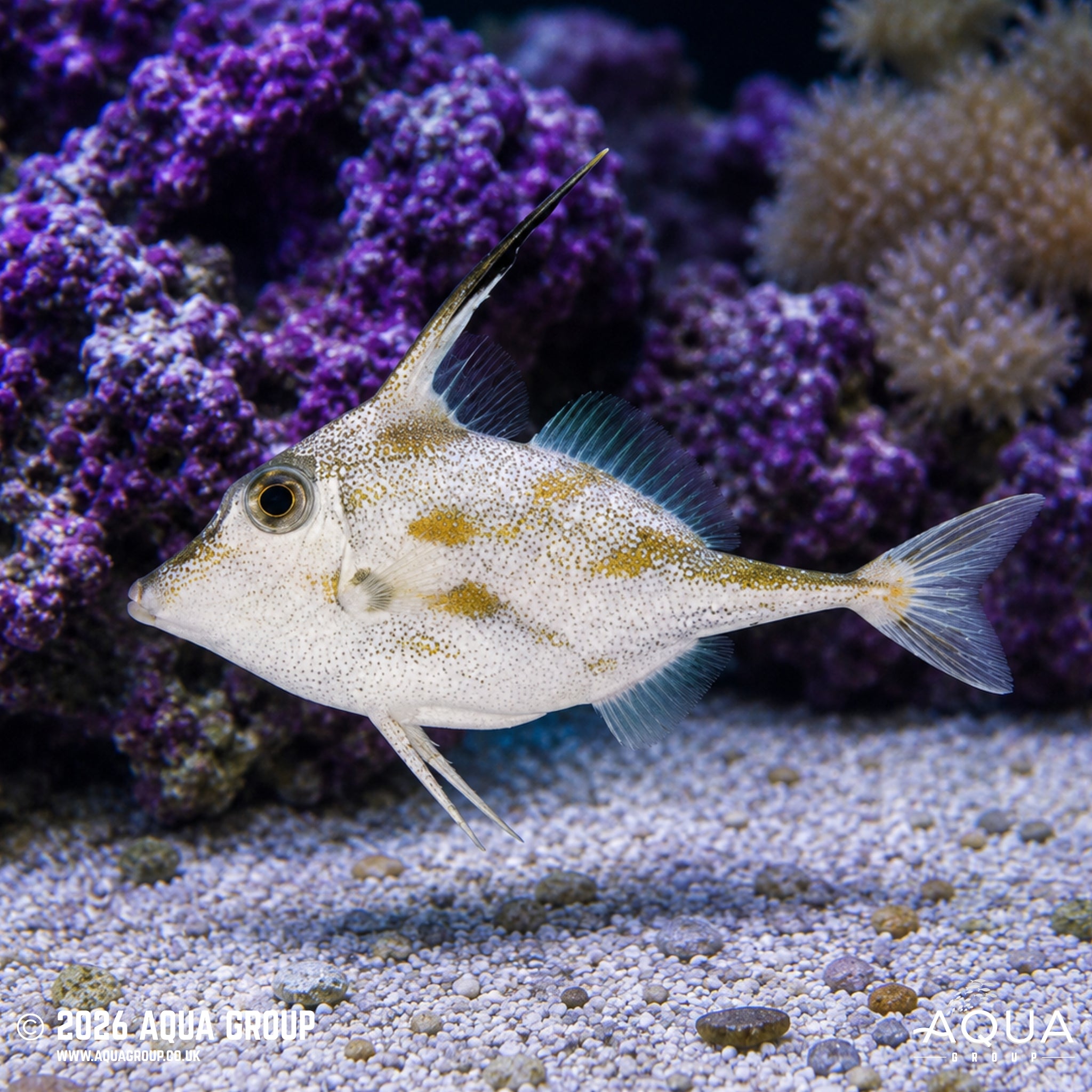
Comb Tripod Fish (Pseudotriacanthus strigilifer)
The Comb Tripod Fish (Pseudotriacanthus strigilifer) is an unusual Indo-West Pacific marine fish recognised by its laterally compressed silvery body, elongated snout, mottled brown to orange markings and prominent first dorsal spine. Also known as the Long-Spined Tripodfish or Blotched Tripodfish, it inhabits sandy and muddy coastal waters, estuaries and sheltered bays, where it searches the substrate for small benthic invertebrates. Rarely encountered in the aquarium trade, this distinctive bottom-oriented species requires a spacious, mature system with an open soft substrate and peaceful tank mates.
Common Name:
Comb Tripod Fish, Comb Tripodfish, Long-Spined Tripodfish, Longspined Tripodfish, Blotched Tripodfish
Scientific Name (Latin):
Pseudotriacanthus strigilifer
Maximum Size:
Up to approximately 25 cm in total length. Aquarium accommodation should be planned around a fully grown, active adult rather than the smaller size at which specimens may occasionally be offered.
Water Type:
Marine / Brackish
Origin / Natural Habitat:
Native to the Indo-West Pacific, with a range extending from the northern Indian Ocean through South and Southeast Asia towards Indonesia and the Philippines.
It inhabits coastal and estuarine waters over sandy or muddy flats, generally remaining close to the seabed. The species is commonly associated with sheltered, sometimes turbid habitats rather than clear, coral-dominated reef environments.
Water Parameters:
Temperature: 24–28°C
pH Range: 8.0–8.4
Salinity: 1.020–1.025 SG
Temperament:
Generally peaceful towards similarly sized fish, but predatory towards very small crustaceans, worms and other animals living within the substrate.
It should be kept with calm to moderately active marine fish that will not continually harass it or prevent it from feeding. Avoid highly aggressive triggerfish, puffers, large wrasses and persistent fin-nipping species.
Diet:
A carnivorous bottom feeder that naturally consumes benthic invertebrates found on and within sand or mud.
In the aquarium, offer a varied diet of mysis shrimp, enriched brine shrimp, finely chopped prawn, mussel, clam, cockle, krill and marine worms. Small sinking carnivore pellets may also be accepted once the fish is established.
Food should be delivered close to the substrate where the fish naturally searches. Offer two or three modest meals daily and confirm that it is actively swallowing food rather than being outcompeted by faster tank mates.
Minimum Tank Size:
A minimum aquarium volume of approximately 300 litres is recommended for a single specimen, with a broad footprint and substantial open substrate area.
A larger aquarium is advisable when keeping it with other active bottom-feeding species or larger marine fish.
Behaviour & Activity:
A bottom-oriented fish that spends much of its time swimming close to sandy or muddy substrate while searching for small prey.
The species has a prominent first dorsal spine and two strong pelvic spines characteristic of tripodfishes. These provide defence and contribute to its distinctive profile.
It generally benefits from uninterrupted open floor space rather than dense reef-style aquascaping. Caves and overhangs should still be provided for shelter, particularly during acclimatisation and overnight.
Newly introduced specimens may remain shy or close to the substrate until they become accustomed to aquarium movement and feeding routines.
Reef Safe:
Not Reef Safe
The Comb Tripod Fish is not considered suitable for a conventional reef aquarium. Small shrimps, worms, tiny crabs, molluscs and other benthic invertebrates may be consumed.
Although healthy coral tissue is unlikely to form a major part of its diet, its natural coastal habitat, bottom-feeding behaviour and potential impact on sand-bed organisms make it better suited to a spacious fish-only or specialist marine aquarium.
Special Requirements or Care Notes:
Provide a broad area of fine marine sand or smooth, soft substrate that allows the fish to forage naturally. Avoid sharp coral gravel, which may damage the mouth and underside during feeding.
Rockwork should be securely positioned and arranged around the edges or rear of the aquarium, leaving extensive open floor space. The aquascape should reflect a sheltered coastal habitat rather than a densely packed coral reef.
Introduce only to a mature, fully cycled aquarium with excellent oxygenation, efficient biological filtration and stable water chemistry. As a coastal and estuarine species, it may tolerate natural environmental variation, but sudden aquarium fluctuations should still be avoided.
This species is rarely maintained in home aquariums, and detailed long-term husbandry information is limited. Feeding response, body condition and behaviour should therefore be monitored particularly closely.
Select an alert specimen with clear eyes, intact dorsal and pelvic spines, normal swimming control and a rounded abdomen. Avoid fish showing mouth damage, severe weight loss or rapid respiration.
Take care during capture and transfer. The long dorsal and pelvic spines may become caught in conventional aquarium nets, so a rigid submerged container is preferable.
A securely covered aquarium is recommended, particularly during introduction or periods of disturbance.
Suitable for:
Experienced fishkeepers
Availability:
Rare
All images are a visual representation of the fish you will receive, made to be as accurate as possible. Please note that Mother Nature is a wonderful thing, and variation in patterns and colours will occur — that is part of the unique beauty of these animals.
Order and get 30 reward points
Earn points by signing up for our rewards program