

Description
Clown Killifish (Epiplatys annulatus)
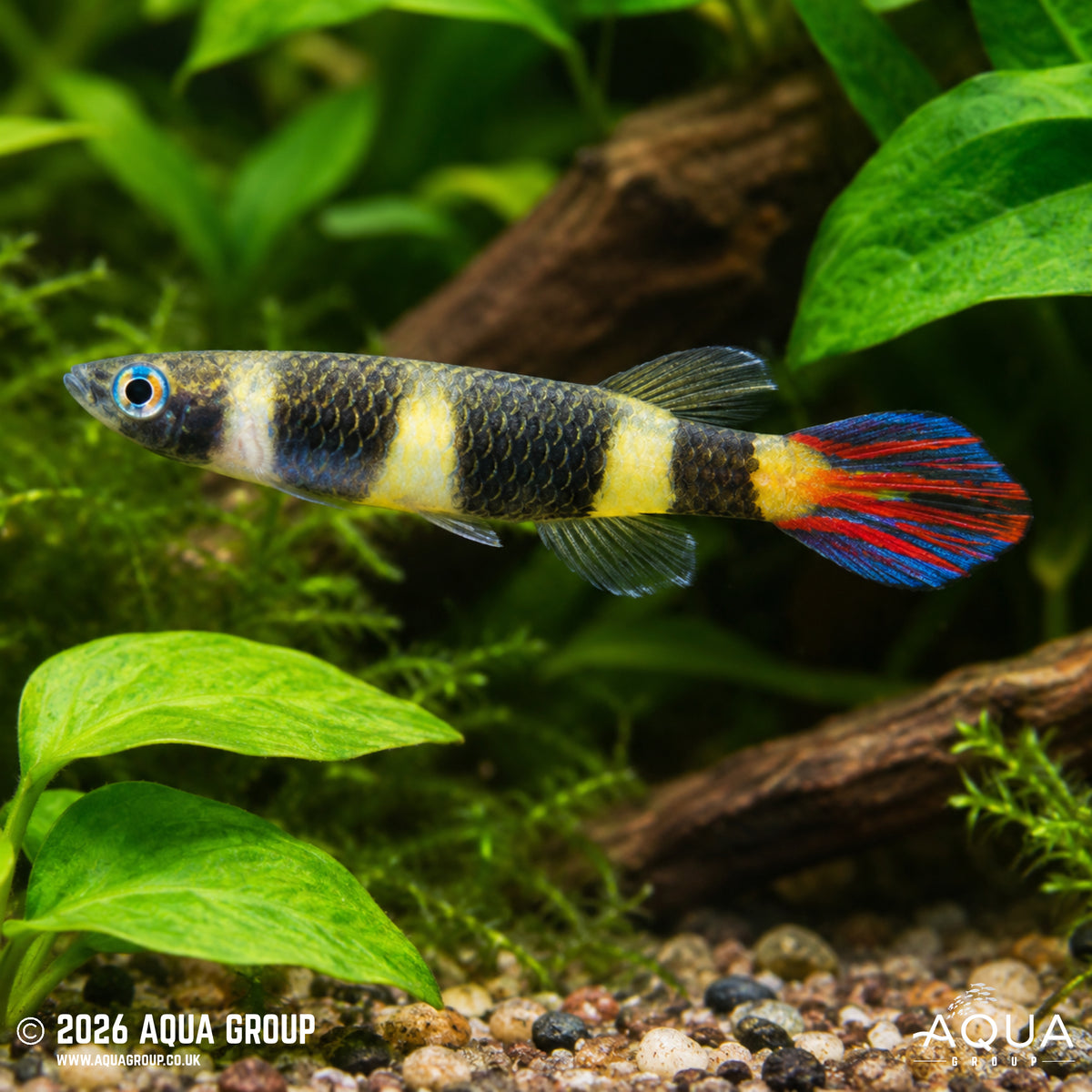
The Clown Killifish is a beautiful and unusual small freshwater fish admired for its distinctive black-and-cream vertical stripes, vibrant tail markings and fascinating surface-dwelling behaviour. Also known as the Rocket Killifish or Clown Panchax, this attractive West African species is particularly recognisable by the colourful, elongated tail fin of mature males, featuring striking red, blue and yellow tones. Unlike many active community fish, Clown Killifish spend much of their time hovering just beneath the water's surface, searching for tiny food organisms among floating plants. Their peaceful temperament, compact adult size and distinctive appearance make them a rewarding choice for established planted aquariums and specialist soft-water freshwater setups.
Common Name:
Clown Killifish, Rocket Killifish, Clown Panchax, Rocket Panchax, Banded Panchax
Scientific Name (Latin):
Epiplatys annulatus (formerly Pseudepiplatys annulatus)
Maximum Size:
Approximately 3–3.5 cm, with mature males generally displaying longer and more colourful fins than females
Water Type:
Freshwater
Origin / Natural Habitat:
The Clown Killifish originates from West Africa, with natural populations occurring in Guinea, Sierra Leone and Liberia.
Wild Epiplatys annulatus inhabit shallow freshwater swamps, slow-moving streams, forest pools and sheltered waterways containing dense aquatic and marginal vegetation.
These environments commonly feature soft, acidic water, submerged roots, fallen leaves and areas of very gentle water movement.
The water is often stained by naturally occurring tannins released from decomposing plant material, creating subdued lighting and sheltered conditions.
In the wild, Clown Killifish remain close to the water's surface, particularly around floating vegetation, where they feed on tiny insects, insect larvae and other small aquatic invertebrates.
Water Parameters:
Temperature: 20–26°C
pH Range: 5.5–7.0
Hardness: Soft, ideally approximately 1–8 dGH
Ammonia/Nitrite: 0 ppm
Nitrate: Kept low and stable
Temperament:
Peaceful
Clown Killifish are peaceful, relatively shy freshwater fish that are best maintained in groups of at least 8–10 individuals.
Although they are not tightly shoaling fish, they benefit from the security of others of their own species and display more confident behaviour when maintained in suitable numbers.
Males may occasionally display towards one another, extending their colourful fins and engaging in brief chasing behaviour. These interactions are generally harmless when sufficient space and floating plant cover are provided.
Their small adult size and delicate feeding behaviour make them unsuitable for communities containing large, aggressive or particularly boisterous fish.
They are best maintained in a dedicated species aquarium or alongside carefully selected, peaceful tankmates with similar water requirements.
Diet:
Carnivore / Micropredator
Clown Killifish naturally feed on tiny insects, insect larvae, small crustaceans and other microscopic aquatic organisms found near the water's surface.
In the aquarium, provide a varied diet consisting primarily of appropriately sized live and frozen foods.
Suitable foods include freshly hatched brine shrimp, cyclops, small daphnia, moina, microworms and other tiny aquatic invertebrates.
Very fine floating micro pellets and crushed tropical flakes may also be accepted, although some individuals can be reluctant to consume prepared foods initially.
Because of their small mouths and surface-feeding behaviour, food should be offered in appropriately sized portions that remain accessible near the surface.
A varied feeding routine helps maintain healthy body condition, natural colouration and good breeding condition.
Feed small portions once or twice daily, taking care to ensure all individuals receive sufficient food.
Minimum Tank Size:
Approximately 60 litres
A mature aquarium measuring at least 60 cm in length is recommended for a group of Clown Killifish.
Although their small adult size makes them suitable for compact aquariums, adequate surface area is particularly important because they spend most of their time swimming and feeding near the waterline.
Larger aquariums are recommended for substantial groups or carefully planned community setups.
Provide plenty of floating plants, fine-leaved vegetation and sheltered areas alongside small sections of open water for feeding.
Strong water movement should be avoided, particularly at the surface, where these small fish prefer relatively calm conditions.
Behaviour & Activity:
The Clown Killifish is a distinctive surface-dwelling species that spends much of its time hovering immediately beneath the waterline.
Its naturally upturned mouth allows it to capture tiny insects and other food organisms from the surface.
The body features alternating dark brown to black and pale cream vertical bands, giving the fish its characteristic clown-like appearance.
Mature males develop particularly attractive tail fins, often displaying bright blue outer sections and a striking red central extension, creating the rocket-shaped appearance responsible for the alternative name Rocket Killifish.
Females are generally smaller and less colourful, with shorter fins and a more rounded body.
Clown Killifish frequently gather beneath floating plants, occasionally darting forward to capture food before returning to sheltered areas.
During breeding, pairs may deposit small eggs among fine-leaved plants, aquarium mosses and the roots of floating vegetation.
Unlike annual killifish, this species does not require a dry incubation period for its eggs.
Clown Killifish are excellent jumpers and can escape through very small gaps, making a secure, tightly fitting aquarium lid essential.
Community Suitability:
Community Fish
Clown Killifish can be maintained in peaceful freshwater community aquariums, although their small size and specialist feeding requirements make them particularly suitable for dedicated species setups.
Suitable companions may include small peaceful rasboras, tiny tetras, dwarf Corydoras and other calm freshwater species that appreciate soft, slightly acidic water.
They may also coexist with peaceful freshwater shrimp, although newly hatched shrimplets may occasionally be consumed.
Avoid large predatory fish, aggressive cichlids, fast-moving barbs and particularly boisterous surface-feeding species that may outcompete them for food.
Care should also be taken when housing them with larger fish that could view adult Clown Killifish as prey.
Their preference for calm surface conditions means tankmates should be chosen carefully to avoid excessive disturbance around floating vegetation and feeding areas.
A dedicated, densely planted aquarium often provides the best opportunity to appreciate their natural behaviour and attractive colouration.
Special Requirements or Care Notes:
Provide a mature, well-established freshwater aquarium with stable water chemistry and efficient biological filtration.
Clown Killifish naturally inhabit soft, acidic freshwater environments and should not be maintained in very hard or strongly alkaline water.
Maintain groups of at least 8–10 individuals to encourage confident behaviour and natural social interactions.
Floating plants are particularly beneficial, providing shelter, subdued lighting and a natural environment close to the water's surface.
Suitable aquarium plants include Java Moss, Java Fern, Anubias and other species that tolerate softer water and relatively subdued lighting.
Avoid strong surface currents, as Clown Killifish prefer calm water where they can hover and feed comfortably.
A gentle sponge filter or carefully adjusted filtration system is particularly suitable for maintaining good water quality without excessive disturbance.
Provide a varied diet containing very small live or frozen foods, as some specimens may initially refuse standard flakes or pellets.
Ensure food reaches the surface and remains accessible, particularly when other fish are present.
A tightly fitting aquarium lid is essential because Clown Killifish are capable jumpers and can escape through surprisingly small openings.
Regular partial water changes are important, although sudden changes in water chemistry should be avoided.
Clown Killifish can be sensitive to deteriorating water quality and should never be introduced into newly established or biologically unstable aquariums.
Breeding may occur naturally in mature planted aquariums, with eggs deposited among mosses, fine-leaved vegetation or floating plant roots.
Newly hatched fry are extremely small and initially require microscopic foods such as infusoria or rotifers before they can accept newly hatched brine shrimp.
As different wild populations may display variations in fin colour and markings, known locality strains should be maintained separately when breeding to preserve their distinctive characteristics.
Suitable for:
Intermediate
Availability:
Occasional / Specialist Availability / Captive-bred and Wild-caught
All images are a visual representation of the fish you will receive, made to be as accurate as possible. Please note that Mother Nature is a wonderful thing, and variation in patterns and colours will occur — that is part of the unique beauty of these animals.
Order and get 3 reward points
Earn points by signing up for our rewards program