

Description
Clarkii Clownfish (Amphiprion clarkii)
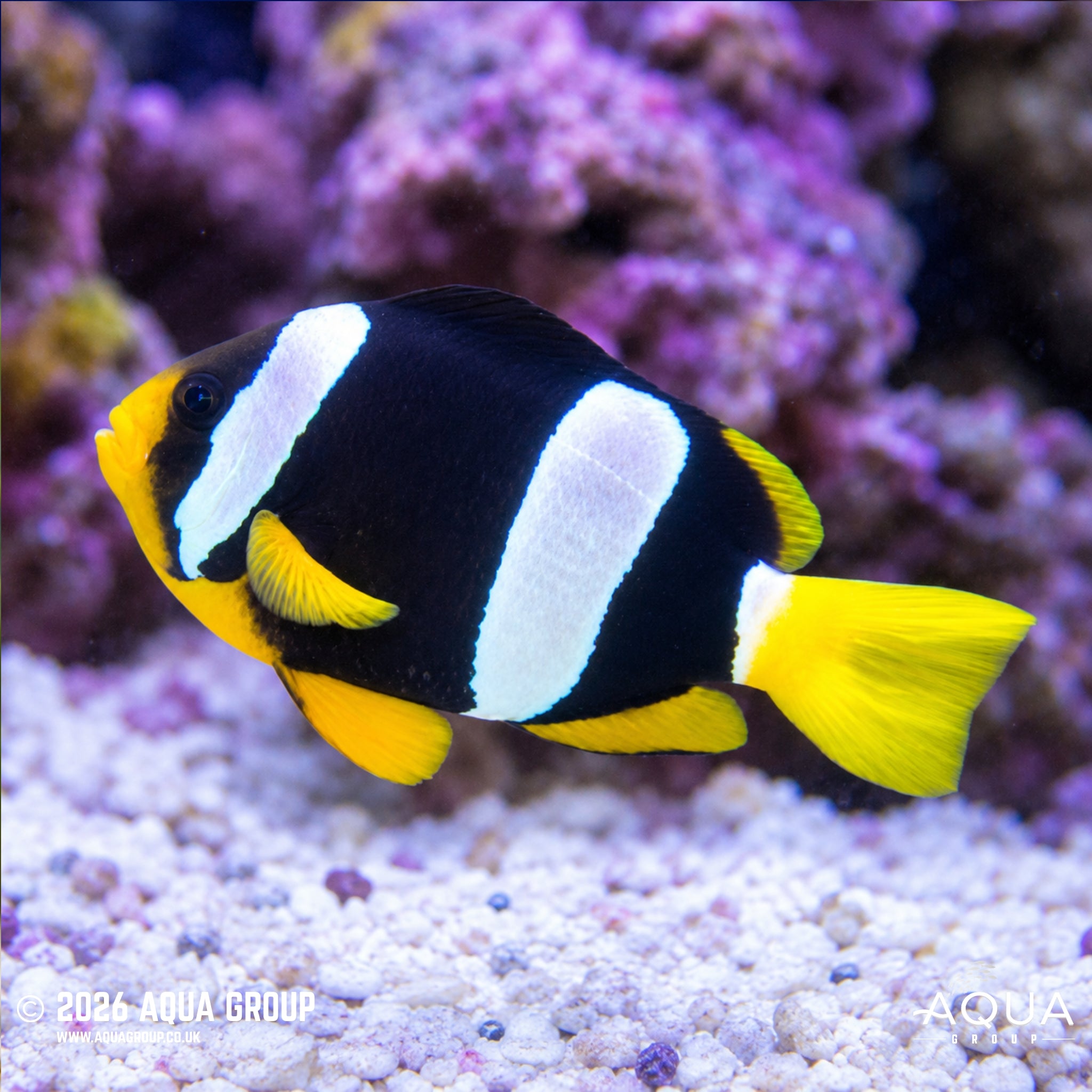
The Clarkii Clownfish, Amphiprion clarkii, is a bold and highly variable Indo-West Pacific anemonefish recognised by its dark brown to black body, contrasting white bars and yellow, orange or white fins. Also known as Clark’s Anemonefish or the Yellowtail Clownfish, its appearance varies considerably between geographical regions, with some individuals displaying much more orange or yellow than others. This adaptable species naturally lives among the tentacles of several host anemones and is one of the larger, more assertive clownfish commonly maintained in marine aquariums. Its hardiness, striking markings and engaging behaviour make it a popular choice, although mature pairs can become strongly territorial.
Common Name:
Clarkii Clownfish, Clark’s Clownfish, Clark’s Anemonefish, Yellowtail Clownfish, Yellowtail Anemonefish.
Scientific Name (Latin):
Amphiprion clarkii
Formerly described and still occasionally listed as Amphiprion xanthurus.
Maximum Size:
Usually around 12–15 cm when fully grown, with females becoming considerably larger than males.
Water Type:
Marine
Origin / Natural Habitat:
Widely distributed throughout the Indo-West Pacific, from the Persian Gulf and eastern coast of Africa across the Indian Ocean to Southeast Asia, southern Japan, northern Australia, Micronesia and parts of the western Pacific.
Clarkii Clownfish inhabit lagoons, sheltered coastal reefs and outer reef slopes from shallow water to depths of approximately 70 metres. They live in close association with sea anemones, usually remaining within or immediately around the protective tentacles of their chosen host.
Water Parameters:
Temperature: 24–28°C
pH Range: 8.1–8.4
Hardness or Salinity: Marine salinity 1.023–1.026 specific gravity; maintain stable salinity, alkalinity, strong oxygenation and consistently good water quality.
Temperament:
Semi-aggressive and territorial, particularly when mature, paired or protecting a host anemone, coral or spawning site. Clarkii Clownfish are generally more assertive than Ocellaris or Percula Clownfish and may chase peaceful fish away from their chosen territory.
A compatible pair can be maintained together, but multiple mature clownfish should not normally be mixed in an average-sized aquarium. The largest individual becomes the dominant female, while the next largest develops into the breeding male.
Diet:
Omnivorous. In the wild, Clarkii Clownfish feed on zooplankton, small crustaceans, algae and edible organic material collected around their host anemone.
In the aquarium, offer enriched mysis shrimp, Artemia, copepods, finely chopped krill, marine prawn and other suitably sized frozen foods. Supplement with high-quality marine pellets, flakes and spirulina or algae-based preparations.
Feed small varied portions once or twice daily, increasing the frequency for juveniles, recently imported fish or actively breeding pairs.
Minimum Tank Size:
A minimum aquarium volume of approximately 150 litres is recommended for one established pair, with extensive rockwork, sheltered retreats and sufficient room for other fish to avoid the pair’s territory.
A larger aquarium is advisable when keeping them with other territorial fish or when providing a large host anemone.
Behaviour & Activity:
An active and confident clownfish that usually remains close to a chosen host, cave, coral or section of rockwork. Once established, it may defend this area vigorously and repeatedly drive away fish that approach too closely.
Clarkii Clownfish are protandrous hermaphrodites. All juveniles begin without a fixed female role, and the dominant individual develops into the female. The next largest becomes the functional male, while smaller individuals remain subordinate.
Compatible pairs may clean a flat rock beside their host before spawning. The female deposits adhesive eggs onto the prepared surface, and the male guards, cleans and fans them until they hatch.
Colouration varies considerably according to age, geographical origin and individual development. The body may range from yellowish brown to almost black, while the tail and other fins may be yellow, orange, white or dark.
Reef Safe:
Reef Safe
Clarkii Clownfish do not normally consume healthy corals, clams or ornamental invertebrates and are suitable for established reef aquariums.
A territorial pair may disturb nearby corals by digging, moving loose substrate or repeatedly brushing against coral tissue chosen as a substitute host. Small unsecured frags may also be displaced.
Special Requirements or Care Notes:
A host anemone is not essential for aquarium survival. Captive Clarkii Clownfish can live successfully without one and may adopt a coral, cave or section of rockwork as their territory.
When an anemone is provided, it must be suitable for the aquarium and introduced only to a mature, stable system. Bubble-tip Anemones, Entacmaea quadricolor, are commonly accepted in captivity, although this adaptable clownfish may associate with several other anemone species in nature.
Do not purchase an anemone solely for the clownfish unless the aquarium can meet the anemone’s requirements for lighting, water stability, flow, feeding and space. An unhealthy or wandering anemone can create considerably more risk than benefit.
Clarkii Clownfish can become highly defensive around their host and may bite the keeper’s hand during aquarium maintenance. Confirm the pair’s position before working near their territory.
Introduce the smaller fish first when forming a pair, or acquire an established compatible pair. Avoid combining two similarly sized mature individuals because prolonged fighting can result in serious injury.
Provide caves, overhangs and visual barriers so subordinate fish and tank mates can retreat. Avoid very timid species that may be repeatedly intimidated by an established breeding pair.
Tank-bred specimens are strongly recommended where available. They generally adapt more readily to prepared foods and aquarium conditions and reduce demand for wild collection.
Quarantine new arrivals and monitor for rapid breathing, excessive mucus, scratching, white spots, faded colour or refusal to feed. Clownfish can be vulnerable to marine velvet, white spot and Brooklynella infections.
A secure aquarium cover is recommended, particularly during introduction or territorial disputes. Maintain stable water chemistry and avoid sudden changes in temperature or salinity.
Suitable for:
Beginner to intermediate marine fishkeepers
Availability:
Common in trade
All images are a visual representation of the fish you will receive, made to be as accurate as possible. Please note that Mother Nature is a wonderful thing, and variation in patterns and colours will occur — that is part of the unique beauty of these animals.
Order and get 25 reward points
Earn points by signing up for our rewards program