

Description
Cherry Barb (Rohanella titteya)
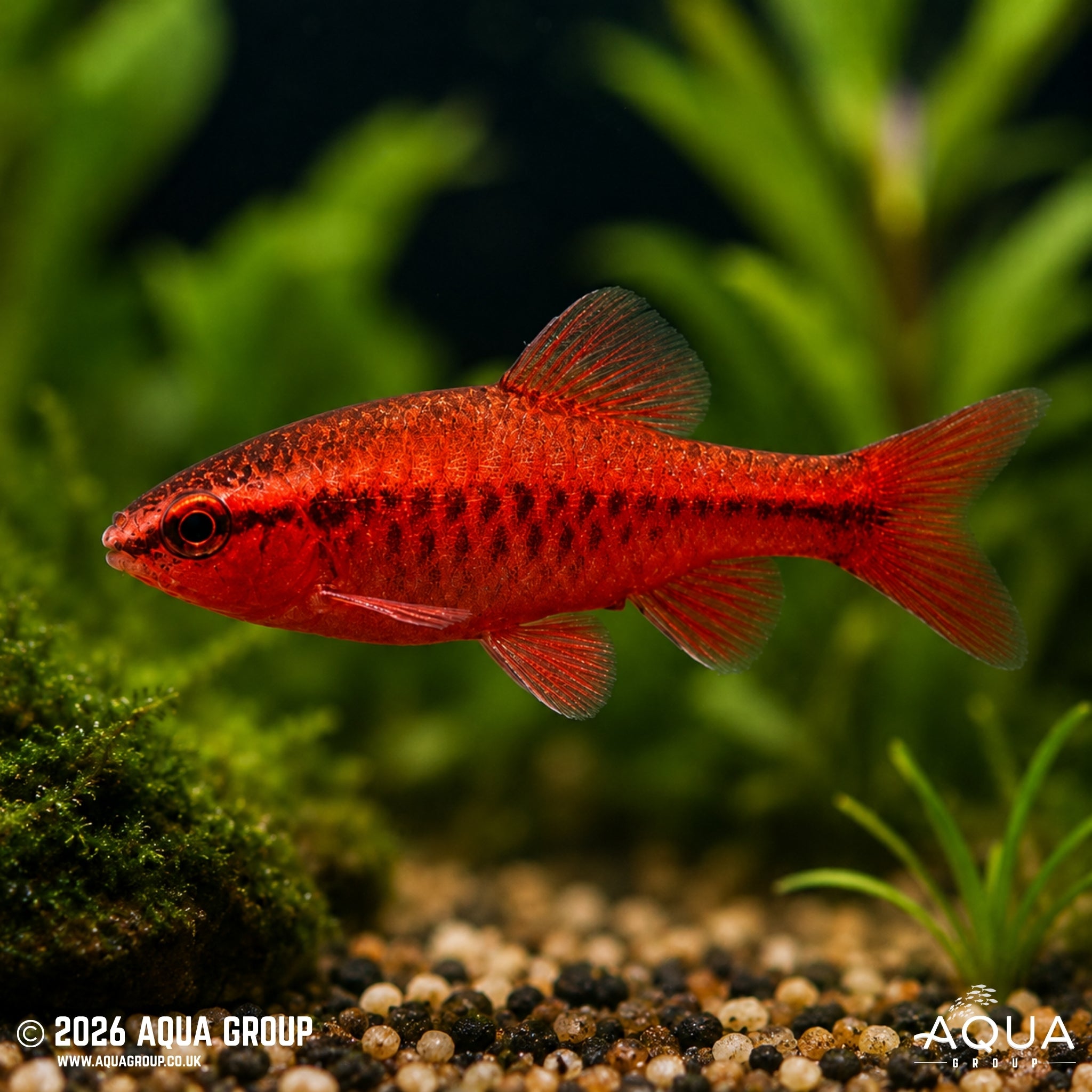
The Cherry Barb is a peaceful and colourful freshwater barb, loved for the rich cherry-red colour shown by mature males and the softer golden-brown tones of females. Unlike some more boisterous barb species, Cherry Barbs are calm, social and well suited to mature planted community aquariums. They are best kept in groups, where males will display to one another and show their strongest colour without becoming disruptive to peaceful tank mates.
Common Name:
Cherry Barb. Also commonly referred to as the Red Cherry Barb, Sri Lanka Cherry Barb or Cherry Red Barb.
Scientific Name (Latin):
Rohanella titteya
Still widely referenced in the aquarium trade as Puntius titteya. Older synonyms include Barbus titteya and Capoeta titteya.
Maximum Size:
Around 4–5 cm in captivity, making it a small and manageable community fish.
Water Type:
Freshwater
Origin / Natural Habitat:
Native to Sri Lanka, especially the Kelani to Nilwala river basins. In the wild, Cherry Barbs are associated with shaded forest streams, rivulets and slower-flowing waters with sandy or silty substrates, leaf litter, marginal vegetation and natural cover. Most specimens available in the aquarium trade are now captive-bred.
Water Parameters:
Temperature: 22–27°C
pH Range: 6.0–8.0
Hardness: soft to moderately hard water, with soft slightly acidic water preferred for breeding
Temperament:
Peaceful and social. Cherry Barbs are much calmer than many other barbs and are suitable for community aquariums with other small, non-aggressive fish. Males may display to each other, but this is normally harmless when the group is kept in good numbers.
Diet:
Omnivorous. It should be offered a varied diet including quality flake, micro pellets, small granules, algae-based foods, frozen daphnia, brineshrimp, cyclops, mosquito larvae and occasional live foods. A varied diet will help maintain colour, condition and natural display behaviour.
Minimum Tank Size:
A practical recommendation is at least 60 litres for a small group, with a longer aquarium preferred for larger groups and better natural behaviour.
Behaviour & Activity:
This is a social mid-to-lower level barb that should be kept in a group of at least 6, ideally 8–10 or more. It is not as tightly shoaling as some tetras, but it is still a group-living species and becomes more confident in numbers. Cherry Barbs appreciate planted areas, shaded cover, driftwood, leaf litter-style décor and open swimming space. Males show their best red colour when kept with females and rival males.
Aquarium Category:
Community Fish
This species is well suited to peaceful planted community aquariums. Suitable tank mates include small tetras, rasboras, peaceful danios, dwarf gouramis, Corydoras, Otocinclus, small plecos and other calm community fish. Avoid large predators, aggressive cichlids, very boisterous barbs and persistent fin nippers.
Special Requirements or Care Notes:
Best kept in a mature, well-planted aquarium with clean water, stable parameters and regular maintenance. Provide both cover and open swimming room, as this species can be shy in bare aquariums. Do not keep only males for colour, as a mixed group encourages more natural behaviour and stronger male display colouration. Although captive-bred Cherry Barbs are adaptable, stable water quality is still important for long-term health.
Suitable for:
Beginner fishkeepers
Availability:
Common in trade, usually as captive-bred stock
All images are a visual representation of the fish you will receive, made to be as accurate as possible. Please note that Mother Nature is a wonderful thing, and variation in patterns and colours will occur — that is part of the unique beauty of these animals.
Order and get 2 reward points
Earn points by signing up for our rewards program