

Description
Cheek-bar Cardinalfish (Ostorhinchus sealei)
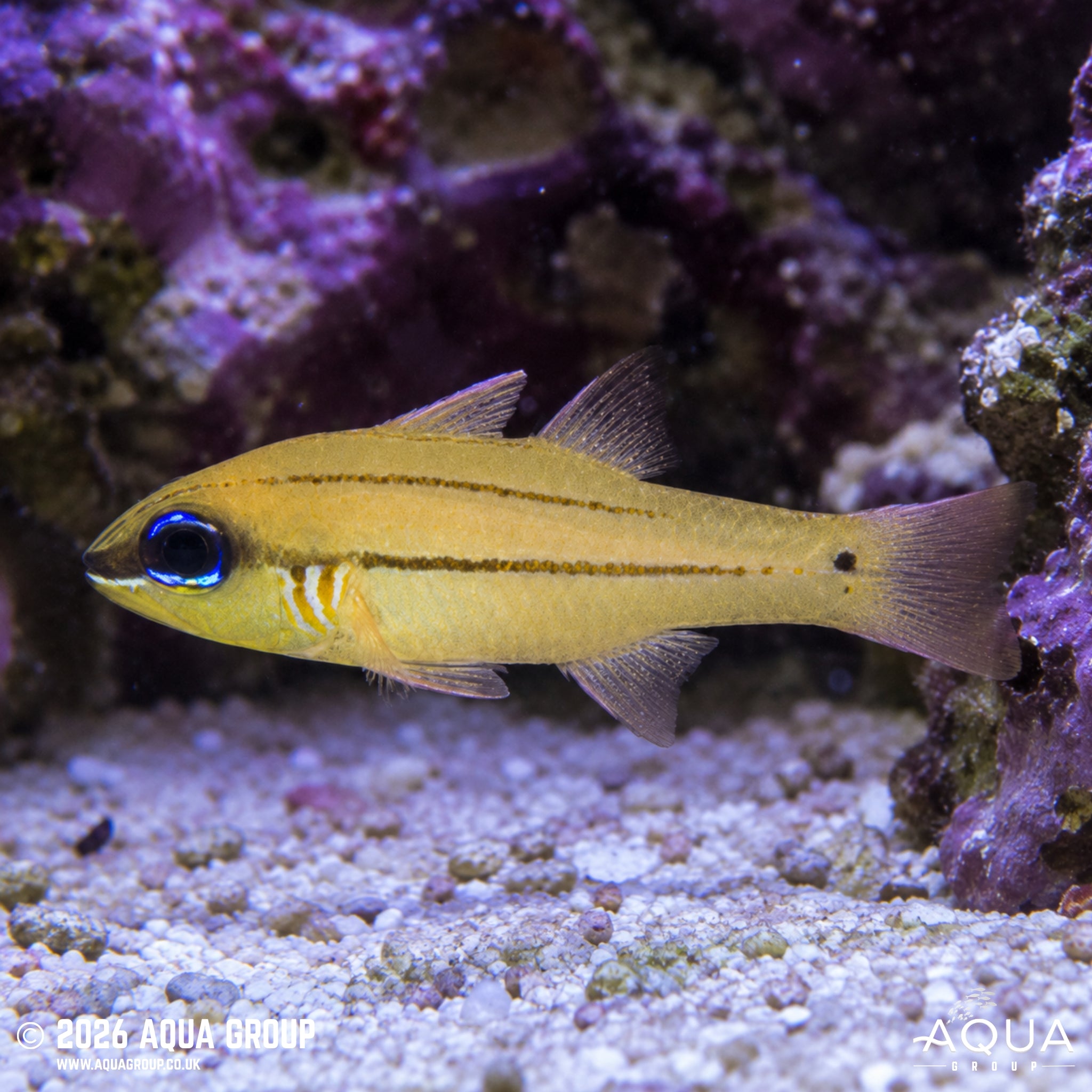
The Cheek-bar Cardinalfish, Ostorhinchus sealei, is a peaceful Indo-Pacific reef fish recognised by its pale yellow to silvery body, narrow brown horizontal stripes, distinctive bars across the gill cover and small dark marking at the base of the tail. Also known as Seale’s Cardinalfish or the Cheekbar Cardinal, this attractive species naturally shelters in groups among branching corals and reef structure. Its compact adult size, calm temperament and shoaling behaviour make it an appealing choice for peaceful community reef aquariums, particularly when maintained as a compatible pair or small group.
Common Name:
Cheek-bar Cardinalfish, Cheekbar Cardinalfish, Cheek-bar Cardinal, Seale’s Cardinalfish, Seale’s Cardinal.
Scientific Name (Latin):
Ostorhinchus sealei
Maximum Size:
Usually around 8–9 cm when fully grown, with some aquarium references listing a maximum close to 10 cm.
Water Type:
Marine
Origin / Natural Habitat:
Indo-West Pacific, ranging from Malaysia and Indonesia eastwards to the Solomon Islands, north to southern Japan and south to north-western Australia, with records from Palau and surrounding Micronesian waters. Cheek-bar Cardinalfish occur on coral reefs at depths of approximately 2–25 metres, where groups commonly shelter beneath ledges and among branching corals during brighter daylight periods.
Water Parameters:
Temperature: 24–27°C
pH Range: 8.1–8.4
Hardness or Salinity: Marine salinity 1.023–1.026 specific gravity; maintain stable salinity, alkalinity and good water quality with adequate oxygenation.
Temperament:
Peaceful, shy and social. Cheek-bar Cardinalfish are generally well suited to calm marine community aquariums and are best housed with non-aggressive fish that will not intimidate them or dominate feeding. Some minor disputes may occur within a group as individuals establish their position, particularly in cramped conditions or when too few hiding places are available.
Diet:
Carnivorous zooplankton feeder. In the wild, this species consumes small crustaceans, zooplankton and other tiny marine organisms. In the aquarium, offer enriched mysis shrimp, Artemia, copepods, finely chopped krill, small marine pellets, quality flakes and other appropriately sized frozen or prepared carnivorous foods. Feed small portions once or twice daily, preferably including some food during lower-light periods when cardinalfish are naturally more active.
Minimum Tank Size:
A minimum aquarium volume of approximately 120 litres is recommended for a single fish or compatible pair. A group should be provided with at least 200 litres, along with generous reef structure and sufficient sheltered areas to reduce competition.
Behaviour & Activity:
A relatively slow-moving cardinalfish that often remains close to branching coral, caves, overhangs or shaded rockwork during the day. Activity typically increases during the evening and under subdued lighting, when the fish move farther into open water to feed. This species may be maintained as a pair or small group, although adequate space and multiple retreats are important. Like other cardinalfish, males are mouthbrooders and carry developing eggs in the mouth.
Reef Safe:
Reef Safe
Cheek-bar Cardinalfish do not normally damage corals, anemones or other sessile reef invertebrates. Very small ornamental shrimps or newly released shrimp larvae may be eaten, particularly at night, but established medium and large ornamental shrimps are generally left alone.
Special Requirements or Care Notes:
Provide caves, overhangs, branching rockwork or coral structures where the fish can retreat during the day. Avoid housing with large, aggressive or extremely boisterous tank mates, as this shy species may remain hidden or struggle to obtain enough food. A pair or carefully introduced small group is preferable, but group members should be added together and provided with sufficient space. Use a secure aquarium cover because startled cardinalfish may jump. Captive-bred specimens may occasionally be available and are often well adapted to prepared aquarium foods.
Suitable for:
Beginner to intermediate marine fishkeepers
Availability:
Rare or occasional in trade / Captive-bred where available
All images are a visual representation of the fish you will receive, made to be as accurate as possible. Please note that Mother Nature is a wonderful thing, and variation in patterns and colours will occur — that is part of the unique beauty of these animals.
Order and get 22 reward points
Earn points by signing up for our rewards program