

Description
Candy Hogfish (Bodianus bimaculatus)
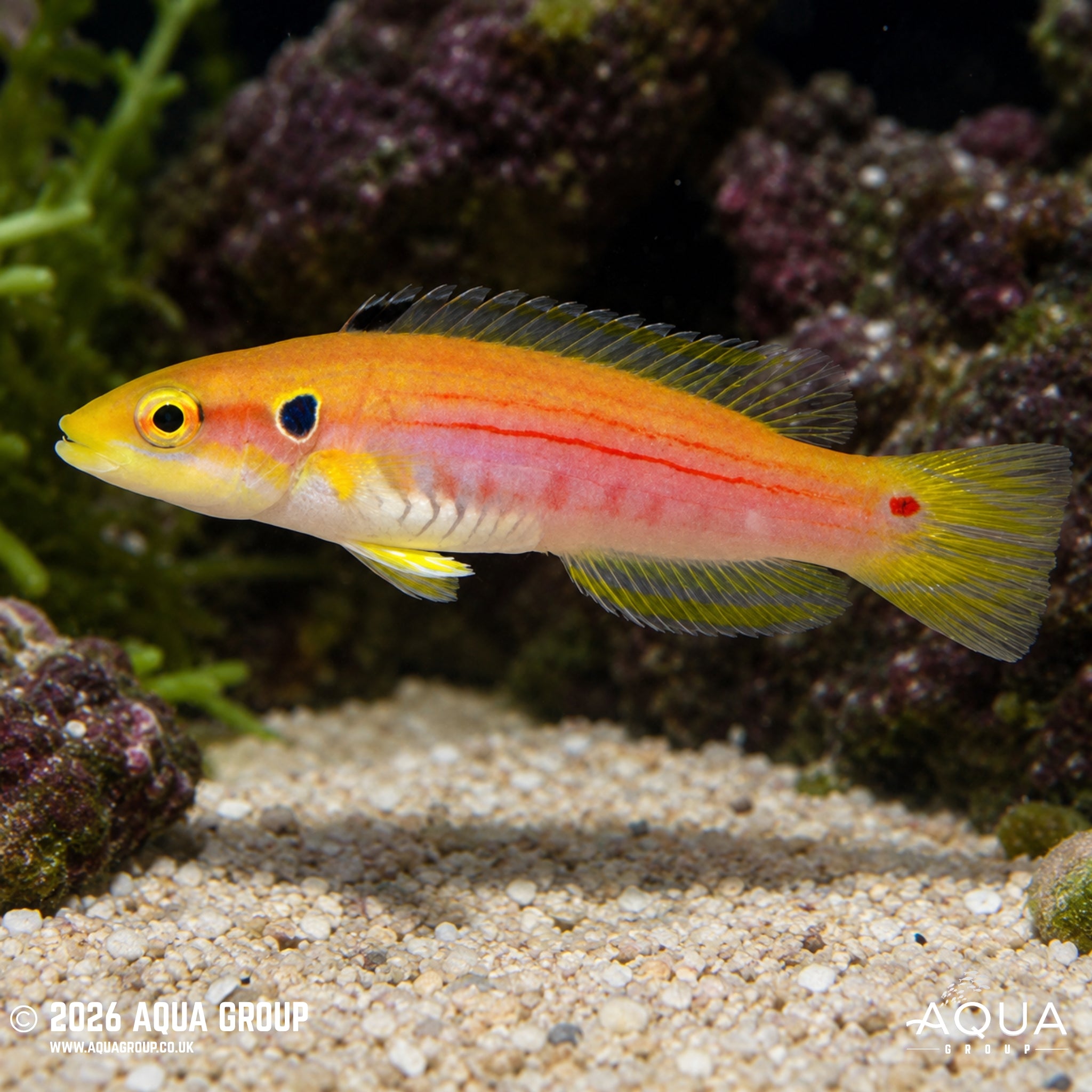
The Candy Hogfish, Bodianus bimaculatus, is a small and beautifully coloured Indo-Pacific wrasse recognised by its warm yellow, orange and pink colouration, fine red horizontal lines and two characteristic dark spots. Also known as the Twospot Hogfish or Two-spotted Hogfish, juveniles are often bright yellow, while females become increasingly orange and mature males develop stronger pink-red striping. This active reef micro-predator naturally inhabits deeper outer reef slopes with sand, rubble, sponges and soft coral growth. Its compact adult size and engaging behaviour make it an attractive choice for established reef aquariums, although small ornamental invertebrates may be at risk.
Common Name:
Candy Hogfish, Twospot Hogfish, Two-spot Hogfish, Two-spotted Hogfish, Twospot Pigfish, Two-spot Slender Hogfish.
Scientific Name (Latin):
Bodianus bimaculatus
Maximum Size:
Usually around 6–7 cm in total length when fully grown, with a reported scientific maximum of approximately 5.9 cm standard length.
Water Type:
Marine
Origin / Natural Habitat:
Widely distributed throughout the Indo-Pacific, from Madagascar eastwards to New Caledonia, and from southern Japan southwards towards New Zealand.
Candy Hogfish inhabit deeper outer reef slopes and drop-offs, generally at depths of approximately 30–100 metres, although they are most often recorded between 30 and 60 metres. They favour areas containing sand, coral rubble, sponges and soft coral growth, usually close to deeper water.
Small social groups may contain juveniles and females under the control of a larger mature male.
Water Parameters:
Temperature: 22–27°C
pH Range: 8.1–8.4
Hardness or Salinity: Marine salinity 1.023–1.026 specific gravity; stable salinity, strong oxygenation and consistently high water quality are important.
Temperament:
Generally peaceful to moderately assertive. Candy Hogfish usually coexist well with calm to moderately active reef fish, but established adults may become territorial towards other small hogfish, wrasses or fish competing for the same caves and feeding areas.
Their small size makes them vulnerable to large aggressive fish, while their active feeding behaviour may unsettle exceptionally shy species. A single specimen is normally the safest option unless a compatible pair or social group is maintained in a suitably spacious aquarium.
Diet:
Carnivorous micro-predator. In the wild, Candy Hogfish feed on small crustaceans, worms, molluscs and other tiny benthic invertebrates collected from rubble, sand and reef surfaces.
In the aquarium, offer enriched mysis shrimp, Artemia, copepods, Calanus, finely chopped krill, prawn and clam, together with small high-quality marine pellets or flakes. Feed small portions at least twice daily to support its active metabolism.
Newly introduced specimens may initially prefer frozen or live foods that move naturally through the water. Ensure food reaches the lower and middle areas of the aquarium before being taken by larger, faster fish.
Minimum Tank Size:
A minimum aquarium volume of approximately 150 litres is recommended for one adult, with mature live rock, open swimming space and several sheltered caves. A larger aquarium is preferable when maintaining it alongside other wrasses or territorial reef fish.
Behaviour & Activity:
An active daytime fish that spends much of its time moving through the lower and middle areas of the aquarium while inspecting rockwork, rubble and substrate for food. It commonly rests or retreats inside a cave or narrow crevice at night.
Juveniles are often bright yellow with two prominent dark spots, one around the gill-cover region and another near the base of the tail. Females gradually develop warmer orange tones and fine red stripes, while mature males become more strongly pink or reddish.
Juveniles may occasionally inspect larger fish in a manner resembling cleaning behaviour, although this should not be relied upon as a method of parasite control.
Reef Safe:
Reef Safe with Caution
Candy Hogfish do not normally consume healthy coral tissue and are generally compatible with established corals, anemones and clams. However, very small ornamental shrimps, tiny crabs, feather duster worms, tubeworms, snails and other small invertebrates may be investigated or eaten.
Larger established ornamental shrimps may be tolerated, but compatibility cannot be guaranteed as the fish matures. The species may also reduce populations of copepods, amphipods and beneficial worms within the aquarium.
Special Requirements or Care Notes:
Provide mature live rock containing caves, shaded overhangs and narrow sleeping crevices, together with open swimming room. A sand bed is beneficial for natural foraging but is not normally required for sleeping, as this hogfish retreats into rockwork rather than burying itself.
Because the species naturally inhabits deeper reef environments, newly imported specimens may initially be shy under intense aquarium lighting. Provide shaded areas and consider reducing light intensity temporarily while the fish settles.
Select only an alert specimen with clear eyes, intact fins and a well-filled body. Confirm that it accepts suitable aquarium foods before purchase whenever possible, as small deep-water wrasses can lose condition quickly if they fail to feed.
Avoid large predators, aggressive dottybacks, territorial damsels and highly dominant wrasses. Introduce similar hogfish carefully and consider using an acclimation box to assess aggression before release.
A tightly fitted aquarium cover or fine mesh lid is essential because Candy Hogfish can jump when startled. Cover openings around cables, pipework and feeding hatches.
Quarantine and slow acclimation are recommended. Provide several small meals each day during the first weeks and monitor the abdomen and area behind the head for signs of weight loss.
Suitable for:
Intermediate fishkeepers
Availability:
Rare or occasional in trade
All images are a visual representation of the fish you will receive, made to be as accurate as possible. Please note that Mother Nature is a wonderful thing, and variation in patterns and colours will occur — that is part of the unique beauty of these animals.
Order and get 45 reward points
Earn points by signing up for our rewards program