

Description
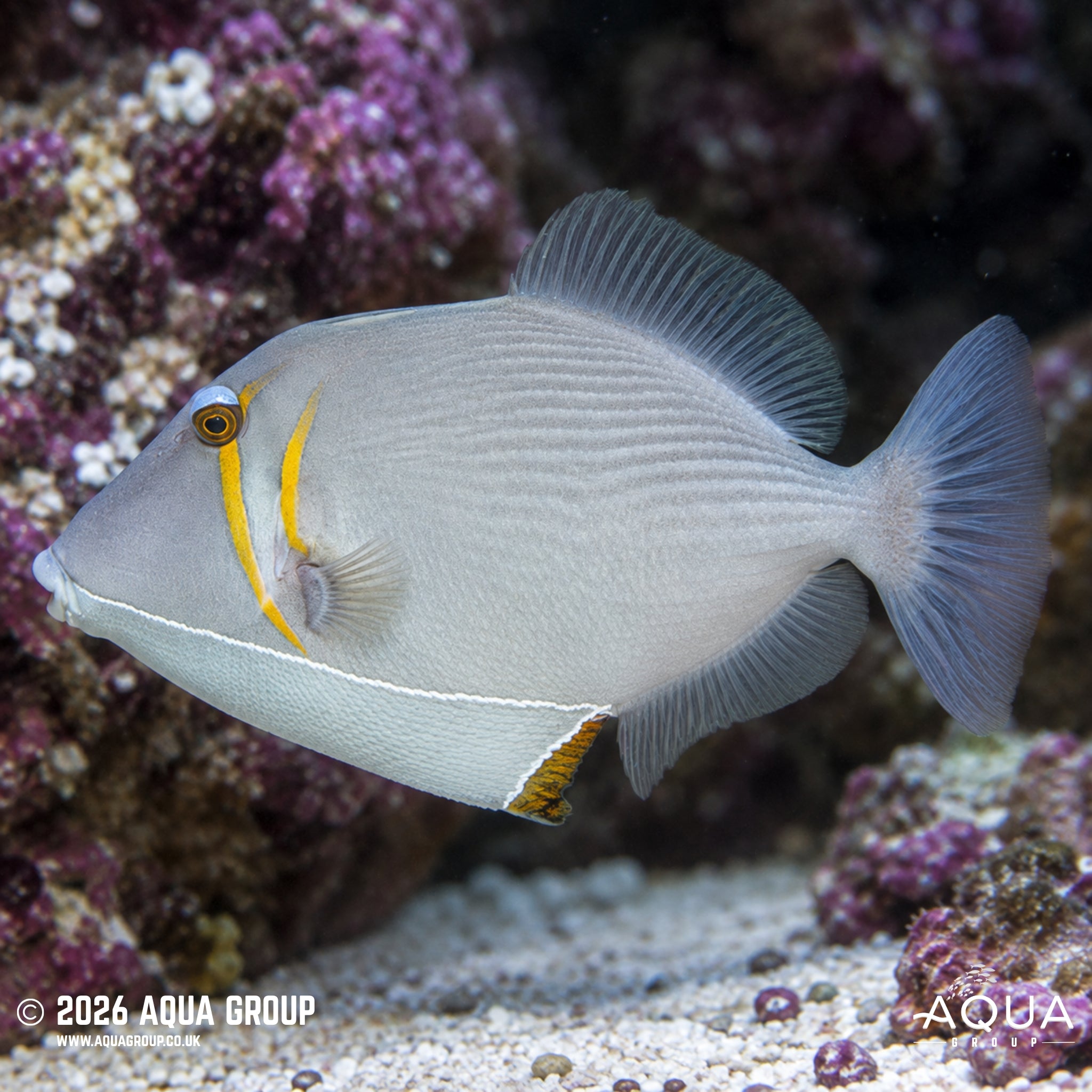
Bursa Triggerfish (Sufflamen bursa)
The Bursa Triggerfish, Sufflamen bursa, is a distinctive Indo-Pacific marine fish recognised by its pale grey to brown body, white underside, diagonal pale marking behind the mouth and curved boomerang-shaped patch around the base of each pectoral fin. Also known as the Boomerang Triggerfish, Pallid Triggerfish or Scythe Triggerfish, it inhabits clear lagoons, reef flats and seaward reefs where it searches rockwork and rubble for crustaceans, molluscs and other hard-shelled prey. Although generally less aggressive than some larger triggerfish, its powerful jaws, territorial nature and appetite for ornamental invertebrates make it best suited to a spacious fish-only or FOWLR aquarium.
Common Name:
Bursa Triggerfish, Boomerang Triggerfish, Pallid Triggerfish, Scythe Triggerfish, Lei Triggerfish.
Scientific Name (Latin):
Sufflamen bursa
Maximum Size:
Usually around 20–25 cm when fully grown.
Water Type:
Marine
Origin / Natural Habitat:
Widely distributed throughout the tropical Indo-Pacific, from East Africa eastwards through the Indian Ocean and northern Australia to the Hawaiian, Marquesas and Pitcairn Islands, and north to southern Japan.
Bursa Triggerfish inhabit clear lagoons, reef flats, coastal reefs and seaward reef slopes. They are commonly associated with coral, rocky reef structure, rubble and sandy areas where they search for benthic invertebrates and retreat into secure crevices when threatened.
Water Parameters:
Temperature: 24–28°C
pH Range: 8.1–8.4
Hardness or Salinity: Marine salinity 1.023–1.026 specific gravity; maintain stable salinity, alkalinity, strong oxygenation and consistently high water quality.
Temperament:
Semi-aggressive and territorial. Bursa Triggerfish are generally considered less confrontational than some large triggerfish species, but mature individuals may still become assertive towards smaller, timid or similarly shaped fish.
They may defend a preferred cave or section of rockwork and can become more territorial as they mature. Avoid housing them with very small fish, delicate bottom dwellers or passive species that may be intimidated during feeding.
Diet:
Omnivorous benthic predator with a strong preference for meaty foods. In the wild, this species feeds on crustaceans, molluscs, worms, echinoderms and other invertebrates collected from reef surfaces and rubble.
In the aquarium, offer whole or chopped marine prawns, krill, mysis shrimp, clam, mussel, cockle, squid and pieces of marine fish. Include hard-shelled foods such as unshelled prawns, cockles or mussels to encourage natural jaw use and help control tooth growth.
Supplement with high-quality marine pellets, spirulina-based foods and occasional marine algae. Feed varied portions once or twice daily, taking care not to overfeed.
Minimum Tank Size:
A minimum aquarium volume of approximately 500 litres is recommended for one adult, with a long swimming area, extensive secure rockwork and several large caves or sheltered retreats.
A larger aquarium is advisable when maintaining the fish with other triggerfish or similarly assertive marine species.
Behaviour & Activity:
An active daytime fish that patrols the lower and middle areas of the aquarium while inspecting rockwork, rubble and substrate for food.
Bursa Triggerfish use their strong jaws and prominent teeth to crush shells, turn over loose objects and investigate crevices. They may move small stones, coral rubble, shells and unsecured aquarium decorations while searching for prey.
When threatened or resting, the fish can raise its first dorsal spine and lock itself securely inside a rock crevice. This behaviour makes it difficult for predators to remove and should be considered before attempting to catch or transfer the fish.
Established individuals often become confident and responsive to their keeper, approaching the aquarium front at feeding time. They may also learn to recognise feeding tools and established maintenance routines.
Reef Safe:
Not Reef Safe
Bursa Triggerfish may consume ornamental shrimps, crabs, snails, hermit crabs, sea stars, urchins, worms, clams and other mobile or sessile invertebrates.
Although healthy coral tissue may not be its preferred food, the fish may bite corals while searching for prey, overturn unsecured colonies or damage coral skeletons and rockwork with its powerful jaws. It is best maintained in a fish-only or FOWLR aquarium rather than a valuable mixed reef system.
Special Requirements or Care Notes:
Provide substantial, securely positioned rockwork containing caves and crevices large enough for the adult fish to enter and turn around comfortably. All rocks should be placed directly onto the aquarium base rather than balanced loosely on sand.
Leave generous open swimming space along the front and centre of the aquarium. Avoid fragile decorations and ensure heaters, cables, thermometers and other equipment are protected from investigation or biting.
Offer a varied diet containing hard-shelled marine foods regularly. Triggerfish teeth grow continuously and natural chewing helps prevent excessive overgrowth.
Use feeding tongs rather than hand feeding. Even a normally calm individual can deliver a painful bite, particularly when excited by food or defending its territory.
Introduce the Bursa Triggerfish after smaller, more peaceful tank mates have settled where possible. Avoid combining it with tiny gobies, firefish, peaceful cardinalfish or slow-feeding species that may be intimidated or outcompeted.
Potential companions should be robust, suitably sized and capable of tolerating its active feeding behaviour. Compatibility with other triggerfish is unpredictable and requires a considerably larger aquarium with multiple territories and visual barriers.
Select only an alert specimen with clear eyes, intact fins, smooth skin and a well-filled body. Check the mouth and teeth for damage caused during capture or transport.
Quarantine is strongly recommended. Monitor for rapid breathing, scratching, cloudy eyes, white spots, damaged fins or refusal to feed. Triggerfish may be vulnerable to marine white spot, velvet and other external parasites.
A tightly fitted aquarium cover is essential because triggerfish can jump when startled. Cover openings around cables, pipework and overflow boxes.
Maintain strong filtration, efficient protein skimming and regular water changes. Triggerfish produce considerable waste, particularly when fed shellfish and other protein-rich foods.
Suitable for:
Intermediate to experienced marine fishkeepers
Availability:
Occasional in trade
All images are a visual representation of the fish you will receive, made to be as accurate as possible. Please note that Mother Nature is a wonderful thing, and variation in patterns and colours will occur — that is part of the unique beauty of these animals.
Order and get 40 reward points
Earn points by signing up for our rewards program