

Description
Bulgarian Seal Point Angelfish (Pterophyllum scalare)
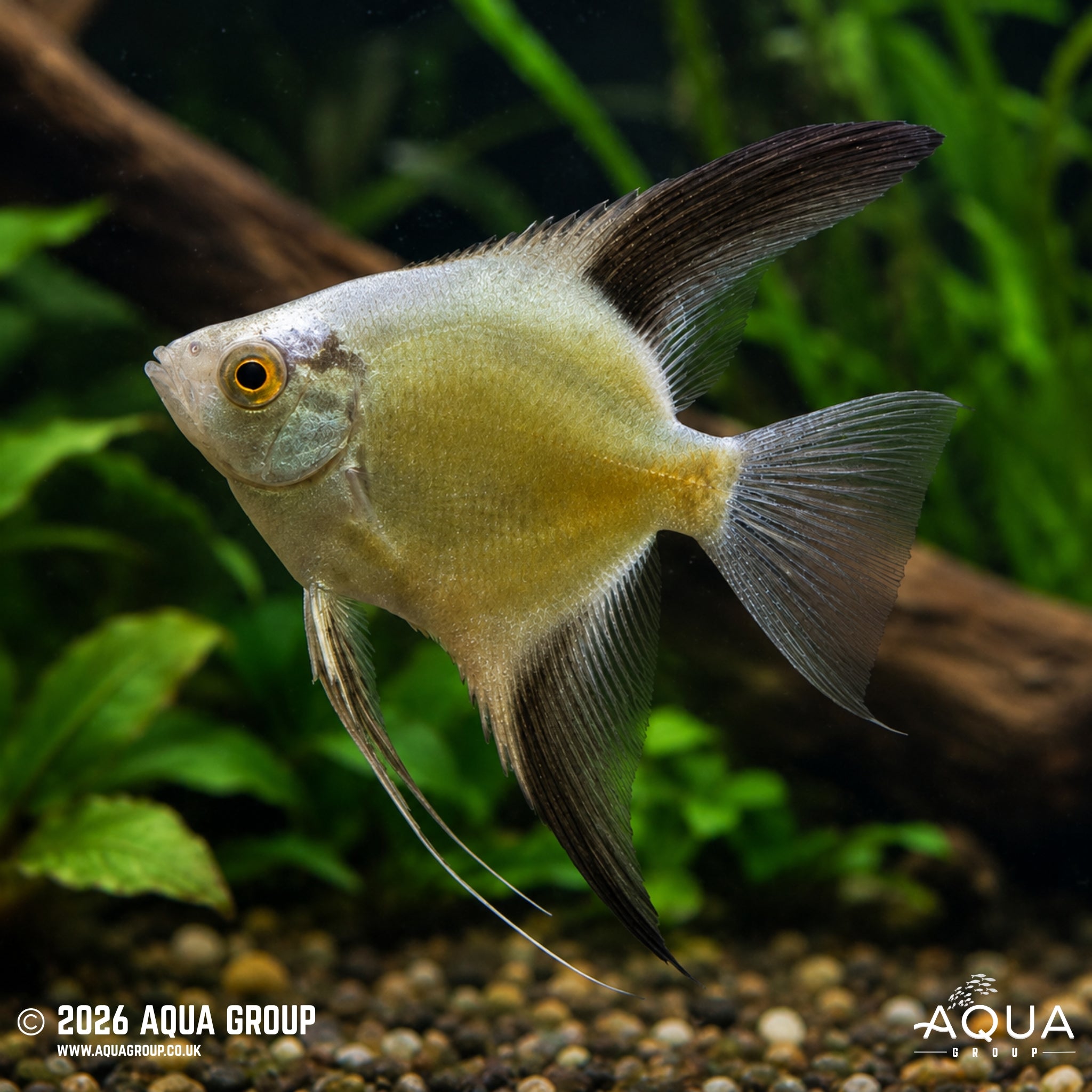
The Bulgarian Seal Point Angelfish, Pterophyllum scalare, is a distinctive selectively bred freshwater angelfish recognised by its pale silver to blue-grey body, darker fins and characteristic seal-point style contrast. Depending on the individual breeding line, subtle green, blue or smoky tones may develop across the body as the fish matures. Like other domestic Angelfish, this strain combines elegant finnage with a tall, laterally compressed body and confident cichlid behaviour. Its unusual colouration and graceful swimming style make it an impressive centrepiece for spacious planted community aquariums, although mature pairs can become territorial when breeding.
Common Name:
Bulgarian Seal Point Angelfish, Bulgarian Green Seal Point Angelfish, Seal Point Angelfish, BSP Angelfish.
Scientific Name (Latin):
Pterophyllum scalare
Maximum Size:
Usually around 10–15 cm in body length when fully grown, with the tall dorsal and anal fins creating a substantially greater overall height.
Water Type:
Freshwater
Origin / Natural Habitat:
The Bulgarian Seal Point Angelfish is a selectively bred ornamental strain and does not occur naturally in this colour form.
Wild Pterophyllum scalare originate from South America, particularly the Amazon River basin in Peru, Colombia and Brazil, with populations also occurring in the Essequibo and Oyapock river systems.
They naturally inhabit slow-moving rivers, flooded forests, tributaries and vegetated waterways containing submerged roots, branches and dense marginal vegetation.
Water Parameters:
Temperature: 24–30°C
pH Range: 6.0–8.0
Hardness or Salinity: Approximately 5–13°dGH; soft to moderately hard freshwater is suitable, with stable conditions being more important than achieving one exact value.
Temperament:
Generally peaceful to semi-aggressive. Bulgarian Seal Point Angelfish can coexist successfully with suitably sized community fish but may become territorial as they mature, particularly when a pair forms or spawning begins.
Adult males and established pairs may defend a section of the aquarium vigorously. Avoid very small fish that can eventually fit into the Angelfish’s mouth and persistent fin-nipping species that may damage the long dorsal, anal or pelvic fins.
Diet:
Omnivorous with a strong preference for animal-based foods. Wild Angelfish feed on small aquatic invertebrates, insect larvae, crustaceans and other available organic material.
In the aquarium, offer high-quality cichlid flakes, granules or slow-sinking pellets as the staple diet. Supplement with frozen or live Artemia, daphnia, mysis shrimp, mosquito larvae and bloodworms.
Include occasional spirulina or vegetable-based foods to provide dietary variety. Feed moderate portions once or twice daily.
Minimum Tank Size:
A minimum aquarium volume of approximately 180 litres is recommended for one established pair, with a tall aquarium, substantial open swimming room and planted or structured areas for shelter.
A larger aquarium of 250 litres or more is preferable for a group of juveniles or when maintaining several adult Angelfish.
Behaviour & Activity:
A graceful middle-water cichlid that spends much of its time swimming slowly between plants, wood and open areas.
Juvenile Angelfish can often be maintained together peacefully, but social behaviour changes as they mature. Pairs may form naturally within a group and begin defending a chosen section of the aquarium.
Bulgarian Seal Point Angelfish may vary noticeably in appearance as they mature. The pale body can develop silver, blue-grey, greenish or smoky tones, while the fins and extremities may become considerably darker.
The tall body shape allows Angelfish to manoeuvre naturally through vertical roots and vegetation. Their long thread-like pelvic fins are used continually while exploring their surroundings.
During breeding, a compatible pair selects and cleans a vertical surface such as a broad plant leaf, piece of slate or aquarium glass. The female lays rows of adhesive eggs, which are fertilised by the male.
Both parents may guard and fan the eggs and defend the fry after hatching, although captive pairs occasionally eat early broods.
Aquarium Category:
Semi-Aggressive
Bulgarian Seal Point Angelfish can be maintained successfully in a carefully planned freshwater community aquarium containing peaceful to moderately active species that are too large to be viewed as prey.
Suitable companions may include larger tetras, peaceful rainbowfish, Corydoras, medium-sized rasboras, peaceful plecos and other calm community species with similar temperature requirements.
Avoid very small tetras, Guppy fry, tiny Rasboras and other fish that may eventually be swallowed.
Special Requirements or Care Notes:
Provide a tall aquarium that allows the dorsal and anal fins to develop fully without repeatedly contacting the substrate or aquarium cover.
Use driftwood, tall plants, broad-leaved species and vertical structures to recreate the sheltered environments naturally preferred by Angelfish. Leave sufficient open water through the centre for comfortable swimming.
Maintain stable warm water with good biological filtration and regular partial water changes. Avoid sudden temperature or pH fluctuations.
When keeping a group, begin with sufficient space for individuals to establish territories as they mature. Once pairs form, aggression towards other Angelfish may increase significantly.
Provide visual barriers using tall plants and wood so subordinate fish can move away from dominant individuals. Remove persistently bullied fish if they are unable to feed or remain in open areas.
Avoid Tiger Barbs and other persistent fin-nipping species. The extended fins of domestic Angelfish can be particularly vulnerable to repeated biting.
Do not combine adult Angelfish with very small ornamental shrimps or tiny fish if predation would be a concern. Although not specialised predators, they will opportunistically consume animals that fit into their mouths.
If breeding is intended, provide broad vertical surfaces for spawning and consider using a dedicated breeding aquarium. Established pairs may defend eggs and fry aggressively against otherwise compatible tank mates.
Feed a varied diet and avoid excessive reliance on rich frozen foods. Overfeeding can lead to poor water quality and unnecessary weight gain.
Select only specimens with straight bodies, symmetrical fins, clear eyes and normal swimming posture. Avoid individuals with permanently clamped fins, bent mouths or obvious spinal deformities.
A secure aquarium cover is recommended because startled Angelfish may jump, particularly during chasing or territorial disputes.
Suitable for:
Intermediate freshwater fishkeepers
Availability:
Rare or occasional in trade
All images are a visual representation of the fish you will receive, made to be as accurate as possible. Please note that Mother Nature is a wonderful thing, and variation in patterns and colours will occur — that is part of the unique beauty of these animals.
Order and get 10 reward points
Earn points by signing up for our rewards program