

Description
Blue Head Tilefish (Hoplolatilus starcki)
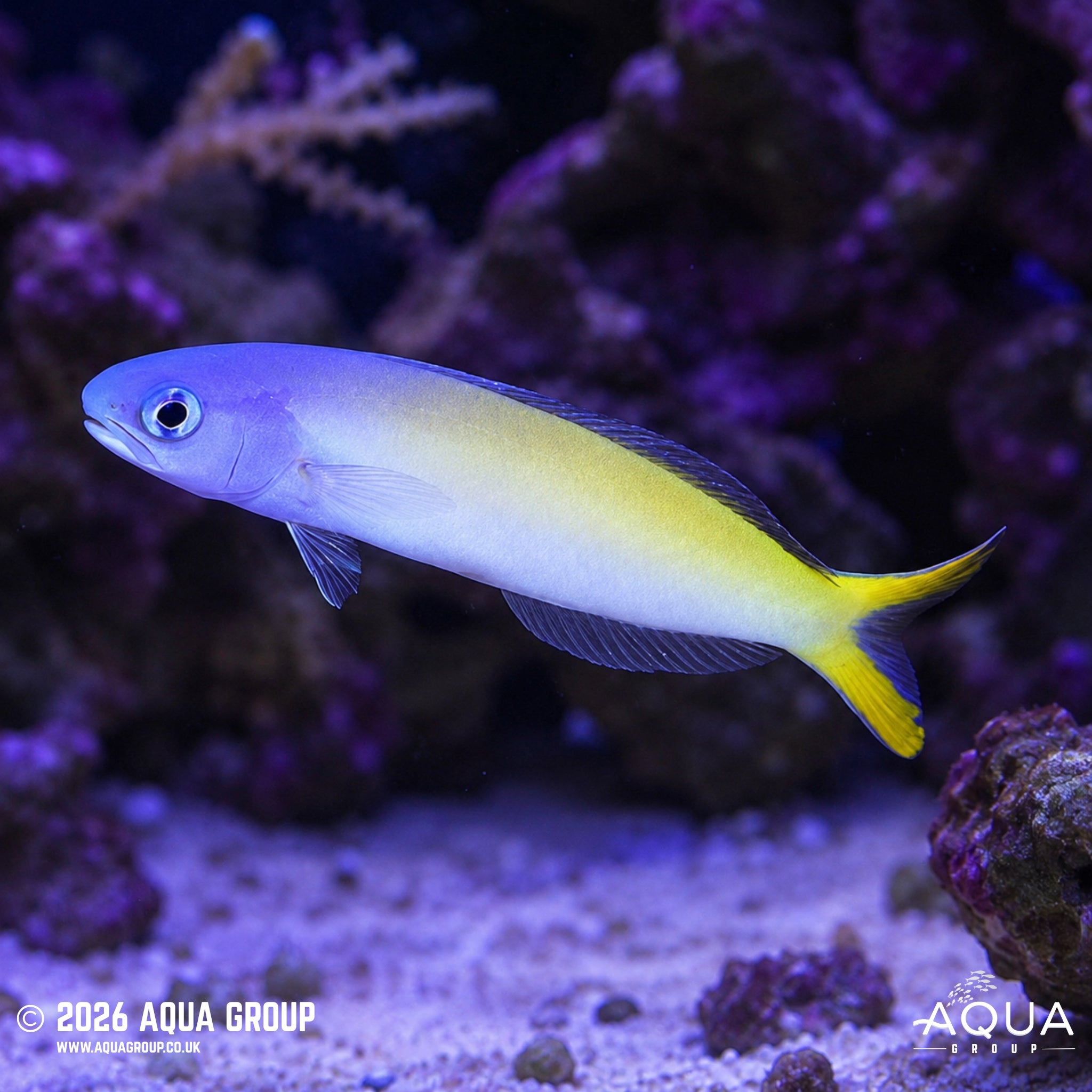
The Blue Head Tilefish (Hoplolatilus starcki) is an elegant Indo-Pacific marine fish recognised by its brilliant blue head, yellow-green body and broad yellow tail lobes. Also known as Stark’s Tilefish or the Blue-Faced Tilefish, it inhabits deep outer reef slopes containing sand, rubble and broken coral, where pairs construct burrows for shelter. Peaceful and highly active once settled, this striking zooplankton feeder can make an impressive addition to a mature reef aquarium, but its nervous disposition, specialised burrowing behaviour and exceptional ability to jump require careful aquarium preparation.
Common Name:
Blue Head Tilefish, Bluehead Tilefish, Stark’s Tilefish, Blue-Faced Tilefish, Blue Jaw Tilefish, Purple-Headed Sand Tilefish
Scientific Name (Latin):
Hoplolatilus starcki
Maximum Size:
Approximately 15–16 cm in total length. Although relatively slender, this is an active open-water swimmer that requires considerably more aquarium space than its body size alone might suggest.
Water Type:
Marine
Origin / Natural Habitat:
Native to the central Indo-Pacific, including Indonesia, the Philippines, Timor, the Mariana Islands, Micronesia, New Caledonia, northern Australia and surrounding Coral Sea reefs.
It inhabits patches of sand, scree, broken coral and rubble on steep outer reef slopes, generally at depths of approximately 20–105 metres. Adults are commonly encountered in pairs hovering close to a burrow, into which they retreat rapidly when alarmed.
Water Parameters:
Temperature: 24–27°C
pH Range: 8.1–8.4
Salinity: 1.023–1.026 SG
Temperament:
Peaceful, shy and easily intimidated. The Blue Head Tilefish is best kept with calm marine fish that will not chase it, dominate its burrow or prevent it from feeding.
It may be maintained singly or as an established compatible pair. Additional tilefish should not be introduced casually after one specimen has established a territory, as disputes may occur.
Diet:
A carnivorous zooplankton feeder that naturally captures small crustaceans and other drifting organisms from the water column.
Offer a varied diet of mysis shrimp, enriched brine shrimp, copepods, calanus, finely chopped krill and high-quality marine flakes or small pellets. Newly imported specimens may initially respond best to live copepods or enriched live brine shrimp before accepting frozen preparations.
Feed at least two or three small meals each day. Food should remain suspended in the water column, as this species is more likely to capture drifting particles than food resting on the substrate.
Minimum Tank Size:
A minimum aquarium volume of approximately 300 litres is recommended for a single specimen, with a tank length of at least 120 cm preferred.
A larger aquarium is advisable for a pair or when housing the fish with other active planktivores. The enclosure must provide both open swimming space and a substantial area suitable for burrow construction.
Behaviour & Activity:
An active daytime fish that usually hovers above the lower and middle areas of the aquarium, moving into open water to collect drifting food.
When frightened, it dives headfirst into its burrow with considerable speed. A settled pair may remain close together and share or maintain neighbouring shelter sites.
Juveniles are predominantly sky blue, while adults develop a vivid blue head and pectoral-fin base, with a tan to greenish body becoming increasingly yellow towards the tail.
Newly introduced specimens may remain hidden for extended periods and can be particularly nervous under intense lighting or around boisterous tank mates.
Reef Safe:
Reef Safe with Caution
The Blue Head Tilefish does not normally damage healthy corals and is generally compatible with clams, snails and most established ornamental invertebrates.
However, very small shrimps and other tiny crustaceans may be eaten. Its digging may also move loose rubble, undermine unsecured coral pieces or deposit substrate around low-positioned corals.
Special Requirements or Care Notes:
A completely secure aquarium cover is essential. Tilefish are exceptionally powerful and accurate jumpers, particularly when startled, chased or newly introduced. Every gap around cables, pipework, overflow boxes and feeding openings must be sealed.
Provide a substrate at least approximately 7–10 cm deep across part of the aquarium. A mixture of fine sand, small coral rubble, shells and smooth gravel allows the fish to construct a stable burrow.
All major rock structures must be positioned directly on the aquarium base or secure supports before substrate is added. Loose rockwork may collapse if the tilefish excavates beneath it.
Subdued lighting or shaded areas are strongly recommended, particularly during acclimatisation. The species naturally occurs on deeper reef slopes and may remain stressed in an intensely illuminated aquarium without sheltered areas.
Provide strong oxygenation, efficient filtration and moderate water movement that keeps small foods suspended without making it difficult for the fish to hold position.
Avoid aggressive tangs, triggers, large wrasses, territorial dottybacks and other boisterous fish. Persistent intimidation can cause repeated jumping, refusal to feed or prolonged hiding.
Confirm that the fish is eating before purchase whenever possible. Avoid specimens with a pinched abdomen, mouth damage, rapid breathing or weak, disorientated swimming.
A carefully managed quarantine period is recommended. Include a covered container of suitable sand and rubble so the fish can retreat naturally during quarantine.
Suitable for:
Experienced fishkeepers
Availability:
Rare or occasional in trade
All images are a visual representation of the fish you will receive, made to be as accurate as possible. Please note that Mother Nature is a wonderful thing, and variation in patterns and colours will occur — that is part of the unique beauty of these animals.
Order and get 85 reward points
Earn points by signing up for our rewards program