

Description
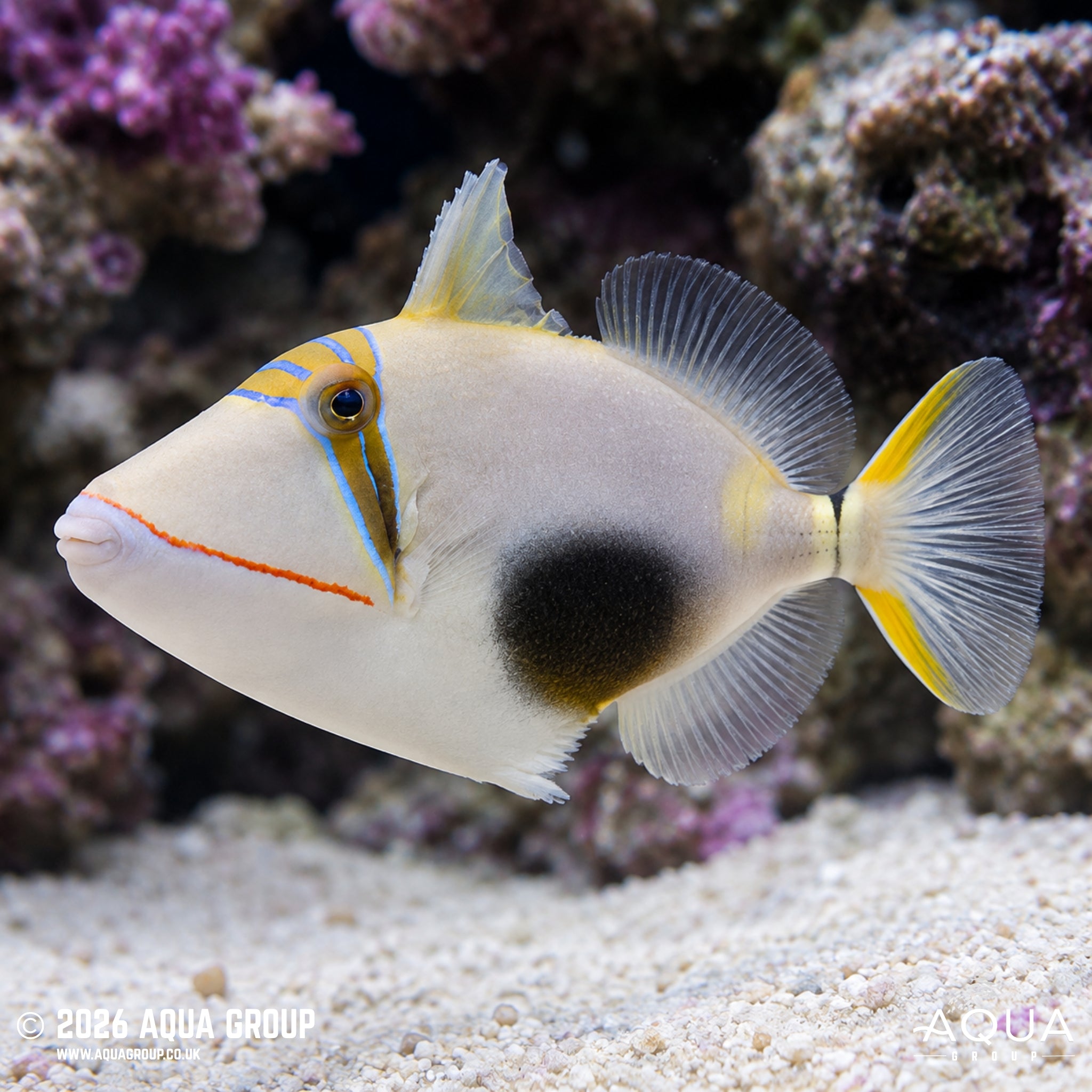
Blackbelly Triggerfish (Rhinecanthus verrucosus)
The Blackbelly Triggerfish, Rhinecanthus verrucosus, is a bold and distinctive Indo-West Pacific marine fish recognised by the large dark patch across its underside, blue facial lines and contrasting black, white and yellow markings. Also known as the Blackpatch Triggerfish or Bursa Triggerfish, it naturally inhabits shallow coral reefs, lagoons and rubble-strewn coastal habitats. This intelligent, highly active triggerfish develops a confident personality and powerful feeding response, but its territorial behaviour, strong teeth and appetite for invertebrates make it best suited to a spacious fish-only or FOWLR aquarium with robust tank mates.
Common Name:
Blackbelly Triggerfish, Black Belly Triggerfish, Blackpatch Triggerfish, Black-patch Triggerfish, Bursa Triggerfish.
Scientific Name (Latin):
Rhinecanthus verrucosus
Maximum Size:
Capable of reaching approximately 23 cm when fully grown. Aquarium specimens commonly reach around 18–22 cm and develop into deep-bodied, powerful fish.
Water Type:
Marine
Origin / Natural Habitat:
Indo-West Pacific, ranging from the Seychelles and Chagos Archipelago eastwards through Southeast Asia and northern Australia to Vanuatu, and north to southern Japan.
Blackbelly Triggerfish inhabit shallow coral reefs, protected lagoons, reef flats and coastal areas containing sand, rubble and rockwork. They usually remain close to the seabed and reef structure, where they search for crustaceans, molluscs, worms and other benthic food.
Water Parameters:
Temperature: 24–28°C
pH Range: 8.1–8.4
Hardness or Salinity: Marine salinity 1.023–1.026 specific gravity; stable salinity, strong oxygenation, efficient biological filtration and consistently good water quality are essential.
Temperament:
Semi-aggressive to aggressive, territorial and increasingly assertive with maturity. Juveniles may initially coexist with a range of marine fish, but established adults can defend caves, feeding areas and large sections of the aquarium.
Blackbelly Triggerfish may chase, bite or intimidate peaceful and similarly shaped fish. They are best housed with robust, confident tank mates that are too large to swallow and capable of tolerating their active behaviour. Keeping more than one Rhinecanthus triggerfish is not normally recommended unless the aquarium is exceptionally large.
Diet:
Omnivorous benthic predator. In the wild, this species feeds on crustaceans, molluscs, worms, echinoderms, tunicates, sponges, algae and other organisms collected from reef surfaces and the substrate.
In the aquarium, offer whole or chopped marine prawns, shell-on shrimp, mussels, cockles, clam, squid, krill and pieces of marine fish. High-quality carnivore pellets and some algae-based marine foods may also be accepted.
Regular hard-shelled foods help provide natural tooth wear. Feed juveniles once or twice daily, while established adults can receive controlled portions once daily or several substantial meals each week depending on size and body condition.
Minimum Tank Size:
A minimum aquarium volume of approximately 400 litres is recommended for one adult, with a long swimming area, substantial open floor space and firmly secured rockwork. A larger aquarium is preferable when keeping it alongside other territorial or large-bodied marine fish.
Behaviour & Activity:
An active and inquisitive daytime fish that spends much of its time patrolling rockwork, investigating the substrate and searching for food. It may blow jets of water into sand, overturn loose objects and bite rock or aquarium equipment while exploring.
Like other triggerfish, it can raise and lock its strong first dorsal spine to wedge itself securely inside a cave or crevice. Established individuals often recognise their keeper, approach the aquarium front at feeding time and may become defensive around a preferred shelter.
Reef Safe:
Not Reef Safe
Blackbelly Triggerfish will hunt ornamental shrimps, crabs, snails, hermit crabs, sea urchins, starfish, tubeworms and other mobile invertebrates. It may also bite clam mantles, disturb corals and overturn unsecured frags or rockwork.
Although healthy coral tissue may not be its primary food, its destructive foraging behaviour and strong jaws make it unsuitable for most conventional mixed reef aquariums.
Special Requirements or Care Notes:
Provide substantial open swimming space alongside large caves and firmly secured rockwork. Decorations must be stable and heavy enough to resist being pushed, bitten or overturned by an established adult.
Use powerful biological filtration, efficient protein skimming and regular water changes. Triggerfish are enthusiastic feeders that produce considerable waste, particularly when offered shellfish and other protein-rich foods.
Choose tank mates carefully. Suitable companions may include robust tangs, larger angelfish, groupers and similarly substantial marine fish, provided the aquarium is large enough. Avoid timid fish, very small species, slow-moving long-finned fish and animals likely to compete for the same cave.
Introduce the Blackbelly Triggerfish after more peaceful fish have become established where possible. An acclimation box may help assess aggression, although it must be strong enough to withstand biting. Persistent attacks should be addressed promptly rather than assumed to be temporary.
Provide hard-shelled marine foods regularly and monitor the teeth for abnormal overgrowth. Do not rely on freshwater feeder fish or mammalian meat, as these are unsuitable long-term foods.
Use long feeding tongs rather than fingers. This species has powerful teeth and can deliver a painful bite, particularly when excited by food or defending its territory. Keep hands away from occupied caves and be aware of the fish’s position during aquarium maintenance.
A strong, tightly fitted aquarium cover is recommended. Protect cables, heater guards and exposed equipment because triggerfish may bite unfamiliar objects. Take care during capture, as the locked dorsal spine can become caught in nets; a rigid submerged container is often safer.
Suitable for:
Intermediate to experienced fishkeepers
Availability:
Occasional in trade
All images are a visual representation of the fish you will receive, made to be as accurate as possible. Please note that Mother Nature is a wonderful thing, and variation in patterns and colours will occur — that is part of the unique beauty of these animals.
Order and get 30 reward points
Earn points by signing up for our rewards program