

Description
Black Picasso Clownfish (Amphiprion ocellaris)
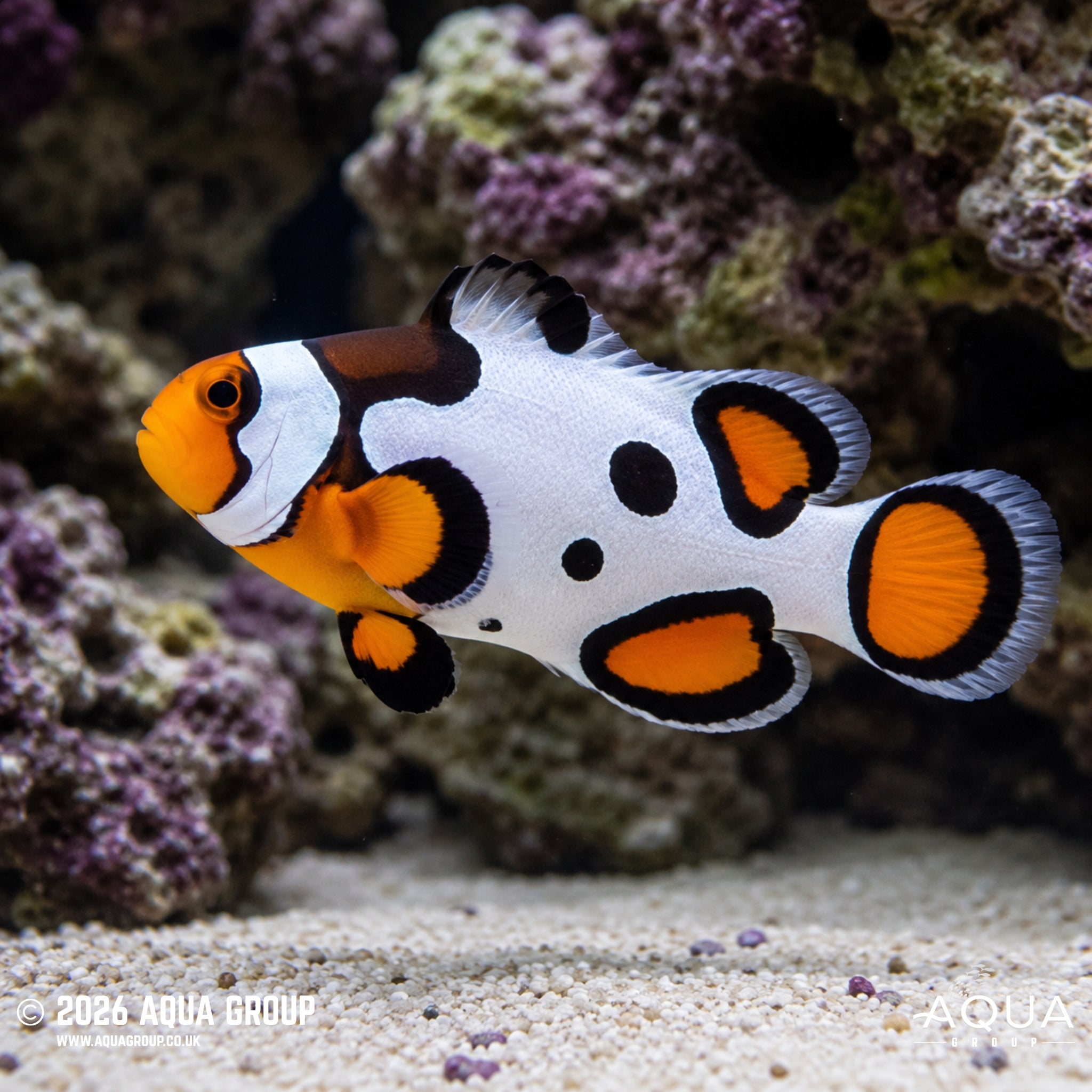
The Black Picasso Clownfish, Amphiprion ocellaris, is a captive-bred designer clownfish selected for its dramatic black colouration and irregular white Picasso-style markings. Each individual develops a unique pattern, with white bars that may widen, connect or form unusual shapes across the body. This striking Ocellaris Clownfish retains the hardy nature, engaging personality and fascinating pairing behaviour associated with the species. It is well suited to established community reef aquariums and does not require a host anemone, making it an appealing choice for both newer and experienced marine fishkeepers.
Common Name:
Black Picasso Clownfish, Black Picasso Ocellaris Clownfish, Picasso Ocellaris Clownfish, Designer Ocellaris Clownfish, False Percula Clownfish.
Scientific Name (Latin):
Amphiprion ocellaris “Black Picasso”
Maximum Size:
Usually around 8–10 cm when fully grown, with dominant females growing larger than males. The wild species has a reported maximum length of approximately 11 cm.
Water Type:
Marine
Origin / Natural Habitat:
The Black Picasso Clownfish is a captive-bred designer colour form and does not represent a naturally occurring geographical population. Its distinctive black and white pattern has been developed through selective breeding.
Wild Amphiprion ocellaris occur in the eastern Indian Ocean and western Pacific, including areas around the Andaman and Nicobar Islands, Thailand, Malaysia, Indonesia, Singapore, the Philippines and northern Australia. They inhabit shallow lagoons and sheltered coral reefs, where they live in close association with compatible host anemones.
Water Parameters:
Temperature: 24–28°C
pH Range: 8.1–8.4
Hardness or Salinity: Marine salinity 1.023–1.026 specific gravity; stable salinity, alkalinity, good oxygenation and consistently high water quality are important.
Temperament:
Generally peaceful to moderately territorial. Black Picasso Clownfish usually adapt well to community marine aquariums but may defend a chosen cave, coral, anemone or section of rockwork, particularly once established or paired.
A mature female may become assertive towards newly introduced clownfish and other fish entering her territory. Avoid mixing several unrelated clownfish in a small aquarium, as dominant individuals may severely harass weaker fish.
Diet:
Omnivorous. Wild Ocellaris Clownfish feed on zooplankton, small crustaceans, algae and organic material gathered around their host anemone.
In the aquarium, offer enriched mysis shrimp, Artemia, copepods, finely chopped krill, quality marine flakes, small pellets and foods containing spirulina or marine algae. Feed varied portions once or twice daily, with smaller and more frequent meals suitable for young fish.
Minimum Tank Size:
A minimum aquarium volume of approximately 75 litres is recommended for one fish or a compatible pair. A larger aquarium is preferable when keeping the pair with several other territorial reef fish.
Behaviour & Activity:
An active and engaging clownfish that usually remains around a preferred area of rockwork, coral or other chosen shelter. It may adopt a suitable anemone, but an anemone is not required for its health or long-term care. Captive-bred fish may instead associate with soft corals, large-polyp stony corals, macroalgae, caves or even aquarium equipment.
Ocellaris Clownfish form a dominance hierarchy. The largest individual develops into the female, while the next-largest becomes the breeding male. When two compatible juveniles are housed together, repeated chasing and submissive body-shaking may occur while the pair establishes its social roles.
Reef Safe:
Reef Safe
Black Picasso Clownfish do not normally damage corals or hunt established ornamental invertebrates. They are suitable for mixed reef aquariums, although an individual may repeatedly rub against or shelter within a coral, potentially causing sensitive polyps to remain retracted. Very small crustacean larvae may be eaten.
Special Requirements or Care Notes:
This designer form should be captive-bred. Pattern shape, white coverage and the amount of black colouration vary naturally between individuals and may continue to develop as the fish matures. Juveniles can retain some orange or brown colour before becoming darker with age, depending on their genetic line.
A host anemone is optional and should only be added to a sufficiently mature, stable aquarium with appropriate lighting and flow. Never purchase an anemone solely because a clownfish requires one, as captive-bred Ocellaris Clownfish can live normally without a host.
When forming a pair, introduce two juveniles of noticeably different sizes or obtain an established compatible pair. Do not add a second large female to an occupied aquarium. Use an acclimation box when introducing a new potential partner and separate the fish if persistent biting, injury or prevention from feeding occurs.
Provide secure rockwork, sheltered retreats and moderate water movement. A fitted aquarium cover is recommended, as newly introduced clownfish may jump when frightened. Quarantine new fish where possible and monitor carefully for common clownfish health concerns, including rapid breathing, excess mucus, white spots, loss of appetite or unusual swimming.
Suitable for:
Beginner to intermediate marine fishkeepers
Availability:
Captive-bred / Occasional in trade
All images are a visual representation of the fish you will receive, made to be as accurate as possible. Please note that Mother Nature is a wonderful thing, and variation in patterns and colours will occur — that is part of the unique beauty of these animals.
Order and get 95 reward points
Earn points by signing up for our rewards program