

Description
Banggai Cardinalfish (Pterapogon kauderni)
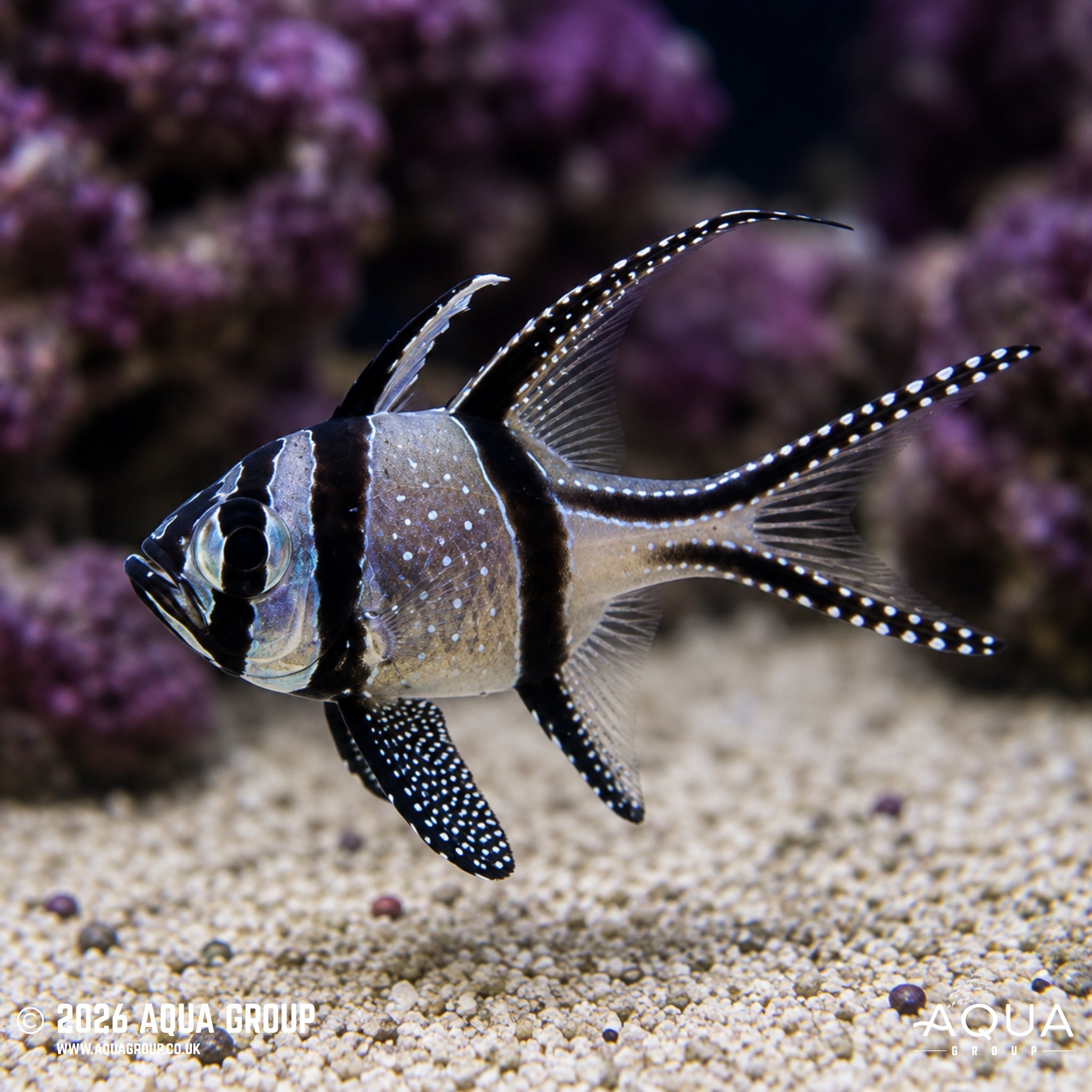
The Banggai Cardinalfish, Pterapogon kauderni, is a distinctive Indonesian marine fish recognised by its silver body, three bold black vertical bands, white-spotted fins and elongated dorsal rays. Also known as Kaudern’s Cardinalfish, it naturally occurs within a very restricted region around the Banggai Islands, where groups shelter among long-spined sea urchins, seagrass and branching reef structure. Its calm swimming style, compact adult size and unusual mouthbrooding behaviour make it a popular reef aquarium fish. Captive-bred specimens are strongly recommended because they adapt well to aquarium foods and reduce pressure on vulnerable wild populations.
Common Name:
Banggai Cardinalfish, Banggai Cardinal Fish, Kaudern’s Cardinalfish, Kaudern’s Cardinal.
Scientific Name (Latin):
Pterapogon kauderni
Maximum Size:
Usually around 7–8 cm when fully grown, with a reported scientific maximum of approximately 8.6 cm.
Water Type:
Marine
Origin / Natural Habitat:
Naturally endemic to the Banggai Archipelago and a small number of nearby islands off eastern Sulawesi, Indonesia. Introduced populations have also become established outside the species’ original range through human activity.
Banggai Cardinalfish inhabit shallow, sheltered coastal environments, including seagrass beds, sandy areas, coral reefs, jetties and rubble habitats. They are closely associated with protective structures such as long-spined sea urchins, branching corals and sea anemones, among which juveniles retreat when threatened.
Water Parameters:
Temperature: 24–28°C
pH Range: 8.1–8.4
Hardness or Salinity: Marine salinity 1.023–1.026 specific gravity; stable salinity, good oxygenation and consistently high water quality are important.
Temperament:
Generally peaceful towards unrelated reef fish but territorial towards its own species once pairs form. Juveniles may coexist in groups, but maturing individuals often establish pairs and can aggressively exclude weaker or unpaired fish.
A compatible pair is normally the safest long-term arrangement in a home aquarium. Larger groups require considerably more space, visual barriers and careful monitoring for persistent chasing or individuals being prevented from feeding.
Diet:
Carnivorous micro-predator and zooplankton feeder. In the wild, Banggai Cardinalfish consume copepods, amphipods, small shrimps and other planktonic or benthic crustaceans.
In the aquarium, offer enriched mysis shrimp, Artemia, copepods, finely chopped krill, small marine pellets and quality marine flakes. Captive-bred fish usually accept prepared foods readily. Feed small portions once or twice daily, ensuring that shy individuals receive enough food.
Minimum Tank Size:
A minimum aquarium volume of approximately 100–120 litres is recommended for one fish or a compatible pair. A larger aquarium of at least 250 litres is advisable for a carefully managed group, with extensive structure and several separated territories.
Behaviour & Activity:
A slow, deliberate midwater fish that normally remains close to rockwork, branching coral, long-spined sea urchins or other protective structure. Unlike many cardinalfish, it is frequently visible during daylight and often hovers in one area rather than swimming continuously around the aquarium.
Banggai Cardinalfish are paternal mouthbrooders. After spawning, the male carries the fertilised eggs and developing young inside his mouth, refusing food throughout much of the incubation period. Newly released young are relatively large and do not pass through a prolonged free-swimming larval stage.
Reef Safe:
Reef Safe
Banggai Cardinalfish do not normally damage corals, anemones, clams or established ornamental invertebrates. They are well suited to peaceful mixed reef aquariums. Very small shrimps, crustacean larvae and tiny mobile invertebrates may be consumed.
Special Requirements or Care Notes:
Choose captive-bred specimens whenever available. The Banggai Cardinalfish has an exceptionally restricted natural distribution, and wild populations have been affected by aquarium collection, habitat damage and other environmental pressures. Captive-bred fish are also generally better adapted to transport and prepared aquarium foods.
Provide caves, branching rockwork and sheltered areas where fish can retreat. Artificial or responsibly maintained long-spined urchins are not essential, but complex structure helps reproduce the protection these cardinalfish seek naturally.
Do not assume that a group of juveniles will remain peaceful as adults. Watch for one fish being isolated, repeatedly chased, hiding continuously or losing weight. Remove or separate bullied individuals promptly, as established pairs can be intolerant of additional Banggai Cardinalfish.
When forming a pair, introduce similarly sized juveniles and allow them to choose naturally where possible. External sex differences are subtle and unreliable, although mature males may show slight differences around the jaw and genital papilla. Purchasing a confirmed compatible pair is the most dependable option.
Avoid large, aggressive or highly boisterous tank mates. A secure aquarium cover is recommended, particularly during introduction. Maintain gentle to moderate water movement with good oxygenation and ensure food reaches the fish without being taken by faster feeders.
Suitable for:
Beginner to intermediate marine fishkeepers
Availability:
Common in trade / Captive-bred strongly recommended
All images are a visual representation of the fish you will receive, made to be as accurate as possible. Please note that Mother Nature is a wonderful thing, and variation in patterns and colours will occur — that is part of the unique beauty of these animals.
Order and get 25 reward points
Earn points by signing up for our rewards program