
Description
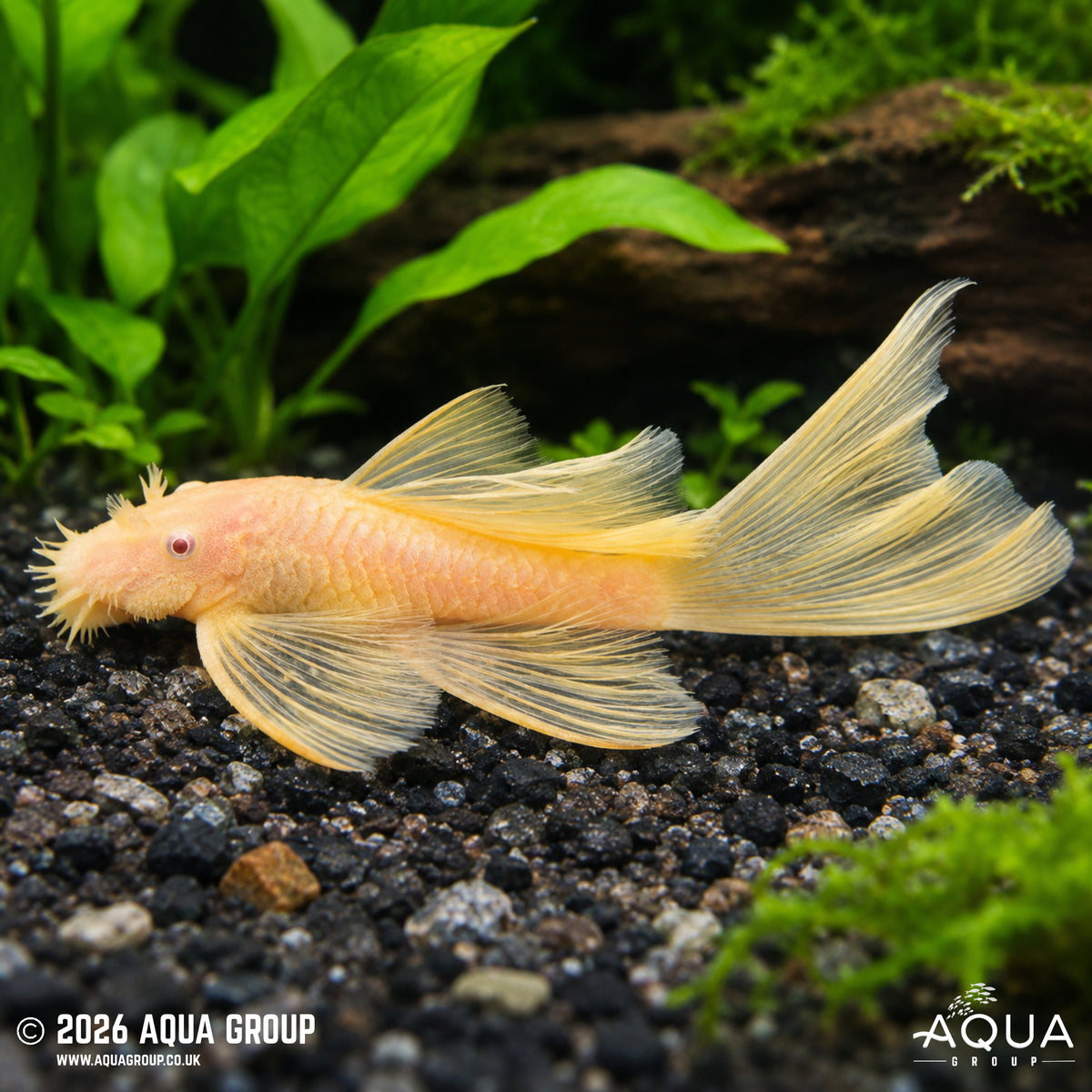
Albino Longfin Bristlenose Pleco (Ancistrus sp. 'Albino Longfin')
The Albino Longfin Bristlenose Pleco is a beautiful and distinctive freshwater catfish admired for its golden-yellow colouration, striking reddish-pink eyes and elegant flowing fins. A selectively bred ornamental variety of the popular Bristlenose Pleco, this attractive fish features a flattened body, specialised sucker-shaped mouth and extended dorsal, pectoral and tail fins that create a particularly graceful appearance. Its peaceful temperament, manageable adult size and natural algae-grazing behaviour make it a popular choice for established tropical community aquariums. Whether resting beneath driftwood or exploring aquarium surfaces in search of food, the Albino Longfin Bristlenose is an interesting and practical addition to planted freshwater displays.
Common Name:
Albino Longfin Bristlenose Pleco, Longfin Albino Bristlenose, Albino Longfin Ancistrus, Longfin Albino Bristlenose Catfish
Scientific Name (Latin):
Ancistrus sp. 'Albino Longfin' (commonly traded as Ancistrus dolichopterus var.)
Maximum Size:
Approximately 12–15 cm, with the extended finnage creating a larger overall appearance
Water Type:
Freshwater
Origin / Natural Habitat:
The Albino Longfin Bristlenose Pleco is a selectively bred ornamental variety developed through captive breeding to produce its distinctive albino colouration and elongated fins.
The precise ancestry of many ornamental Bristlenose breeding lines remains uncertain, although the wild relatives of these fish originate from freshwater river systems throughout tropical South America.
Wild Ancistrus species inhabit rivers, streams and tributaries containing submerged driftwood, rocks, natural crevices and areas of flowing, oxygen-rich water.
These environments provide shelter and natural grazing surfaces where algae, biofilm and other organic material accumulate.
Their specialised sucker-shaped mouths allow them to cling to submerged surfaces and graze while navigating areas of moving water.
The Albino Longfin variety retains the feeding habits and general behaviour of its wild relatives but has been selectively bred for its attractive ornamental appearance.
Water Parameters:
Temperature: 22–28°C
pH Range: 6.0–7.8
Hardness: Soft to Moderately Hard, approximately 4–15 dGH
Ammonia/Nitrite: 0 ppm
Nitrate: Kept low and stable
Temperament:
Peaceful to Semi-Aggressive
Albino Longfin Bristlenose Plecos are generally peaceful bottom-dwelling fish that are well suited to established freshwater community aquariums.
They spend much of their time resting beneath driftwood, exploring aquarium surfaces and grazing on naturally occurring algae and biofilm.
Although usually peaceful towards unrelated fish, mature males can become territorial towards other Bristlenose Plecos, particularly when competing for caves or preferred resting areas.
They can be maintained individually or in compatible pairs, provided sufficient aquarium space and shelter are available.
Avoid keeping multiple mature males together in smaller aquariums, as territorial disputes may result in stress or injury.
Their extended fins are more vulnerable to damage than those of standard Bristlenose varieties, making careful tankmate selection particularly important.
Diet:
Omnivore / Primarily Herbivorous Grazer
Albino Longfin Bristlenose Plecos naturally spend much of their time grazing on algae, biofilm and other organic material found on submerged surfaces.
In the aquarium, provide a balanced diet based around high-quality algae wafers, spirulina-enriched sinking pellets and specialist vegetable-based catfish foods.
Fresh vegetables such as blanched courgette, spinach, cucumber and shelled peas can also be offered regularly.
Small quantities of protein-rich foods, including frozen bloodworm, brine shrimp and suitable sinking omnivore pellets, may be provided occasionally.
Although these fish are effective grazers of certain types of soft algae, they should not be expected to survive exclusively on naturally occurring aquarium growth.
A varied diet containing plenty of vegetable matter is important for maintaining healthy digestion, growth and long-term condition.
Natural aquarium-safe driftwood provides useful grazing surfaces and encourages normal foraging behaviour.
Feed primarily during the evening or when aquarium lighting is subdued, ensuring food reaches the substrate and remains accessible.
Minimum Tank Size:
Approximately 100–120 litres for a single adult
An aquarium measuring at least 80 cm in length is recommended, with larger aquariums preferable for fully grown specimens or mixed communities containing other bottom-dwelling fish.
For compatible pairs or groups, additional floor space and separate hiding places are important to reduce territorial competition.
Provide driftwood, smooth rocks, caves and shaded resting areas alongside open sections of substrate.
Although smaller than Common Plecos, Albino Longfin Bristlenose Plecos still produce a considerable amount of waste and require effective biological filtration.
A mature aquarium containing established surfaces for natural grazing is particularly beneficial.
Behaviour & Activity:
The Albino Longfin Bristlenose Pleco is a primarily bottom-dwelling catfish that spends much of its time attached to driftwood, aquarium glass, rocks and other submerged surfaces.
Its specialised sucker-shaped mouth allows it to cling securely while grazing on algae and biofilm.
The albino variety typically displays a pale cream to golden-yellow body with distinctive reddish-pink eyes, while the Longfin characteristic produces extended flowing fins.
Mature males develop prominent fleshy tentacles around the snout and upper head, commonly referred to as bristles.
Females generally have fewer or shorter bristles, often concentrated around the edge of the snout, although individual variation occurs.
These fish are often most active during the evening and at night, when they emerge from sheltered areas to search for food.
With time, many individuals become confident enough to explore and feed during daylight hours.
During breeding, males establish territories within suitable caves and guard eggs deposited by females.
The male typically remains close to the eggs, using his fins to circulate water and protect the developing young.
Community Suitability:
Community Fish
Albino Longfin Bristlenose Plecos are excellent additions to peaceful tropical freshwater community aquariums containing compatible fish.
Suitable companions include peaceful tetras, rasboras, guppies, platies, rainbowfish, Corydoras catfish and other non-aggressive species with similar water requirements.
They can also coexist with many peaceful freshwater snails and adult shrimp, although very small shrimp may occasionally be disturbed during feeding.
Their generally peaceful behaviour makes them suitable for planted aquariums, provided adequate space and shelter are available.
Avoid aggressive cichlids, large predatory fish and persistent fin-nipping species that may damage their extended fins.
Care should also be taken when housing multiple territorial bottom-dwelling catfish, particularly other Bristlenose Plecos or similarly shaped Loricariids.
Providing individual caves, driftwood structures and natural visual barriers helps reduce competition for preferred resting places.
Special Requirements or Care Notes:
Provide a mature, well-established freshwater aquarium with stable water chemistry, efficient biological filtration and good oxygenation.
Albino Longfin Bristlenose Plecos appreciate clean water with gentle to moderate circulation and sufficient dissolved oxygen.
Include natural aquarium-safe driftwood, which provides useful grazing surfaces, shelter and opportunities for natural foraging behaviour.
Provide caves, smooth rocks and shaded resting places where individuals can retreat during daylight hours.
The extended fins of the Longfin variety are more vulnerable to damage than those of standard Bristlenose Plecos, so avoid sharp decorations, abrasive surfaces and aggressive fin-nipping tankmates.
A smooth sand or fine rounded gravel substrate is recommended to minimise the risk of injury.
Although useful for grazing on soft algae and biofilm, Albino Longfin Bristlenose Plecos are not a complete solution to aquarium algae problems and should always receive dedicated feeding.
Offer a varied diet containing algae wafers, spirulina-based foods, fresh vegetables and occasional protein-rich supplements.
Remove uneaten vegetables promptly to prevent deterioration of water quality.
Maintain excellent filtration and carry out regular partial water changes, as Bristlenose Plecos can produce considerable waste relative to their size.
Mature males may become territorial towards other males, particularly when suitable caves are limited.
If maintaining more than one individual, provide sufficient aquarium space and separate sheltered areas to reduce competition.
This variety is capable of breeding in home aquariums, with males guarding eggs inside caves. Suitable arrangements should be made if breeding is encouraged.
The albino colouration and extended finnage are the result of selective breeding, and the exact shade of yellow, fin length and development of facial bristles may vary between individuals.
Avoid using copper-based medications without confirming their suitability for catfish, and take particular care with treatments that may affect sensitive bottom-dwelling species.
When handling or transporting Bristlenose Plecos, avoid coarse nets where possible, as their pectoral spines can become entangled.
Suitable for:
Beginner to Intermediate
Availability:
Occasional / Regularly Available / Captive-bred Ornamental Variety
All images are a visual representation of the fish you will receive, made to be as accurate as possible. Please note that Mother Nature is a wonderful thing, and variation in patterns and colours will occur — that is part of the unique beauty of these animals.
Order and get 10 reward points
Earn points by signing up for our rewards program