
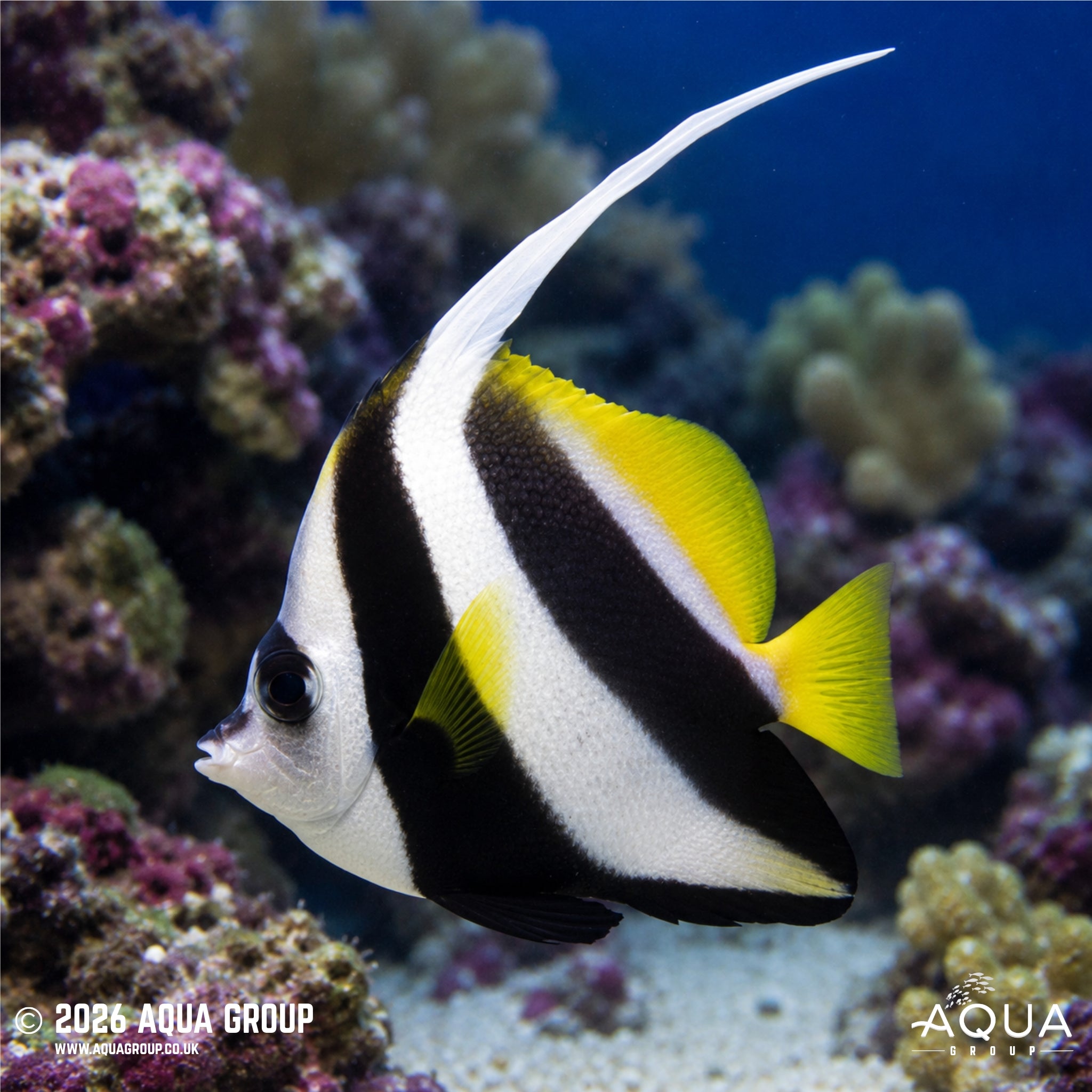

Description
Heniochus Butterfly (Heniochus acuminatus)
The Heniochus Butterfly, Heniochus acuminatus, is an elegant Indo-Pacific butterflyfish recognised by its strongly compressed white body, two broad black bands, bright yellow rear fins and exceptionally long white dorsal pennant. Also known as the Longfin Bannerfish, Pennant Coralfish or Reef Bannerfish, it inhabits protected lagoons, deep coastal channels and outer reef slopes where it searches the water column and reef structure for zooplankton and small benthic invertebrates. Its distinctive Moorish Idol-like appearance and generally adaptable feeding behaviour make it an impressive marine display fish, although its adult size, active nature and tendency to investigate corals require a spacious, carefully planned aquarium.
Common Name:
Heniochus Butterfly, Longfin Bannerfish, Pennant Coralfish, Reef Bannerfish, Common Bannerfish, Coachman.
Scientific Name (Latin):
Heniochus acuminatus
Maximum Size:
Usually around 20–25 cm in total length when fully grown, excluding the extended dorsal pennant.
Water Type:
Marine
Origin / Natural Habitat:
Widely distributed throughout the tropical Indo-Pacific, from the Persian Gulf, Gulf of Oman and East African coastline eastwards across the Indian Ocean to Japan, Micronesia, Australia and French Polynesia.
Heniochus Butterflyfish inhabit protected lagoons, reef channels, coastal reefs and outer reef slopes, commonly at depths of approximately 2–75 metres. They usually remain close to substantial coral or rocky reef structure while swimming a short distance above the reef to search for planktonic and benthic food.
Water Parameters:
Temperature: 24–28°C
pH Range: 8.1–8.4
Hardness or Salinity: Marine salinity 1.023–1.026 specific gravity; maintain stable salinity, alkalinity, strong oxygenation and consistently high water quality.
Temperament:
Generally peaceful to moderately assertive. Heniochus Butterflyfish usually coexist well with suitably sized marine community fish but may become territorial towards similar butterflyfish or other Heniochus species, particularly in restricted accommodation.
Adults are often encountered alone or in pairs rather than in large schools. A compatible pair may be maintained in a sufficiently spacious aquarium, but several specimens should only be attempted in a very large system with extensive rockwork and multiple feeding areas.
Diet:
Omnivorous planktivore and reef browser. In the wild, this species feeds on zooplankton, small crustaceans and other invertebrates collected from the water column and reef surfaces. Juveniles may occasionally remove external parasites from larger fish.
In the aquarium, offer enriched mysis shrimp, Artemia, krill, chopped marine prawn, clam, mussel and other varied frozen marine foods. Supplement with high-quality marine flakes, pellets, spirulina-based foods and specialist butterflyfish preparations.
Feed varied portions at least two or three times daily. Newly introduced specimens may respond well to food presented within rock crevices or on a feeding grid that encourages natural picking behaviour.
Minimum Tank Size:
A minimum aquarium volume of approximately 500 litres is recommended for one adult, with a long open swimming area, extensive mature rockwork and several large caves or shaded overhangs.
A larger aquarium is required for a compatible pair or when maintaining the fish alongside other butterflyfish and similarly active marine species.
Behaviour & Activity:
An active daytime fish that spends much of its time swimming through the middle and lower areas of the aquarium while inspecting rockwork and the water column for food.
The extended dorsal filament trails above and behind the fish as it swims and may become extremely long in healthy established adults. Adequate swimming space and unobstructed areas are important to prevent repeated damage to this delicate fin.
Juveniles may occasionally act as cleaner fish by removing external parasites from larger reef fish. This behaviour may become less frequent as they mature.
Heniochus acuminatus is frequently confused with the Schooling Bannerfish, Heniochus diphreutes. The Heniochus Butterfly generally has a longer, more pointed snout, a more rounded chest profile and a different alignment of the rear black body band.
Reef Safe:
Reef Safe with Caution
Heniochus Butterflyfish may coexist with some established corals, particularly when well fed, but they are not considered completely reliable in a mixed reef aquarium.
Individual fish may nip soft corals, zoanthids, fleshy large-polyp stony corals, small-polyp stony corals, anemones, clam mantles, sponges and feather duster worms. Very small ornamental crustaceans may also be investigated.
The risk of coral picking increases when natural browsing opportunities or suitable aquarium foods are limited. Valuable corals should be monitored carefully following introduction.
Special Requirements or Care Notes:
Introduce the Heniochus Butterfly only to a mature, biologically stable aquarium containing extensive live rock, open swimming room and several secure retreats.
Confirm that the exact specimen is feeding before purchase whenever possible. Select an alert fish with clear eyes, intact fins, a complete dorsal pennant, an undamaged mouth and a full body profile.
Offer several small meals each day during acclimation. A hollow abdomen or pinched area behind the head may indicate inadequate feeding or prolonged nutritional decline.
Provide extensive securely positioned rockwork with caves and shaded overhangs. Leave generous unobstructed swimming space so the elongated dorsal filament does not repeatedly contact sharp rock or aquarium equipment.
Avoid aggressive triggerfish, large territorial angelfish and highly boisterous tank mates that may damage the dorsal pennant or prevent the fish from feeding. Very timid species may also be intimidated by its active swimming behaviour.
Introduce other butterflyfish carefully and use an acclimation box where appropriate. Similar Heniochus species may show territorial aggression, particularly when the aquarium lacks separate visual territories.
Do not confuse this species with the more strongly schooling Heniochus diphreutes when planning group accommodation. Heniochus acuminatus is more commonly encountered alone or in pairs and may be less tolerant of conspecific groups in limited space.
Quarantine is strongly recommended. Butterflyfish may be vulnerable to marine white spot, velvet, flukes and transport-related stress. Monitor for rapid breathing, scratching, cloudy eyes, mouth injuries, faded colour or refusal to feed.
A tightly fitted aquarium cover is recommended, particularly during introduction or territorial disturbances. Maintain strong filtration, efficient protein skimming and stable water chemistry.
Suitable for:
Intermediate marine fishkeepers
Availability:
Common to occasional in trade
All images are a visual representation of the fish you will receive, made to be as accurate as possible. Please note that Mother Nature is a wonderful thing, and variation in patterns and colours will occur — that is part of the unique beauty of these animals.
Order and get 40 reward points
Earn points by signing up for our rewards program