

Description
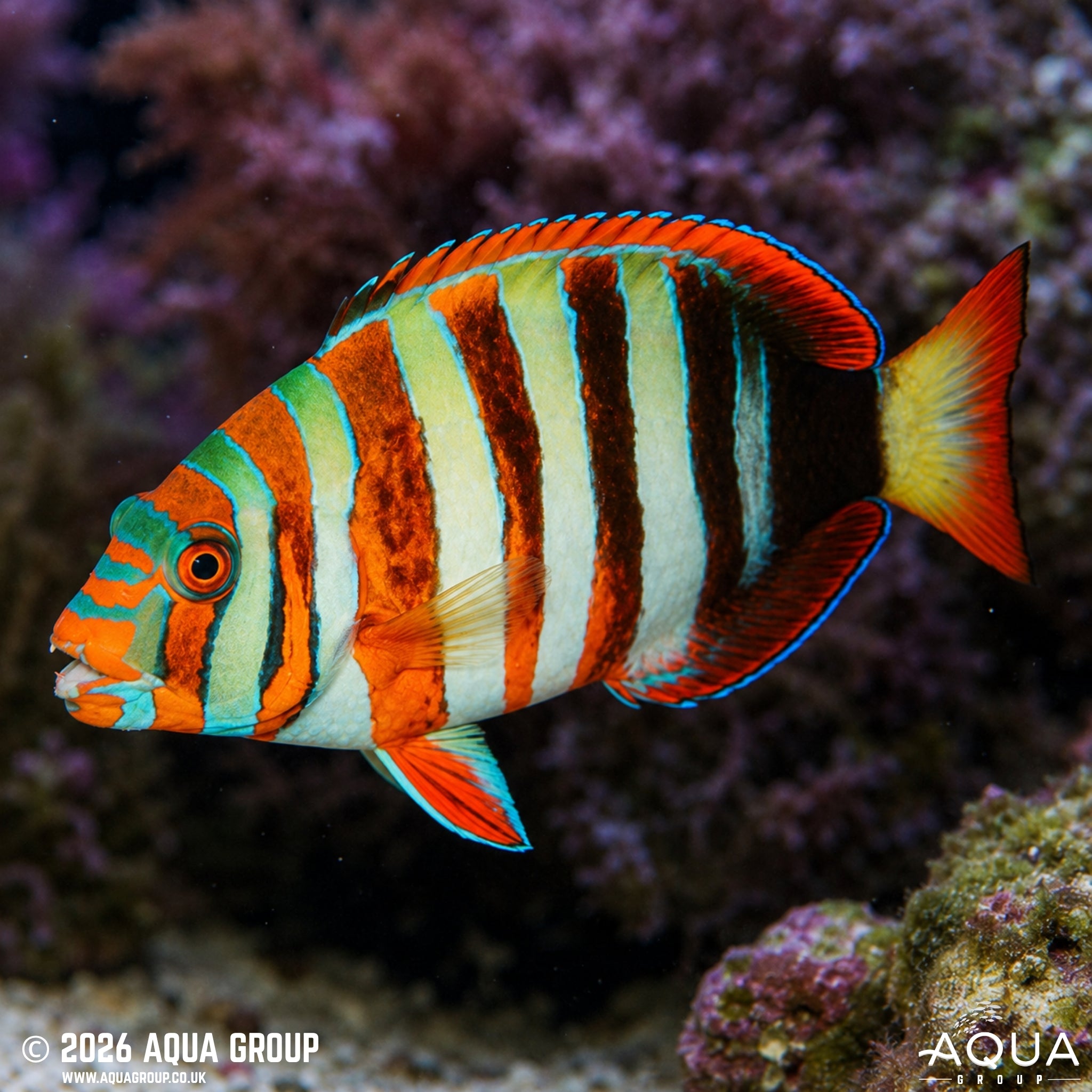
Australian Harlequin Tusk (Choerodon fasciatus)
The Australian Harlequin Tusk is a spectacular marine wrasse, prized for its bold orange-red, blue, white and black vertical banding, powerful body shape and unmistakable bright blue teeth. Australian specimens, especially those associated with the Great Barrier Reef region, are often considered some of the most colourful and desirable examples in the aquarium trade. This is a hardy and impressive show fish for a large mature marine aquarium, but it should be planned carefully because it is predatory towards many ornamental invertebrates.
Common Name:
Australian Harlequin Tusk. Also commonly referred to as the Harlequin Tuskfish, Harlequin Tusk Wrasse, Harlequin Tusk or Australian Tuskfish.
Scientific Name (Latin):
Choerodon fasciatus
Maximum Size:
Around 25–30 cm in captivity, with scientific references listing adults up to around 30 cm. It should be planned for as a large, powerful wrasse.
Water Type:
Marine.
Origin / Natural Habitat:
Found in the Western Pacific, with Australian records from the Great Barrier Reef, Queensland, down to northern New South Wales. In the wild it inhabits seaward reefs, reef slopes, caves, overhangs, coral rubble and sandy reef areas, where it searches for hard-shelled invertebrates and other benthic prey.
Water Parameters:
Temperature: 24–27°C
pH Range: 8.1–8.4
Salinity: 1.020–1.025 SG
Temperament:
Semi-aggressive. It is usually confident and robust rather than constantly aggressive, but it may intimidate smaller, timid or newly added fish. It is best kept with similarly sized, confident marine fish such as tangs, larger angelfish, robust wrasses and other suitable semi-aggressive species.
Diet:
Carnivorous predator. In the wild it feeds on molluscs, crustaceans, worms and echinoderms. In the aquarium it should be offered a varied meaty diet including chopped clam, mussel, cockle, prawn, squid, krill, mysis, brineshrimp, white fish and quality marine carnivore pellets. Hard-shelled foods are useful for natural feeding behaviour and dental wear.
Minimum Tank Size:
A practical long-term recommendation is at least 600–800 litres for a single adult, with larger aquariums preferred due to its adult size, strength and active swimming behaviour.
Behaviour & Activity:
This is an active daytime wrasse that spends much of the day cruising around rockwork, caves and open swimming areas while searching for food. It is usually kept singly, as adults can be territorial with their own kind. A secure lid is strongly recommended, as large wrasses can jump when startled.
Reef Safe:
Reef Safe with Caution
This species does not usually target corals directly, but it is not safe with many ornamental invertebrates. It may eat shrimps, crabs, hermit crabs, snails, small bivalves, worms, brittle stars and small urchins. It is best suited to fish-only systems, FOWLR aquariums, or large reef aquariums where the keeper accepts the risk to clean-up crew and ornamental invertebrates.
Special Requirements or Care Notes:
Best kept in a mature, spacious marine aquarium with excellent filtration, strong oxygenation, live rock, caves and plenty of open swimming space. Tank mates should be robust enough not to be bullied but not so aggressive that they prevent the tusk from settling. Avoid keeping with small ornamental crustaceans or very small fish. Australian specimens are often highly valued for their strong colour and hardiness, so careful acclimation and quarantine are recommended.
Suitable for:
Experienced marine fishkeepers
Availability:
Occasional in trade, with Australian specimens often sold as premium imports
All images are a visual representation of the fish you will receive, made to be as accurate as possible. Please note that Mother Nature is a wonderful thing, and variation in patterns and colours will occur — that is part of the unique beauty of these animals.
Order and get 195 reward points
Earn points by signing up for our rewards program