

Description
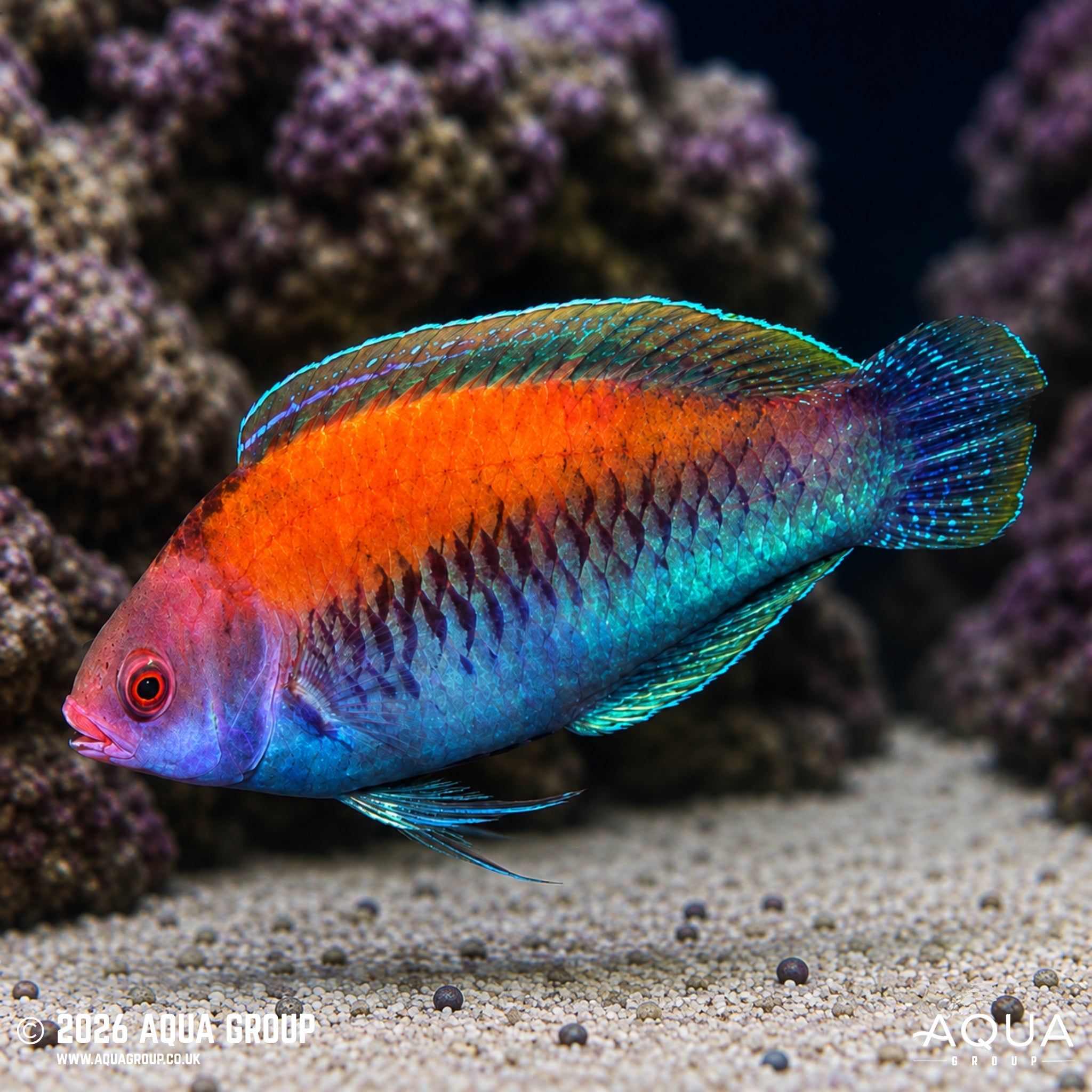
Flame Back Parrot Wrasse (Cirrhilabrus aurantidorsalis)
The Flame Back Parrot Wrasse, Cirrhilabrus aurantidorsalis, is a beautifully coloured Indonesian reef fish recognised by its vivid orange to golden upper back, contrasting blue-violet lower body and delicate facial markings. More widely known as the Orangeback Fairy Wrasse, this compact Cirrhilabrus species naturally forms small groups above rubble-rich reef slopes around northern Sulawesi. Its peaceful temperament, manageable adult size and excellent coral compatibility make it a highly desirable choice for established reef aquariums with calm tank mates, frequent feeding and a completely secure cover.
Common Name:
Flame Back Parrot Wrasse, Flame Back Wrasse, Orangeback Fairy Wrasse, Orange-back Fairy Wrasse.
Scientific Name (Latin):
Cirrhilabrus aurantidorsalis
Maximum Size:
Usually around 8–10 cm when fully grown.
Water Type:
Marine
Origin / Natural Habitat:
Restricted to Indonesia, with the species particularly associated with northern Sulawesi, including the Lembeh Strait and Tomini Bay region. Flame Back Parrot Wrasses inhabit coastal reef slopes and areas containing coral rubble, scattered reef growth and open water above the substrate.
They are generally observed swimming in small social groups close to the reef, where they feed on passing plankton and retreat rapidly into rock or coral crevices when threatened.
Water Parameters:
Temperature: 24–28°C
pH Range: 8.1–8.4
Hardness or Salinity: Marine salinity 1.023–1.026 specific gravity; maintain stable salinity, alkalinity, strong oxygenation and consistently high water quality.
Temperament:
Peaceful, active and generally well suited to calm reef communities. Flame Back Parrot Wrasses normally coexist with unrelated marine fish but may become territorial towards closely related fairy wrasses, particularly males with similar colouration.
Avoid large, aggressive or highly dominant tank mates that may intimidate them or prevent them from feeding. Keeping more than one mature male is not recommended unless the aquarium is exceptionally spacious and carefully structured.
Diet:
Carnivorous zooplankton feeder. In the wild, this species feeds on copepods, tiny crustaceans and other planktonic organisms captured from the water column above the reef.
In the aquarium, offer enriched mysis shrimp, Artemia, copepods, finely chopped krill, small marine pellets and high-quality marine flakes. Feed small portions at least twice daily, as fairy wrasses are active fish with relatively high energy requirements.
Minimum Tank Size:
A minimum aquarium volume of approximately 200 litres is recommended for one adult, with generous open swimming room and extensive mature rockwork. A larger aquarium is preferable when maintaining several fairy wrasses or a compatible social group.
Behaviour & Activity:
An active daytime swimmer that spends much of its time moving through the middle and upper areas of the aquarium while collecting food from the water column. Mature males may intensify their colours, spread their fins and perform rapid display swimming when interacting with females or rival wrasses.
At night, the fish retreats into a narrow rock crevice and may surround itself with a thin protective mucus cocoon. Unlike many Halichoeres and leopard wrasses, the Flame-back Fairy Wrasse does not normally bury itself in sand.
Reef Safe:
Reef Safe
Flame Back Parrot Wrasses do not normally damage corals, anemones, clams or established ornamental invertebrates. They feed mainly on small organisms suspended in the water and are well suited to mixed reef aquariums. Very small planktonic crustaceans and larvae may be consumed as part of their natural diet.
Special Requirements or Care Notes:
A tightly fitted aquarium cover or fine mesh lid is essential, as fairy wrasses are exceptionally capable jumpers and may escape through very small openings around cables, pipework and feeding hatches.
Provide secure mature rockwork containing numerous caves and narrow sleeping crevices, together with open swimming space and moderate, well-distributed water movement. A sand bed is optional because this species sleeps within rockwork rather than burying itself.
Introduce closely related Cirrhilabrus species carefully and consider using an acclimation box to assess aggression before release. Add the largest or most dominant male last where possible. A social group should normally contain one male with one or more females, although females may transition into males if no dominant male is present.
Newly introduced specimens may remain close to shelter for several days. Offer small foods near their retreat and avoid boisterous feeders that could prevent them from eating. Slow acclimation and quarantine are recommended, and body condition should be monitored carefully during the first weeks.
Suitable for:
Intermediate fishkeepers
Availability:
Rare or occasional in trade
All images are a visual representation of the fish you will receive, made to be as accurate as possible. Please note that Mother Nature is a wonderful thing, and variation in patterns and colours will occur — that is part of the unique beauty of these animals.
Order and get 80 reward points
Earn points by signing up for our rewards program