

Description
Bicolour Chromis (Pycnochromis margaritifer)
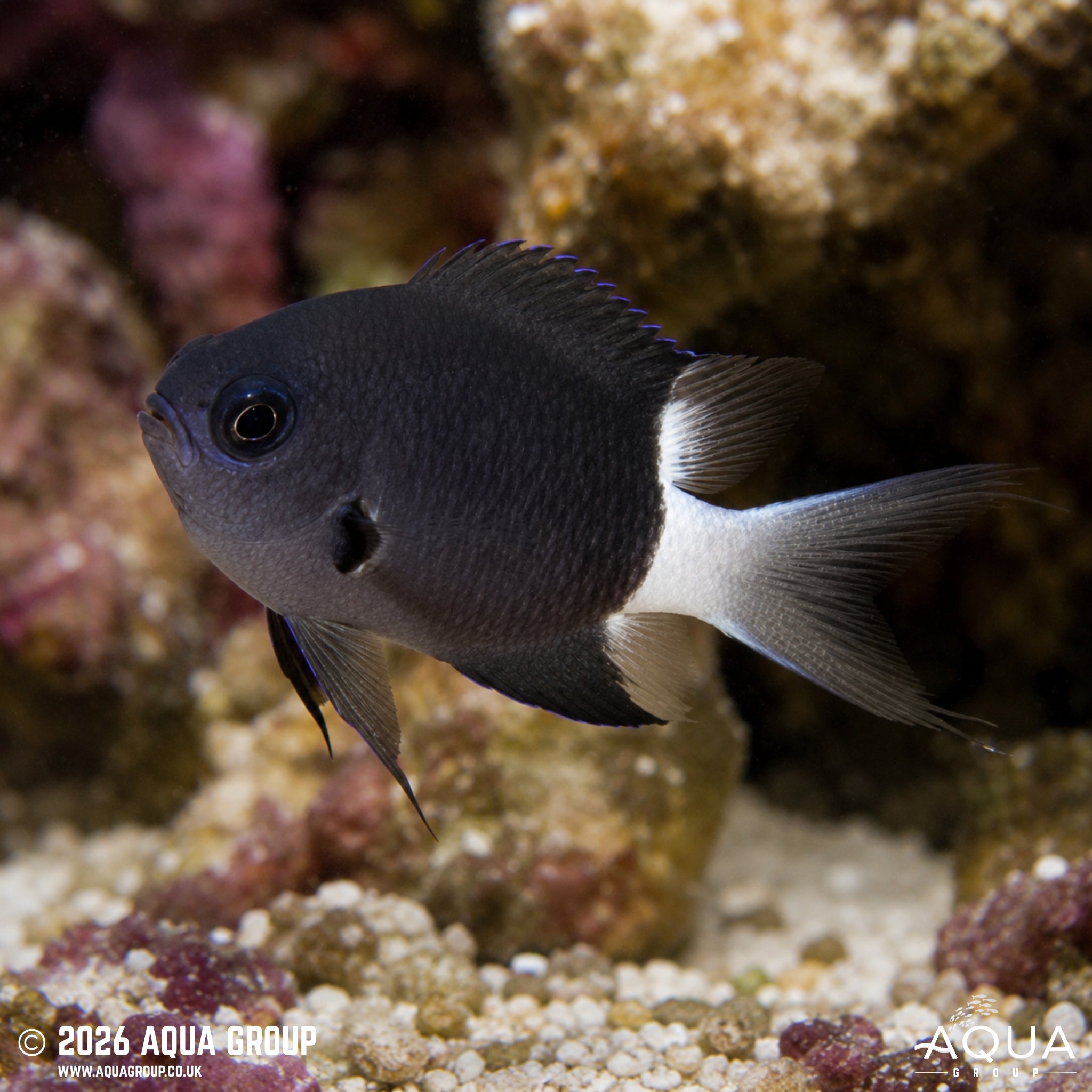
The Bicolour Chromis (Pycnochromis margaritifer) is an attractive marine damselfish recognised by its sharply divided colour pattern, with a dark brown to black front half contrasting against a bright white rear body and tail. Also known as the Black-and-White Chromis, Whitetail Chromis or Half-and-Half Chromis, it originates from tropical Indo-Pacific reefs where individuals live alone or in small groups and feed on drifting zooplankton. Compact, active and generally reef safe, it is a suitable choice for an established community marine aquarium, although territorial behaviour may develop between members of a group.
Common Name:
Bicolour Chromis, Bicolor Chromis, Black-and-White Chromis, Whitetail Chromis, Half-and-Half Chromis, Chocolate Dip Chromis
Scientific Name (Latin):
Pycnochromis margaritifer
Formerly classified as Chromis margaritifer.
Maximum Size:
Approximately 9 cm in total length.
Water Type:
Marine
Origin / Natural Habitat:
Native to tropical waters of the eastern Indian Ocean and Pacific Ocean, including areas around north-western Australia, Christmas Island, the Cocos Islands, southern Japan and numerous central Pacific island groups.
Adults inhabit exposed seaward reefs, rocky reef areas and mixed algae-and-coral habitats. They are less frequently encountered in sheltered lagoons and channels and usually occur alone or in small, loosely associated groups.
Water Parameters:
Temperature: 23–27°C
pH Range: 8.1–8.4
Salinity: 1.020–1.025 SG
Temperament:
Generally peaceful to moderately territorial. The Bicolour Chromis is usually less aggressive than many traditional damselfish, but established individuals may chase smaller or subordinate members of their own species.
It can normally be kept with peaceful and moderately assertive reef fish. Avoid very aggressive predators or highly territorial damselfish that may continually harass it.
Diet:
A planktivorous omnivore that naturally feeds primarily on zooplankton suspended in the water column.
In the aquarium, offer a varied diet of enriched brine shrimp, mysis shrimp, copepods, calanus, finely chopped krill and high-quality marine flakes or small pellets. Foods containing marine algae or spirulina may also be included as part of a balanced diet.
Feed two or three small meals daily. Frequent, modest portions better reflect its natural feeding behaviour than a single large meal.
Minimum Tank Size:
A minimum aquarium volume of approximately 150 litres is recommended for a single specimen or carefully managed small group.
A larger aquarium is advisable when keeping several individuals, as additional swimming space, rockwork and feeding areas can reduce competition and territorial pressure.
Behaviour & Activity:
An active daytime fish that generally swims in the middle and upper areas of the aquarium, moving into open water to capture food before retreating towards rockwork when alarmed.
Wild adults are usually seen singly or in small groups rather than forming permanently dense schools. In captivity, groups may develop a social hierarchy, and weaker individuals can be persistently chased if space and shelter are limited.
Provide open swimming room alongside branching rockwork, caves and crevices. During breeding, a male may clean and defend a section of rock where adhesive eggs are deposited.
Reef Safe:
Reef Safe
The Bicolour Chromis is generally compatible with corals, clams and established ornamental invertebrates. It feeds mainly from the water column and does not normally damage healthy coral tissue.
Very small planktonic organisms may naturally be consumed, but the species is not considered a meaningful threat to normal reef aquarium invertebrates.
Special Requirements or Care Notes:
Introduce only to a fully cycled marine aquarium with stable water chemistry, efficient filtration and strong oxygenation.
Although commonly described as a shoaling fish, keeping a group does not guarantee peaceful behaviour. Dominant individuals may gradually harass weaker fish, especially in smaller or sparsely aquascaped aquariums. A single specimen is often the safest choice where long-term group dynamics cannot be closely monitored.
When keeping several, introduce them at the same time and provide multiple caves, visual barriers and feeding areas. Select similarly sized, healthy specimens and watch closely for persistent hiding, damaged fins or weight loss.
Feed several small meals each day, as this active planktivore may lose condition when fed too infrequently. Ensure shy or subordinate individuals receive food.
Chromis and related damselfish can be susceptible to external parasites and bacterial infections following transport. A carefully managed quarantine period is recommended before introduction to the display aquarium.
Select fish with clear eyes, intact scales, undamaged fins and a full body profile. Avoid individuals with open sores, rapid breathing or areas of reddened skin.
A secure aquarium cover is recommended, particularly during introduction, territorial disputes or maintenance.
Suitable for:
Beginner to intermediate fishkeepers
Availability:
Occasional in trade
All images are a visual representation of the fish you will receive, made to be as accurate as possible. Please note that Mother Nature is a wonderful thing, and variation in patterns and colours will occur — that is part of the unique beauty of these animals.
Order and get 12 reward points
Earn points by signing up for our rewards program