

Description
Yellowtail Checkerboard Wrasse (Halichoeres hortulanus)
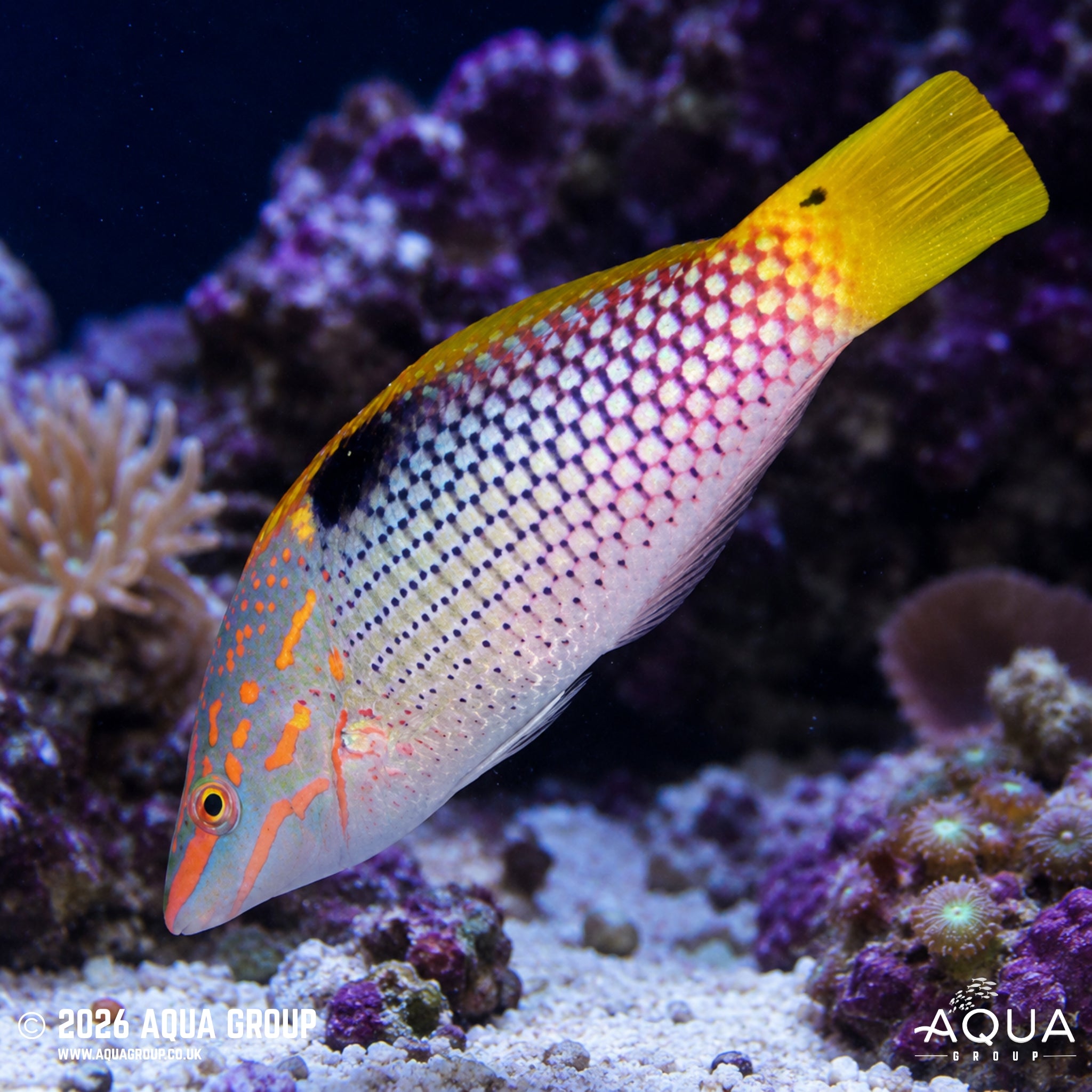
The Yellowtail Checkerboard Wrasse (Halichoeres hortulanus) is a colourful and active Indo-Pacific marine wrasse recognised by its intricate checkerboard scale pattern, vivid facial markings and contrasting yellow coloration around the fins and rear of the body. Also known as the Checkerboard Wrasse, Chequered Wrasse or Marble Wrasse, this species undergoes a considerable transformation as it matures, with adult males developing stronger green, blue, pink and yellow markings. Hardy once established and constantly active during daylight hours, it is best suited to a spacious marine aquarium with a deep sand bed, robust tank mates and no valuable small invertebrates.
Common Name:
Yellowtail Checkerboard Wrasse, Checkerboard Wrasse, Chequered Wrasse, Marble Wrasse, Wall Wrasse
Scientific Name (Latin):
Halichoeres hortulanus
Maximum Size:
Up to approximately 27 cm in total length. Juveniles are often sold at a considerably smaller size, but they develop into powerful, active adults requiring generous permanent accommodation.
Water Type:
Marine
Origin / Natural Habitat:
Widely distributed throughout the tropical Indo-Pacific, from the Red Sea and East African coast across the Indian Ocean and Southeast Asia to southern Japan, northern Australia and the central Pacific islands.
It inhabits coral-rich lagoons, reef flats, channels and seaward reef slopes, usually over mixed areas of sand, rubble and coral. Juveniles remain closer to shelter, while larger adults range more widely across the reef while searching for prey.
Water Parameters:
Temperature: 23–28°C
pH Range: 8.1–8.4
Salinity: 1.020–1.025 SG
Temperament:
Semi-aggressive and increasingly assertive with age. Juveniles may initially coexist peacefully with many robust marine fish, but adults can become territorial towards other wrasses and may intimidate small, timid or slow-feeding tank mates.
It is generally best maintained as a single specimen unless the aquarium is exceptionally large. Avoid keeping it with very small fish, delicate bottom dwellers or similarly shaped wrasses that may be treated as competitors.
Diet:
A carnivorous predator that naturally feeds on sand-dwelling gastropods, bivalves, hermit crabs, polychaete worms, crustaceans and occasional small fish.
In the aquarium, offer a varied selection of mysis shrimp, chopped prawn, mussel, clam, cockle, squid, krill and other marine-origin foods. Larger adults may also accept appropriately sized carnivore pellets.
Feed at least twice daily, with several smaller meals beneficial for growing juveniles. Hard-shelled marine foods can provide useful feeding enrichment and encourage natural crushing behaviour.
Minimum Tank Size:
A minimum aquarium volume of approximately 500 litres is recommended for long-term care, with a tank length of at least 150–180 cm preferred.
A larger aquarium is advisable when maintaining the fish alongside other large wrasses or active territorial species.
Behaviour & Activity:
An energetic daytime swimmer that spends much of its time exploring rockwork and searching the substrate for edible invertebrates.
At night, when frightened or during periods of stress, the Yellowtail Checkerboard Wrasse buries itself completely beneath the sand. This is normal behaviour and should not be confused with the fish being lost or deceased.
Juveniles and females display a lighter checkerboard pattern, while mature males become more intensely coloured and may develop one or two yellow saddle-like markings across the back. Colour and pattern can vary according to age, sex, mood and collection locality.
This species is a strong jumper and may launch itself from the aquarium when startled or chased.
Reef Safe:
Reef Safe with Caution
The Yellowtail Checkerboard Wrasse does not normally consume healthy coral tissue, but it is a significant predator of mobile invertebrates. Ornamental shrimps, hermit crabs, snails, small crabs, worms, brittle stars and other benthic animals may be eaten, particularly as the fish matures.
It may also overturn loose coral pieces or rubble while hunting. It is best suited to a fish-only-with-live-rock aquarium or a robust reef system where losses among the clean-up crew can be accepted.
Special Requirements or Care Notes:
A deep bed of fine, soft sand is essential. Provide a minimum depth of approximately 7–10 cm across a substantial area of the aquarium so the wrasse can bury itself safely at night.
Avoid coarse coral gravel or sharp substrate, which may damage the fish’s mouth, skin and scales during normal burying behaviour.
A tightly fitted aquarium cover is essential. Seal all gaps around cables, pipework, feeding openings and overflow boxes, as this species can escape through surprisingly small spaces.
Provide extensive open swimming room alongside stable live rock containing caves, overhangs and visual barriers. Rock structures should be positioned securely before the sand is added so they cannot shift if the fish excavates beneath them.
The fish may remain buried for several days after introduction. Do not disturb the substrate unnecessarily, provided water quality remains stable and the fish appeared healthy during acclimatisation.
Avoid housing it with ornamental crustaceans or delicate clean-up crew animals. Compatibility risks increase substantially as the wrasse grows.
A carefully managed quarantine period is recommended. Wrasses may be sensitive to sudden changes in salinity, poorly oxygenated water and aggressive medication regimes, so treatment should be monitored closely.
Select an alert specimen with clear eyes, an intact mouth and a rounded body profile. Mouth damage caused during collection or transport can prevent normal feeding.
Suitable for:
Intermediate fishkeepers
Availability:
Occasional in trade
All images are a visual representation of the fish you will receive, made to be as accurate as possible. Please note that Mother Nature is a wonderful thing, and variation in patterns and colours will occur — that is part of the unique beauty of these animals.
Order and get 30 reward points
Earn points by signing up for our rewards program