

Description
Blue-Spotted Ribbontail Stingray (Taeniura lymma)
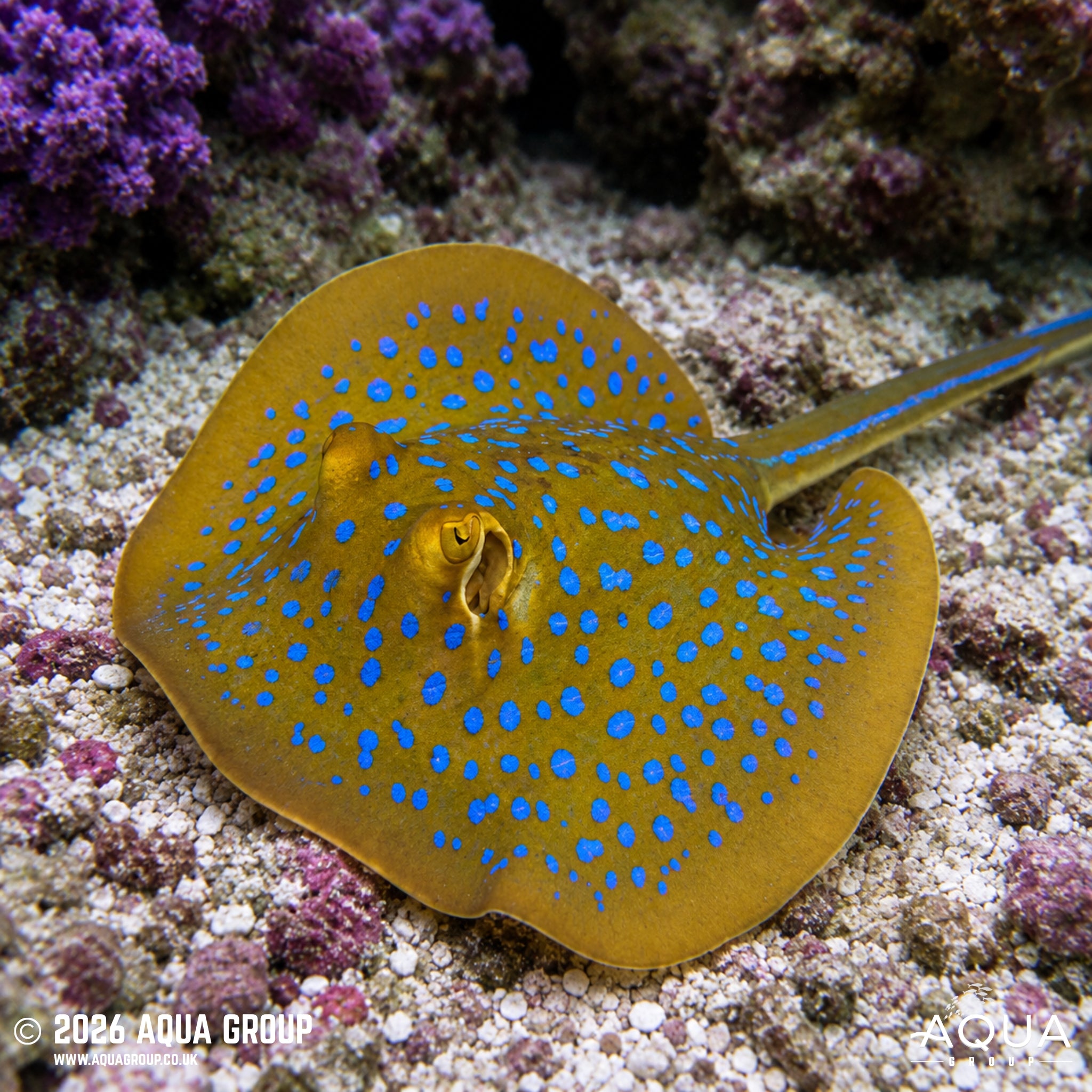
The Blue-Spotted Ribbontail Stingray (Taeniura lymma) is an exceptionally striking Indo-Pacific ray recognised by its rounded yellowish-brown to olive disc, brilliant electric-blue spots and vivid blue stripes running along its thick tail. Also known as the Bluespotted Ribbontail Ray or Bluespotted Fantail Ray, it inhabits shallow coral reefs, sandy flats and sheltered lagoons, where it searches for worms, molluscs and crustaceans. Although its manageable disc width makes it visually appealing to specialist marine aquarists, it is a delicate species that frequently fails to thrive in captivity and requires an exceptionally large, mature and carefully managed aquarium.
Common Name:
Blue-Spotted Ribbontail Stingray, Bluespotted Ribbontail Ray, Blue-Spotted Ribbontail Ray, Bluespotted Stingray, Bluespotted Fantail Ray
Scientific Name (Latin):
Taeniura lymma
Maximum Size:
Approximately 35 cm across the disc and up to around 70 cm in total length, including the tail. Its broad swimming footprint and delicate underside require substantially more aquarium floor space than its length alone suggests.
Water Type:
Marine
Origin / Natural Habitat:
Widely distributed throughout the tropical Indo-Pacific, from the Red Sea and East African coast across the Indian Ocean to Southeast Asia, southern Japan, northern Australia and numerous western Pacific islands.
It inhabits shallow coral reefs, lagoons, sandy flats and rubble areas, generally in coastal water shallower than approximately 20 metres. During rising tides, individuals may move onto sandy areas to forage before retreating beneath coral ledges, inside caves or among reef structures as the tide falls.
Water Parameters:
Temperature: 24–27°C
pH Range: 8.1–8.4
Salinity: 1.023–1.026 SG
Temperament:
Generally peaceful and shy towards fish that are too large to swallow, but predatory towards small bottom-dwelling fish and mobile invertebrates.
The ray should be housed only with calm, non-aggressive species that will not nip its disc, steal all available food or compete for floor space. Triggerfish, puffers, large angelfish and aggressive wrasses are unsuitable because they may harass or bite the ray.
Diet:
A carnivorous bottom feeder that naturally consumes molluscs, polychaete worms, shrimps, crabs and other small benthic animals.
In the aquarium, offer a varied selection of marine-origin foods such as chopped prawn, mysis shrimp, krill, mussel, clam, cockle, squid and marine worms. Small whole shellfish can provide useful feeding enrichment once the ray is established.
Food should be placed directly on or slightly beneath the sand near the ray. Several small feedings are preferable during acclimatisation. Never assume that investigating or covering food means it has been eaten; observe the animal carefully to confirm swallowing and monitor its body condition.
Minimum Tank Size:
A minimum aquarium volume of approximately 1,500 litres is recommended for long-term private care, with a broad, shallow aquarium footprint and a large uninterrupted sand area.
Floor dimensions are more important than height. An adult must be able to swim, turn and forage without repeatedly contacting rockwork, aquarium walls or equipment. Larger public-aquarium-style accommodation is strongly preferred.
Behaviour & Activity:
A bottom-dwelling ray that spends much of its time resting beneath ledges or moving across open sand in search of food.
Unlike many stingrays, this species does not routinely remain deeply buried. It may cover itself lightly with sand or retreat beneath rock overhangs, but is often visible resting on the substrate.
It locates hidden prey using sensory structures around the mouth and underside of the disc. When feeding, it may settle over prey and manoeuvre it towards the mouth beneath the body.
The tail carries one or more sharp, venomous defensive spines. The ray is not normally aggressive towards people, but it may strike defensively if trapped, stepped on or handled.
Reef Safe:
Reef Safe with Caution
The Blue-Spotted Ribbontail Stingray does not normally consume healthy coral tissue, but it is unsuitable for a conventional mixed reef aquarium.
Ornamental shrimps, crabs, worms, small molluscs and small bottom-dwelling fish may be eaten. Its movements can also bury low-positioned corals, overturn unsecured pieces and damage delicate structures.
Any coral included in the aquarium should be securely mounted well away from the ray’s main swimming and feeding area.
Special Requirements or Care Notes:
This species frequently adapts poorly to aquarium life and should be considered suitable only for genuinely expert keepers with previous experience maintaining marine elasmobranchs.
Introduce only to a very large, mature and biologically stable aquarium. Ammonia and nitrite must remain undetectable, while nitrate should be maintained at a consistently low level. Powerful biological filtration, efficient protein skimming and exceptional oxygenation are essential.
Provide a broad bed of fine, soft marine sand. Sharp coral gravel, crushed shell and coarse substrate can abrade the delicate underside of the disc and lead to serious bacterial infection.
Aquascaping should be minimal and securely constructed, leaving most of the aquarium floor open. Any caves or ledges must be wide enough for the ray to enter and leave without scraping its disc or tail.
Marine rays are highly sensitive to copper and many conventional fish medications. Never expose the ray to copper-based treatments. Medication should only be used with specialist veterinary or experienced elasmobranch guidance.
Confirm that the specimen is actively feeding before purchase. Avoid rays with visible redness, abrasions, curled disc edges, cloudy eyes, rapid breathing or a hollow appearance around the head and pelvic region.
Do not lift the ray with a conventional aquarium net. The tail spine can become entangled and may injure both the ray and keeper. Transfers require a large rigid submerged container and careful planning.
Never place hands close to the tail or attempt to touch, restrain or hand-feed the animal. The venomous spine can inflict a deep and extremely painful injury requiring urgent medical attention.
The aquarium must have protected pump intakes, heaters and other equipment. Strong suction points can trap or damage the disc, while exposed heaters can cause serious burns.
This species may stop feeding after transport or appear healthy before declining unexpectedly. Appetite, respiration, body weight and the condition of the underside should be monitored closely every day.
Suitable for:
Expert only
Availability:
Rare or occasional in trade
All images are a visual representation of the fish you will receive, made to be as accurate as possible. Please note that Mother Nature is a wonderful thing, and variation in patterns and colours will occur — that is part of the unique beauty of these animals.
Order and get 325 reward points
Earn points by signing up for our rewards program